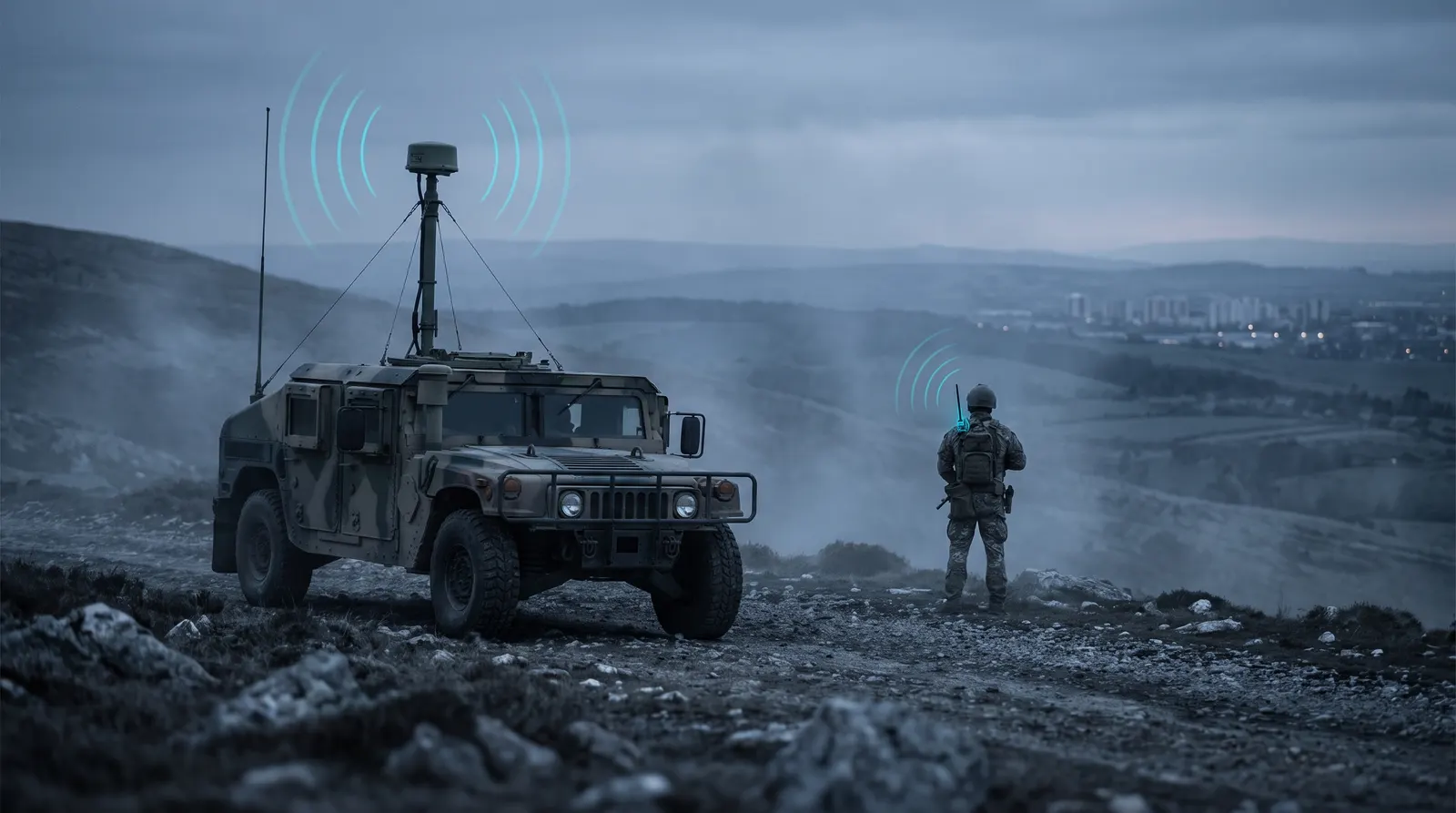
A mapping drone and a military ISR drone can fly the same airframe and carry the same receiver, and still ask completely different things of the antenna. The mapping drone wants the best possible accuracy in a cooperative sky. The ISR drone has to keep working in a sky where someone is actively trying to take its position away — and, worse, trying to hand it a false one. Since early 2022, aviation authorities have logged a notable rise in GNSS jamming and spoofing around conflict zones, from the Black Sea to the Baltic. That is the environment a military drone antenna is now specified for.
This shifts the whole problem. The civilian UAV antenna guide is about squeezing centimetres out of a clean signal; this one is about holding a usable, trustworthy position through a deliberate attack — what the defense community calls assured PNT (positioning, navigation, and timing). It shares that heritage with the launch-vehicle antenna, the other end of the aerospace-and-defense antenna family. Here we cover why the threat changes the antenna’s job, what the antenna can and cannot do about jamming and spoofing, and why the size of the airframe quietly decides how much protection you get.
Why military drone GNSS isn’t commercial drone GNSS
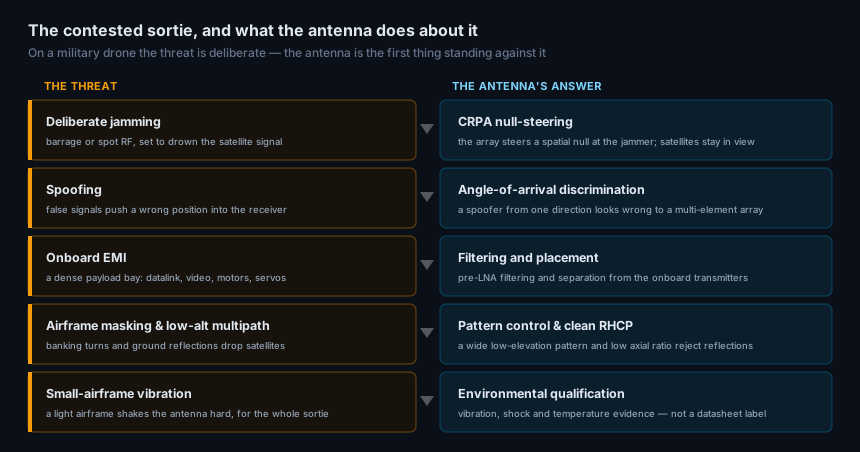
Three things separate a military drone antenna from the one on a survey quad.
The first is that the threat is deliberate. A commercial drone deals with incidental interference — a nearby 5G site, its own video transmitter, multipath off a building. A military drone deals with an adversary who has chosen to deny or deceive it, with equipment built for the purpose. Incidental interference is a nuisance you engineer margin against; a deliberate one is an opponent who adapts.
The second is that the success metric changes. On a mapping job, success is a high fix ratio and a clean point cloud. On a sortie, success is finishing the mission — or, failing that, getting the aircraft home. Nobody grades an ISR flight on centimetres if it was spoofed off course and lost. The antenna is no longer chasing the last centimetre of accuracy; it is defending continuity and integrity.
The third is the platform ceiling, and it is the one people forget. The best anti-jam antenna is a multi-element array, and an array has size, weight, and power that a small airframe may simply not have. So the antenna you can fly is bounded by the drone you are flying it on — a constraint we come back to, because it decides more than any spec sheet.
Denial and deception: the two threats
Jamming and spoofing are often named in one breath, but they are different attacks and the antenna answers them differently. The distinction, in the words of the European aviation regulator, is that “jamming blocks a signal, whereas spoofing sends false information to the receiver”. For a fuller treatment of the two, see GPS jamming vs spoofing.
Jamming is denial. A jammer floods the band with noise until the true signal, which arrives from space at very low power, is buried. The antenna-level answer is spatial: a controlled-reception-pattern antenna (CRPA) uses several elements to steer a null — a blind spot in its pattern — onto the direction the jamming comes from, while keeping the satellites in view. How that null-steering works, and how to test it, is the whole subject of the anti-jamming guide; the point here is that it is the front-line defence and it needs more than one element to do it.
Spoofing is deception, and for a military drone it is the worse of the two. A jammed drone knows it has lost GNSS and can fall back on other navigation; a spoofed drone may believe a lie and fly it. A multi-element array helps here too, by angle of arrival: the real constellation is spread across the sky, but a simple spoofer transmits every fake satellite from one direction, so an array can spot that the geometry is wrong and reject or flag it. This is real and useful — but state the limit honestly. Research on multi-antenna spoofing detection notes that a sophisticated spoofer using multiple transmitters can defeat a simple array, because it no longer arrives from a single point. Spatial defence raises the bar; it does not make spoofing impossible.
What M-code does and doesn’t ask of the antenna
Defense GNSS discussions get to M-code quickly, and it is worth being precise about the antenna’s role, because it is easy to oversell.
M-code is the modernized, encrypted military GPS signal. It rides on the standard L1 (1575.42 MHz) and L2 (1227.60 MHz) frequencies alongside the civilian signals, and its protection — exclusivity, authentication, and jam resistance — lives in the signal design, the cryptographic keys, and the Military GPS User Equipment (MGUE) receiver that decodes it. None of that is an antenna function.
What that means practically: the antenna’s job for M-code is simply to pass L1 and L2 with low loss and a clean phase response, exactly as it would for any dual-band signal. There is no special “M-code band” to add, and no antenna can “provide” M-code security — a datasheet that implies otherwise is selling the wrong thing. The antenna earns its keep on a defense platform through anti-jam nulling, spoofing rejection, and survival, not through the signal it happens to be passing.
The SWaP-C ceiling: match the array to the airframe
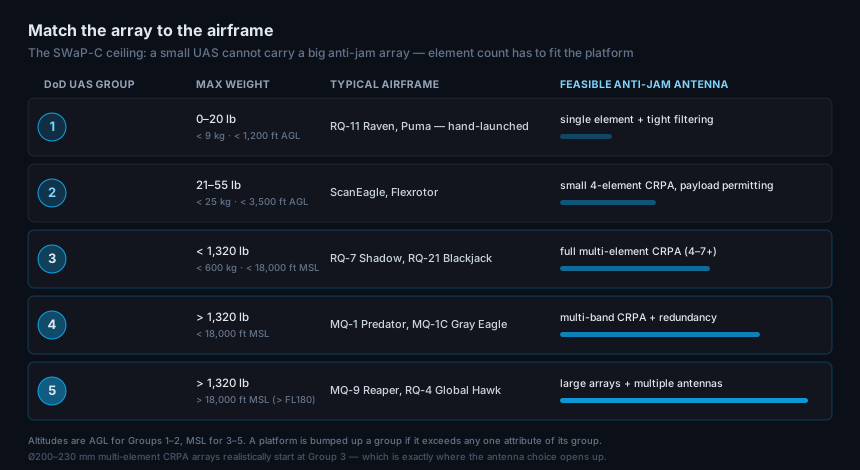
Here is the constraint that governs everything above. Anti-jam performance scales with element count, and element count scales with size, weight, power, and cost — SWaP-C. A small airframe cannot carry a big array, so the platform sets a ceiling on the protection you can install.
The U.S. DoD groups its drones by weight, altitude, and speed, and that classification maps almost directly onto what antenna is feasible:
- Groups 1–2 (hand-launched to ~55 lb — Raven, ScanEagle) live at the hard end of the SWaP-C ceiling. There is rarely room for a large array, so protection comes from a well-filtered single element, careful placement, and at most a small four-element CRPA where the payload budget allows. The CRPA-versus-single-element trade-off is decided right here.
- Group 3 (up to 1,320 lb — Shadow, Blackjack) is where the choice opens up. There is finally room and power for a full multi-element CRPA, and it is no coincidence that practical Ø200–230 mm arrays start being mountable at this class.
- Groups 4–5 (Predator, Reaper, Global Hawk) can carry multi-band arrays, redundancy, and multiple antennas — a full assured-PNT suite rather than a single compromise.
Choosing how many elements for a given airframe — and mounting, ground plane, and phase-matched cabling once you have — is its own engineering problem, worked through in how to choose CRPA element count, CRPA integration for UAVs, and the broader SWaP-C guidance. The rule that survives all of them: pick the antenna the airframe can actually carry, then extract the most from it.
Assured PNT is layered — the antenna is the first layer
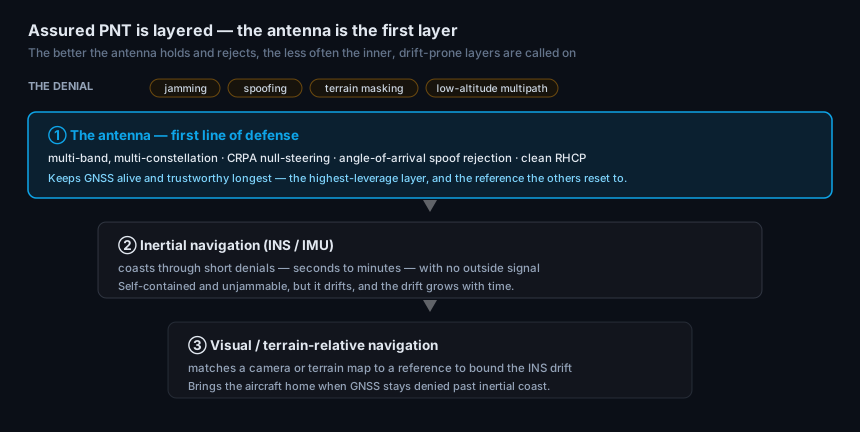
No antenna makes a drone immune to a determined attack, and honest defense design does not pretend otherwise. Assured PNT is built in layers, and the antenna is the outer one — not because it is weakest, but because it is where events are cheapest to stop.
When GNSS is denied past what the antenna can hold, the aircraft coasts on inertial navigation — self-contained and unjammable, but drifting further from truth the longer it runs. When even that runs out, visual or terrain-relative navigation matches a camera or terrain map to a reference to bound the drift and bring the aircraft home. The inner layers are the safety net; they are also drift-prone and expensive to trust for long.
That is exactly why the antenna matters more than its position in the stack suggests. Every second it keeps a clean GNSS fix is a second the drifting layers are not needed — and when they are, it is the antenna’s honest, un-spoofed fix that they reset against. A good anti-jam, high-integrity antenna does not just defend GNSS; it protects the whole navigation solution by staying trustworthy longest. (The timing world runs the same playbook with a holdover oscillator in place of the INS.)
Where the antenna fits
Everything above lands on a handful of requirements, and they are why a military drone antenna is a purpose-built part rather than a hardened commercial one:
- Anti-jam capability matched to the airframe — a CRPA with enough elements to null the expected threat, sized to the platform’s SWaP-C ceiling rather than to a wish.
- Spoofing integrity — the spatial, angle-of-arrival discrimination a multi-element array provides. Clean right-hand circular polarization will not stop a competent co-polarized spoofer, but it does reject the reflections and cross-polarized energy that would otherwise muddy that check.
- Multi-band, multi-constellation reception — independent measurements make both the anti-spoof check and the wider solution more robust, and give the receiver more to work with when part of the sky is denied.
- A stable, calibrated phase center — because the antenna’s fix is the reference the inertial and visual layers reset to, and every lever arm in the fusion is measured from it.
- Environmental and vibration qualification — a light airframe transmits a great deal of vibration, so environmental qualification and the vibration, shock, and temperature discipline are evidence to demand, not a label to accept.
This is defense-and-aerospace-grade hardware. It sits in the defense & military line and draws directly on the anti-jamming CRPA arrays — multi-element, multi-band designs built for platforms operating in contested airspace.
Frequently asked questions
How is a military drone GNSS antenna different from a mapping drone’s? The mission changes the priority. A mapping antenna is optimised for the best accuracy in a cooperative sky. A military or ISR antenna is optimised for assured PNT under attack — holding a usable position through jamming and rejecting spoofing that would feed it a false one. In practice that means a multi-element anti-jam array, spatial spoofing rejection, and full environmental qualification, all sized to the airframe.
Can an antenna stop GPS spoofing? It can help, within limits. A multi-element (CRPA) array discriminates a spoofer by angle of arrival: real satellites are spread across the sky, while a simple spoofer sends every fake from one direction, so the array can flag the mismatch and null the source. A sophisticated spoofer transmitting from multiple antennas can defeat that, which is why spoofing defence is layered across antenna, receiver, and inertial navigation rather than resting on the antenna alone.
Does M-code need a special antenna? No. M-code is broadcast on the standard L1 and L2 frequencies, and its encryption and anti-jam robustness live in the signal, the crypto keys, and the MGUE receiver — not in the antenna. The antenna only needs to pass L1/L2 with low loss and a clean phase response. Be wary of any antenna marketed as “providing” M-code capability.
How many CRPA elements does an ISR drone need? As many as the airframe can carry and the threat demands — those two often disagree. More elements mean more nulls and better jam resistance, but also more size, weight, power, and cost. Small Group 1–2 drones may only support a single filtered element or a compact four-element array; Group 3 and larger platforms can carry full multi-element CRPAs. The element-count guide works the trade-off through.
What happens when GNSS is completely denied? The drone falls back through the navigation layers: inertial navigation coasts through short denials but drifts with time, and visual or terrain-relative navigation bounds that drift to bring the aircraft home. The antenna’s role is to make those fallbacks rare and their resets trustworthy — every second of clean, un-spoofed GNSS is a second the drifting layers are not carrying the aircraft alone.
Written by GNSource Engineering. GNSource manufactures anti-jam, high-integrity GNSS antennas for defense, ISR, and high-dynamics platforms. Talk to our engineers about an anti-jam antenna matched to your airframe, or explore the defense & military line.