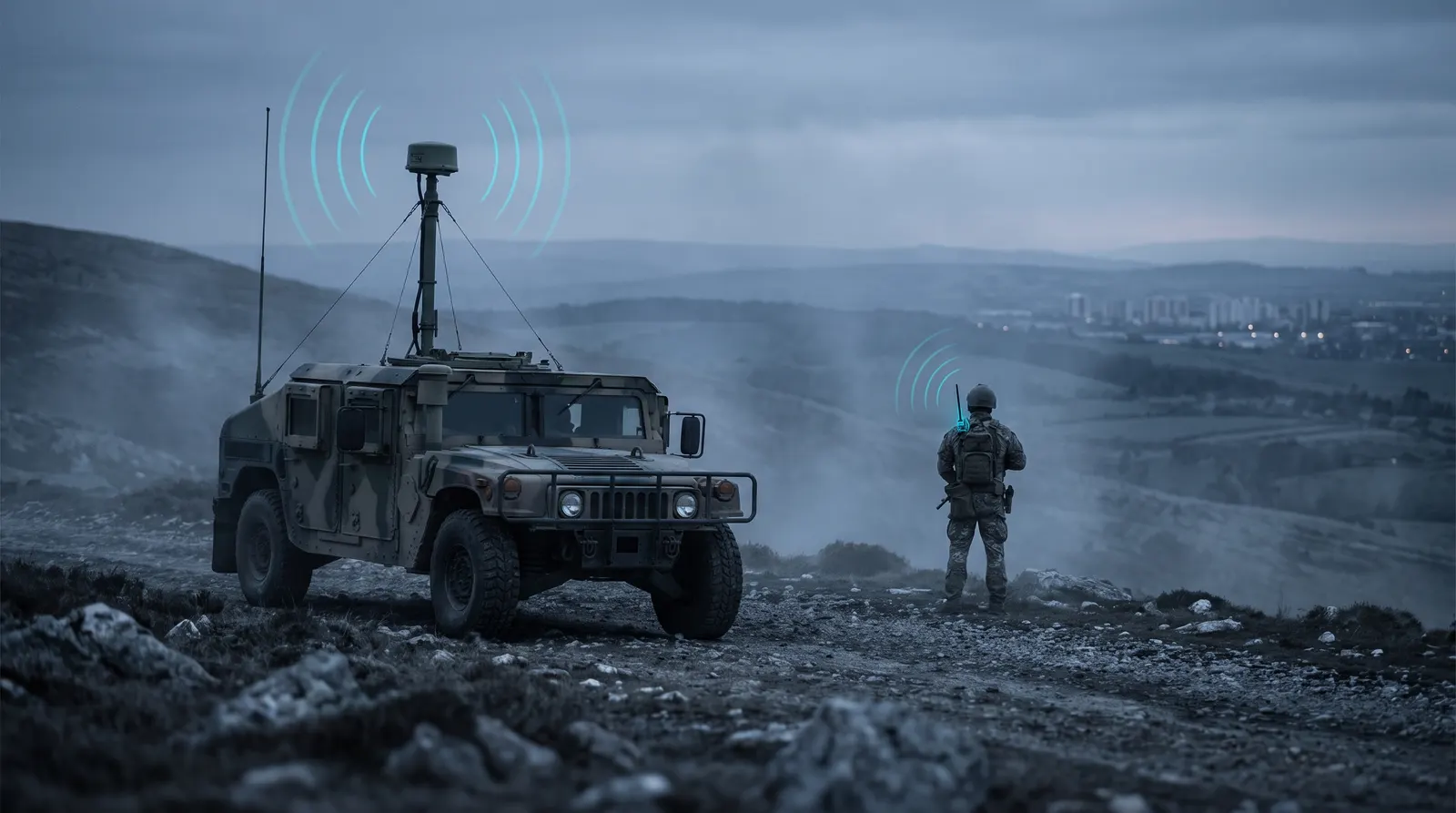
A GNSS antenna on a rocket, a military drone, an armored vehicle, and a warship look like four different products — and in their details they are. But they answer to the same discipline, one that separates them from every commercial antenna: they work in an extreme environment, against a deliberate adversary, on a mission where a believable wrong answer is more dangerous than no answer at all. That discipline has a name — assured PNT (positioning, navigation, and timing) — and it is what this cluster is about.
This is the hub for GNSS antennas across the four defense domains: space, air, land, and sea. Each platform has its own guide with its own specifics, but they share a spine, and this page is where that spine is laid out — what makes an antenna aerospace-and-defense-grade, why the mission is trust rather than accuracy, and how the same anti-jam physics scales from a soldier’s back to a warship’s mast.
Everything in the aerospace & defense library
This guide is the hub. Below it sit the four platform guides — one per domain. Each covers its own dynamics, environment, and threat; each links back here.
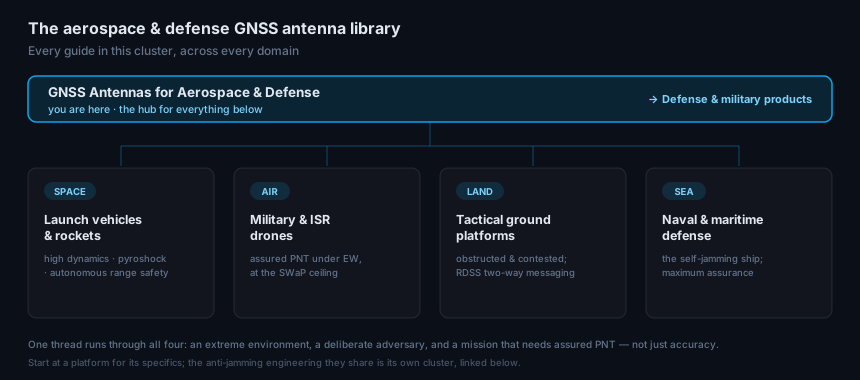
- Space — GNSS antennas for launch vehicles & rockets — high dynamics, pyroshock to thousands of g, and the autonomous flight-safety system that decides whether a flight continues.
- Air — GNSS antennas for military & ISR drones — assured PNT under electronic warfare, and why a small airframe’s SWaP ceiling bounds how much protection you can carry.
- Land — GNSS antennas for tactical ground platforms — an obstructed, contested sky, and the BeiDou RDSS two-way messaging that keeps a platform connected when the network is gone.
- Sea — GNSS antennas for naval & maritime defense — the self-jamming warship, and the SWaP headroom that lets a naval platform stack maximum assurance.
The anti-jam engineering these platforms share — how a controlled-reception-pattern antenna actually steers nulls — is its own deep subject, covered in the ultimate guide to anti-jamming CRPA antennas. When you’re ready to specify hardware, the defense & military line is built for exactly these platforms.
What sets aerospace-and-defense GNSS apart
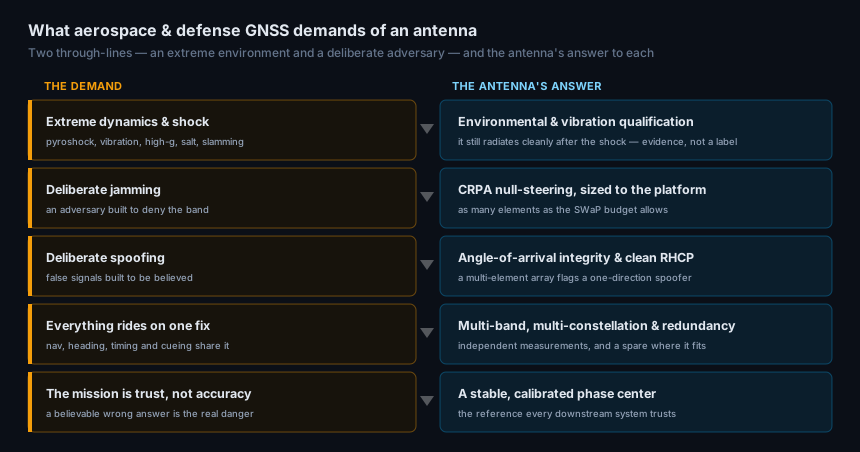
Two through-lines run through every platform in this cluster.
The first is an extreme environment. A launch antenna sees pyroshock in the thousands of g and vibroacoustic loads; a drone antenna rides a light airframe that transmits every vibration; a masthead antenna lives in salt fog and slamming for years; a ground antenna takes shock and dust. In each case the antenna must still radiate a clean, stable pattern after the abuse — which is why environmental and vibration qualification is evidence to demand, not a word on a datasheet.
The second is a deliberate adversary. Commercial GNSS deals with incidental interference; defense GNSS deals with an opponent who has chosen to deny the band (jamming) or to feed the receiver a convincing lie (spoofing). The antenna’s front-line answer is spatial — a multi-element CRPA steers nulls onto a jammer and uses angle of arrival to flag a spoofer that arrives from a single direction — but the depth of how that works, and its limits, belongs to the anti-jamming guide and the difference between jamming and spoofing. What matters at the cluster level is that the antenna is the first place the fight is won or lost.
Assured PNT: trust, not accuracy
On a commercial platform the goal is the last centimeter of accuracy in a cooperative sky. On a defense platform the goal changes: it is a position you can trust, held continuously, through an attack designed to take it away or corrupt it. Getting spoofed off course and never knowing is a worse outcome than losing the fix and knowing — so integrity and continuity, not raw accuracy, are what a defense antenna defends.
That reframing is why the antenna earns its keep through anti-jam nulling, spoofing rejection, and survival — not through the signal it happens to be passing. It is also why a common misconception is worth killing directly: encrypted military signals like GPS M-code do not need a special antenna. M-code rides the standard L1/L2 frequencies, and its security lives in the signal, the cryptographic keys, and the military receiver — never in the antenna, which only has to pass L1/L2 cleanly. The ISR-drone guide works through that point in full.
The SWaP spectrum, from a soldier to a warship
The single idea that most shapes a defense antenna is how much size, weight, and power the platform can spare. It runs across the whole cluster as a spectrum. At one end, a dismounted soldier or a small drone lives at a hard SWaP ceiling and fits the smallest anti-jam solution that will work. At the other, a warship has power and deck space to spare and stacks maximum assurance — large multi-element arrays, multiple antennas, and redundancy. The physics is identical; only the budget changes. Read the way that spectrum inverts the design question — from “what protection can I afford?” to “how much assurance can I stack?” — in the naval and tactical-ground guides.
Specifying an aerospace or defense antenna
| Spec | Why it matters |
|---|---|
| Multi-element anti-jam (CRPA), sized to the platform | null the expected jamming threat with as many elements as the SWaP budget allows |
| Angle-of-arrival integrity, clean RHCP | flag and reject spoofing that arrives from a single direction |
| Multi-band, multi-constellation (L1/L2/L5 + BDS/GLONASS/Galileo) | independent measurements for a robust, spoof-resistant solution |
| Environmental & vibration qualification to the platform’s regime | it must radiate cleanly after pyroshock, vibration, salt, or shock |
| Stable, calibrated phase center | the reference every downstream system — nav, heading, timing, cueing — trusts |
| Redundancy and heading where the platform allows | multiple antennas for a spare and for GNSS-derived heading |
| Coexistence with onboard emitters (filtering, limiter) | survive and reject the platform’s own radar, satcom, and datalinks |
The general selection framework — the specs to put in an RFQ and how they trade against each other — is covered in the buyer’s guide to high-precision GNSS antennas; this cluster is the aerospace-and-defense layer on top of it, and the hardware sits in the defense & military and anti-jamming CRPA lines.
Frequently asked questions
What makes a GNSS antenna “defense-grade” or “aerospace-grade”? Three things at once: it survives an extreme environment (pyroshock, vibration, salt, shock) with a stable pattern; it defends against a deliberate adversary through anti-jam and anti-spoof capability; and it is built for assured PNT, where holding a trustworthy position under attack matters more than the last centimeter of accuracy. “Defense” on a datasheet is not a test result — ask what the antenna has actually been qualified and measured to.
What is “assured PNT,” and how is it different from accuracy? Assured PNT is positioning, navigation, and timing you can rely on while someone is actively trying to deny or falsify it. Accuracy asks “how close is the fix?”; assurance asks “can I trust this fix, and will I still have it in a minute?” A believable wrong answer — a successful spoof — is the outcome assured PNT exists to prevent, which is why integrity and continuity, not raw precision, drive defense antenna design.
Do all defense platforms use the same GNSS antenna? No — the platform decides. The same anti-jam physics scales from a single filtered element on a dismounted soldier, to a compact array on a small drone, to a full multi-element CRPA on a ground vehicle, to large arrays with redundancy on a warship. What changes is the SWaP budget and the environment; each platform guide in this cluster covers its own.
Can an antenna stop jamming and spoofing on its own? It is the first line, not the whole defense. A multi-element CRPA steers nulls onto jammers and uses angle of arrival to flag a single-source spoofer — but a sophisticated multi-transmitter spoofer can defeat a simple array, so assured PNT is layered across the antenna, the receiver, and inertial navigation. The antenna’s job is to make the fix clean and honest for as long as possible.
Does encrypted military GPS (M-code) need a special antenna? No. M-code is broadcast on the standard L1 and L2 frequencies, and its encryption and anti-jam robustness live in the signal, the keys, and the military receiver — not in the antenna, which only needs to pass L1/L2 with low loss and a clean phase response. Be wary of any antenna marketed as “providing” M-code capability.
Written by GNSource Engineering. GNSource manufactures anti-jam, ruggedized GNSS antennas for aerospace and defense platforms across every domain. Talk to our engineers about an antenna for your platform, or explore the defense & military line.