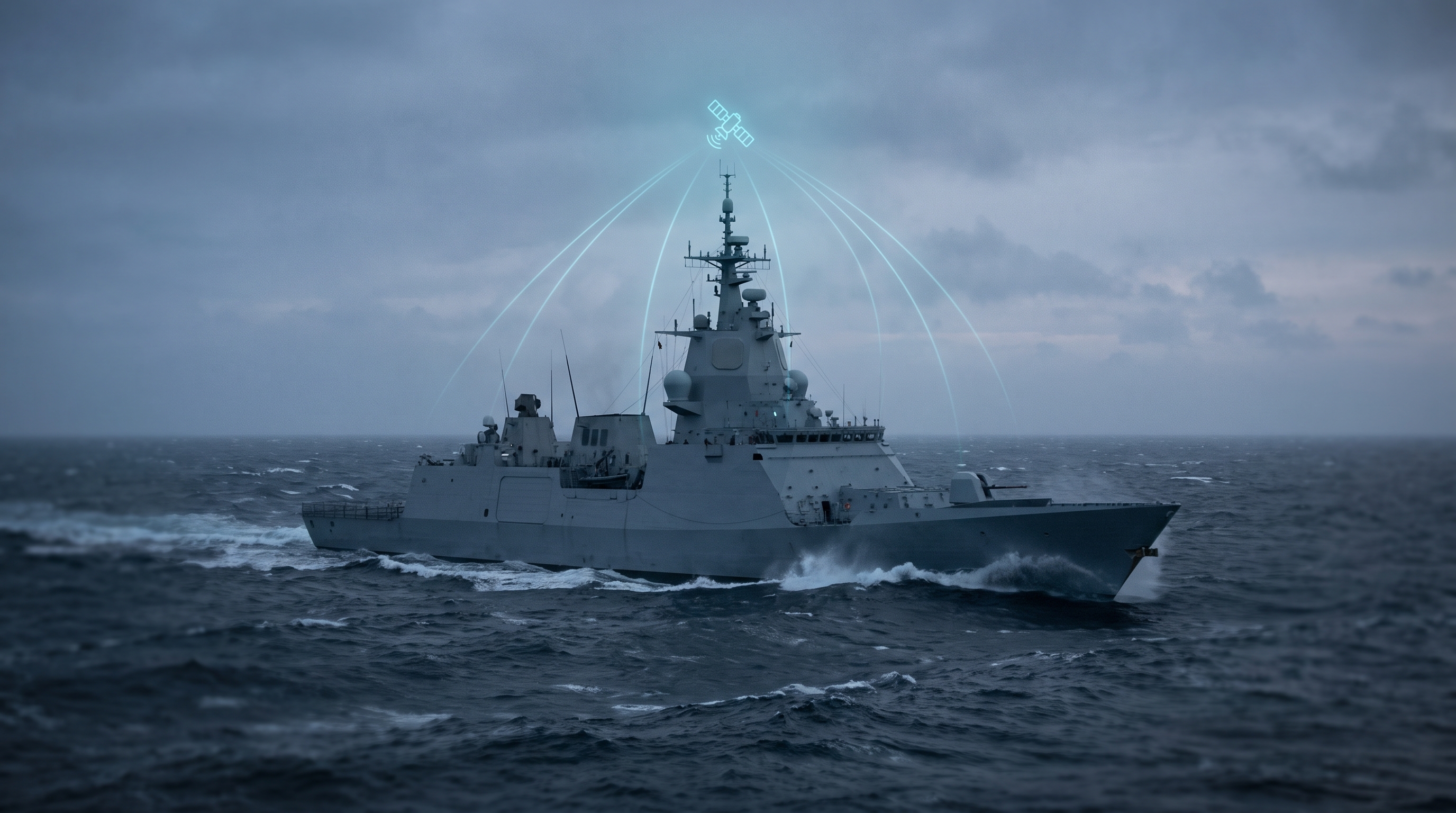
A survey vessel and a warship can share a hull form and still ask opposite things of a GNSS antenna. The survey ship wants the cleanest possible position in a cooperative sky; its enemies are salt, the moving deck, and the sea’s reflection. The warship wants a position it can trust while someone is actively trying to deny or falsify it. Maritime GNSS interference is no longer hypothetical: an independent study identified spoofing affecting 1,311 civilian vessel navigation systems across ten locations since 2016, and the U.S. maritime authority has standing advisories on GPS interference and AIS spoofing degrading bridge navigation in the Mediterranean, the Persian Gulf, and beyond — the exact waters navies operate in.
This is the sea member of the aerospace-and-defense antenna family, alongside the launch-vehicle, military and ISR drone, and tactical ground antennas — space, air, land, and now sea. It is deliberately not the commercial-marine problem: salt-fog survival, sea-surface multipath, and survey accuracy belong to the marine & offshore antenna guide and its cluster. This guide is about the defense layer on top — the contested electromagnetic environment a warship works in, why the ship fights its own antennas, and why naval GNSS is the one platform that can afford to stack maximum assurance.
Why naval GNSS isn’t commercial marine GNSS
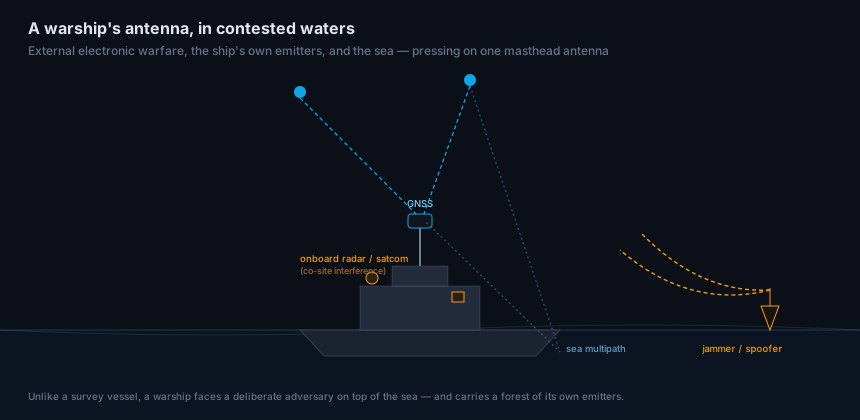
The commercial marine cluster already covers what the sea does to an antenna — corrosion, the moving deck, and the specular multipath thrown up off a flat, conductive water surface, which is its own selection discipline. A warship inherits all of that and adds two things a survey ship never faces.
The first is a deliberate adversary. The interference above is not incidental RFI; it is jamming built to deny the band and spoofing built to feed the bridge a convincing lie. The difference between the two attacks, and why spoofing is the more dangerous, carries over unchanged from the air and land articles — but at sea the false position flows straight into navigation and the ship’s combat systems.
The second is that the ship is its own worst electromagnetic neighbor. A modern surface combatant is, in the words of one naval-electronics account, “a dense forest of antennas of virtually every size and description” — radar, satcom, comms, and electronic-warfare systems, all transmitting near the GNSS antenna and all capable of desensitizing it through co-site interference. The GNSS antenna has to reject an external jammer and coexist with the powerful friendly emitters a few meters away.
The ship fights its own antennas
That co-site problem shapes the antenna as much as the external threat. The defenses are the familiar ones taken to a naval level: strong out-of-band rejection and pre-filtering so the ship’s own radar and satcom don’t swamp the front end, a robust limiter to survive high incident power, and placement high and clear of the worst emitters — a negotiation with the naval architects, because masthead real estate is fought over. Against the external jammer, the answer is spatial: a multi-element controlled-reception-pattern antenna (CRPA) steers nulls onto the jamming directions while holding the satellites. How that null-steering works is the whole subject of the anti-jamming guide; what matters here is that a warship has room to do it properly.
Naval has headroom — so it maximizes assurance
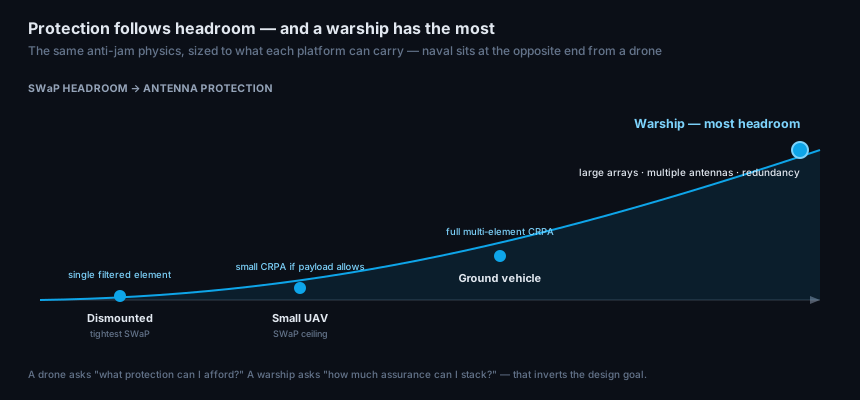
Here is what sets naval apart from every other platform in this family. On a drone or a dismounted soldier, antenna protection is bounded by a hard SWaP ceiling — you fit the smallest anti-jam solution the platform can carry. A warship inverts that. It has power, deck space, and mass to spare, so the design question stops being “what protection can I afford?” and becomes “how much assurance can I stack?”
That headroom buys real things: large multi-element CRPA arrays rather than compact compromises; multiple GNSS antennas for redundancy and for heading; and the ability to run the anti-jam front end alongside a full multi-band, multi-constellation receive chain without fighting for grams. Practical naval-grade arrays are physically substantial — a Ø230 mm multi-element unit like the TDXL-KGR1101, built for naval, airborne, and high-value platforms in contested environments, would never fly on a small UAV, and that is exactly the point. Naval is the platform where the antenna choice opens all the way up.
Assured PNT feeds the whole ship
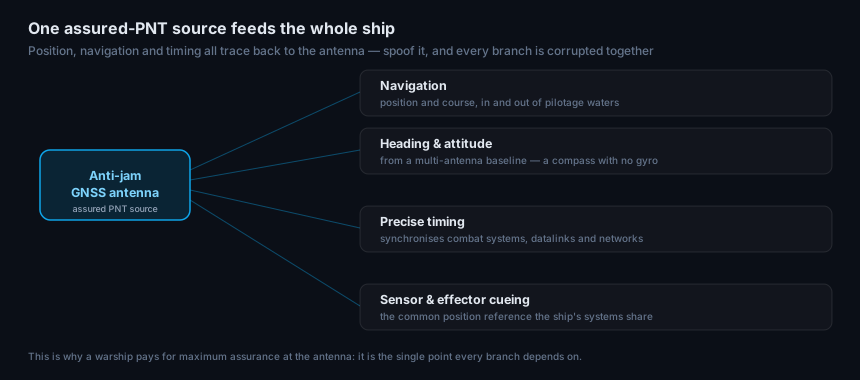
The reason a warship pays for maximum assurance is that GNSS is not just its navigator. GPS is defined as a positioning, navigation, and timing utility, and on a combatant all three branches matter and all trace back to the same antenna:
- Navigation — position and course, in open ocean and in tight pilotage waters.
- Heading and attitude — a dual- or multi-antenna installation derives heading from the baseline between antennas, “a pointing device similar to a magnetic compass,” with no dependence on a gyro.
- Precise timing — the time reference that synchronizes combat systems, datalinks, and networks; when timing drifts, coordination degrades. (Specifying that time source is the subject of the timing-antenna guide.)
- Sensor and effector cueing — the common position reference the ship’s systems share.
Because every branch depends on the one antenna, a successful spoof corrupts all of them at once — navigation, heading, timing, and cueing degrade together. That single-point dependence is precisely why the antenna is where a navy spends its assurance budget: it is cheaper and more effective to keep the fix clean at the source than to unwind a false one downstream.
Where the antenna fits
The requirements land in a short list that is neither a survey antenna nor a compact tactical one:
- Multi-element anti-jam (CRPA) capability, sized to the platform rather than to a SWaP ceiling — a warship can and should carry a large array with enough elements to null the expected threat.
- Coexistence with the ship’s own emitters — strong out-of-band rejection, pre-filtering, and a high-power limiter so friendly radar and satcom don’t desensitize the front end.
- Multi-band, multi-constellation reception for the independent measurements that make both the anti-spoof check and the wider solution robust.
- Redundancy and heading — support for multiple antennas, including a matched pair for GNSS heading with an accurately known baseline.
- A stable, calibrated phase center and naval ruggedization — the fix is the reference every ship system shares, and the masthead is a place of salt, shock, and vibration.
This is defense-and-marine-grade hardware. It sits across the defense & military line and the anti-jamming CRPA arrays — multi-element, multi-band designs built for platforms that have to hold assured PNT in contested waters. The environmental and multipath engineering that keeps a masthead antenna alive at sea is covered in the marine & offshore cluster; this is the defense layer that sits on top of it.
Frequently asked questions
How is a naval GNSS antenna different from a commercial marine one? A commercial marine antenna is built to survive the sea — salt fog, the moving deck, and sea-surface multipath — and to position accurately in a cooperative environment. A naval antenna adds a defense layer on top: multi-element anti-jam (CRPA) capability against deliberate jamming, spoofing rejection, coexistence with the ship’s own radar and satcom emitters, and the redundancy a warship’s systems demand. Same sea, a contested mission.
Is GNSS jamming really a threat to ships? Yes, and it is documented. An independent study attributed spoofing to more than 1,300 civilian vessel navigation systems across ten locations since 2016, and maritime authorities maintain standing advisories on GPS interference and AIS spoofing degrading bridge navigation in regions including the Mediterranean and the Persian Gulf — the same waters naval forces operate in.
Why does a warship interfere with its own GNSS antenna? Because it is covered in transmitters. Radar, satcom, communications, and electronic-warfare systems all emit near the masthead, and that co-site interference can desensitize a GNSS receiver as effectively as an external jammer. A naval antenna therefore needs strong out-of-band rejection, pre-filtering, and a high-power limiter, plus placement chosen to keep it clear of the worst friendly emitters.
Why can a warship carry more antenna than a drone? Size, weight, and power. A small UAV or a dismounted soldier lives at a hard SWaP ceiling and takes the smallest anti-jam solution that fits. A warship has power, deck space, and mass to spare, so it can carry large multi-element CRPA arrays, multiple antennas, and redundancy. Naval is the platform where the design goal flips from “what protection can I afford?” to “how much assurance can I stack?”
Does GNSS give a ship its heading? It can. A dual- or multi-antenna GNSS installation derives heading — and, with three antennas, full attitude — from the precisely measured baseline between the antennas, functioning like a compass with no moving parts and no gyro drift. It needs a matched antenna pair and an accurately known baseline, and it feeds the same assured-PNT picture the rest of the ship relies on.
Written by GNSource Engineering. GNSource manufactures anti-jam, multi-band GNSS antennas for naval, defense, and high-dynamics platforms. Talk to our engineers about an antenna that holds assured PNT in contested waters, or explore the defense & military line.