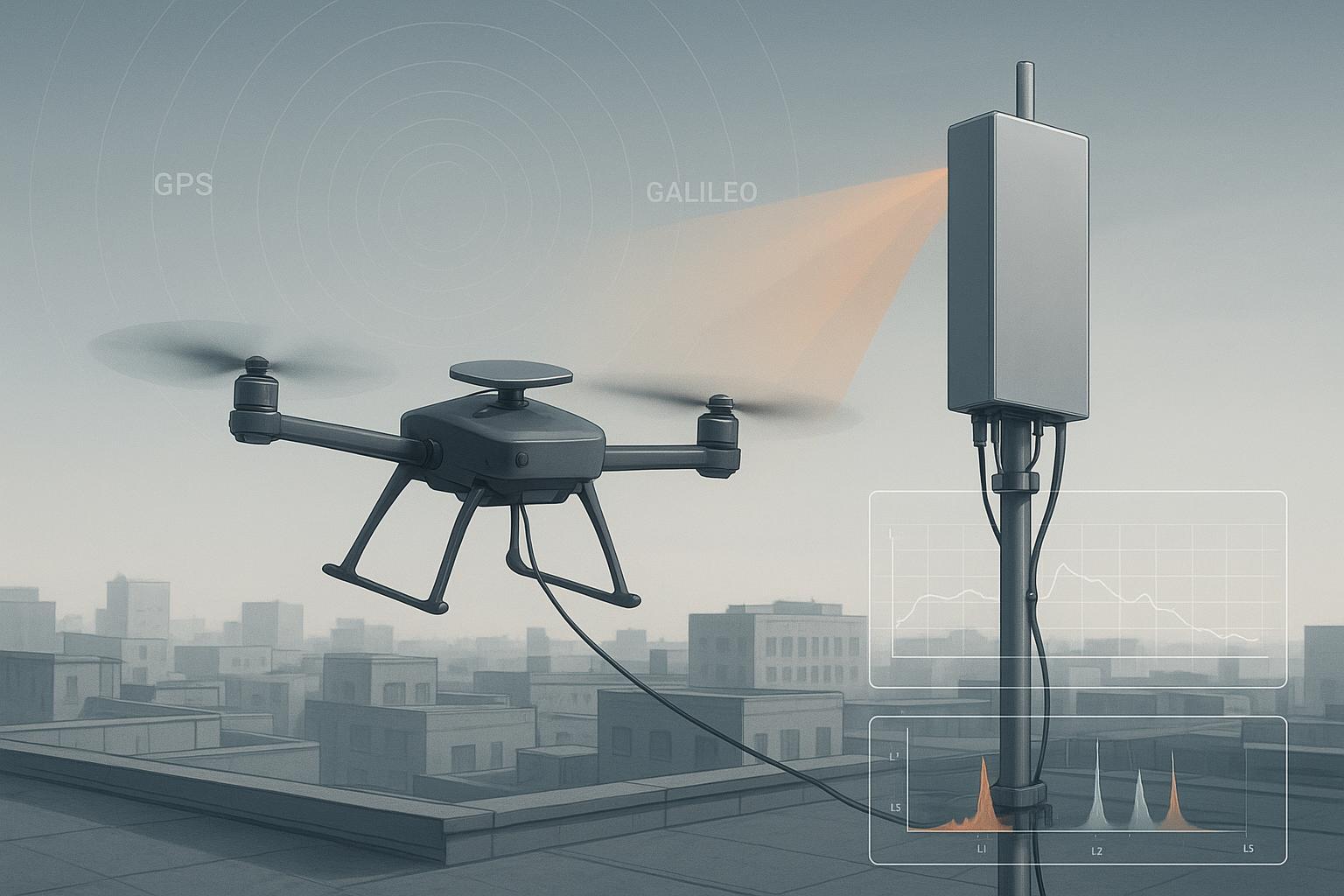
Jamming and spoofing are both attacks on GNSS, but they fail you in opposite ways. Jamming denies — it drowns the satellite signal in noise until your receiver loses lock and you know you’ve lost positioning. Spoofing deceives — it feeds your receiver counterfeit signals that look authentic, quietly walking your position or clock to a false value while everything appears normal. Jamming is loud and obvious. Spoofing is silent and, for exactly that reason, more dangerous: a receiver that’s been jammed reports failure; a receiver that’s been spoofed reports confidence in a lie.
That distinction drives everything downstream — how you detect each attack, how you defend against it, and why the two need different hardware. Here’s the difference in full, the scale of the threat right now, and what actually stops each one.
Jamming vs spoofing at a glance
| Jamming | Spoofing | |
|---|---|---|
| Goal | Deny service | Deceive the solution |
| Method | Overpower GNSS with RF noise on the same frequency | Broadcast counterfeit signals that mimic real satellites |
| What the receiver sees | Loss of lock, no fix | A confident but false position/time |
| Detectability | Obvious — you know you lost the signal | Subtle — often undetected without dedicated checks |
| Primary danger | Downtime, degraded navigation | Acting on wrong data you believe is correct |
| Main defense | Spatial nulling (CRPA), filtering, multi-band | Authentication, multi-antenna, RAIM, INS cross-check |
Read the table top to bottom and the core asymmetry is clear: jamming costs you availability, spoofing costs you integrity. Losing availability is disruptive, but it’s visible — you know to fall back to other navigation. Losing integrity — trusting a position that’s wrong — is how aircraft get routed toward terrain and how autonomous systems drive off course.
What jamming actually does
A jammer is a transmitter that floods the GNSS band with enough RF power to bury the real satellite signals. GNSS signals arrive at the antenna extraordinarily weak — around -125 to -130 dBm, below the receiver’s own thermal noise floor — so it takes surprisingly little power to overpower them. A cheap handheld jammer can deny GPS across a few hundred meters; a serious emitter can blanket a wide corridor.
The effect is loss of lock: the receiver can no longer track satellites and stops producing a fix. That’s disruptive, but it’s honest — the system reports that it has no position. Operators can fall back to inertial navigation, dead reckoning, or a hold pattern. The failure is visible, which is the one mercy jamming offers.
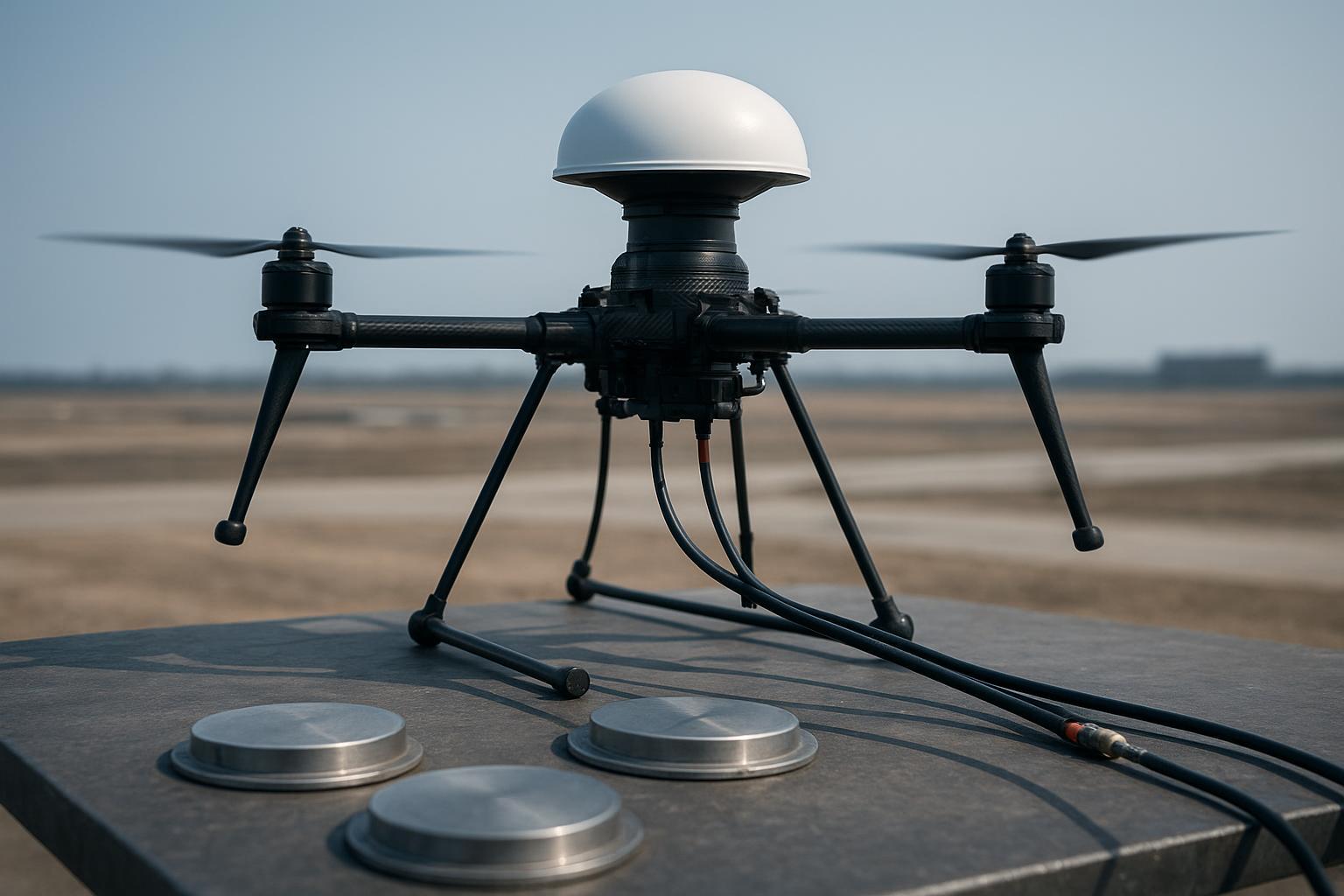
Defending against jamming is fundamentally a spatial and spectral problem. If the interference comes from a direction — which it almost always does — an antenna that can steer a null toward that direction rejects it while keeping the satellites in view. This spatial anti-jamming is what a Controlled Reception Pattern Array (CRPA) does, and it’s covered in depth in our anti-jamming antenna guide.
What spoofing actually does
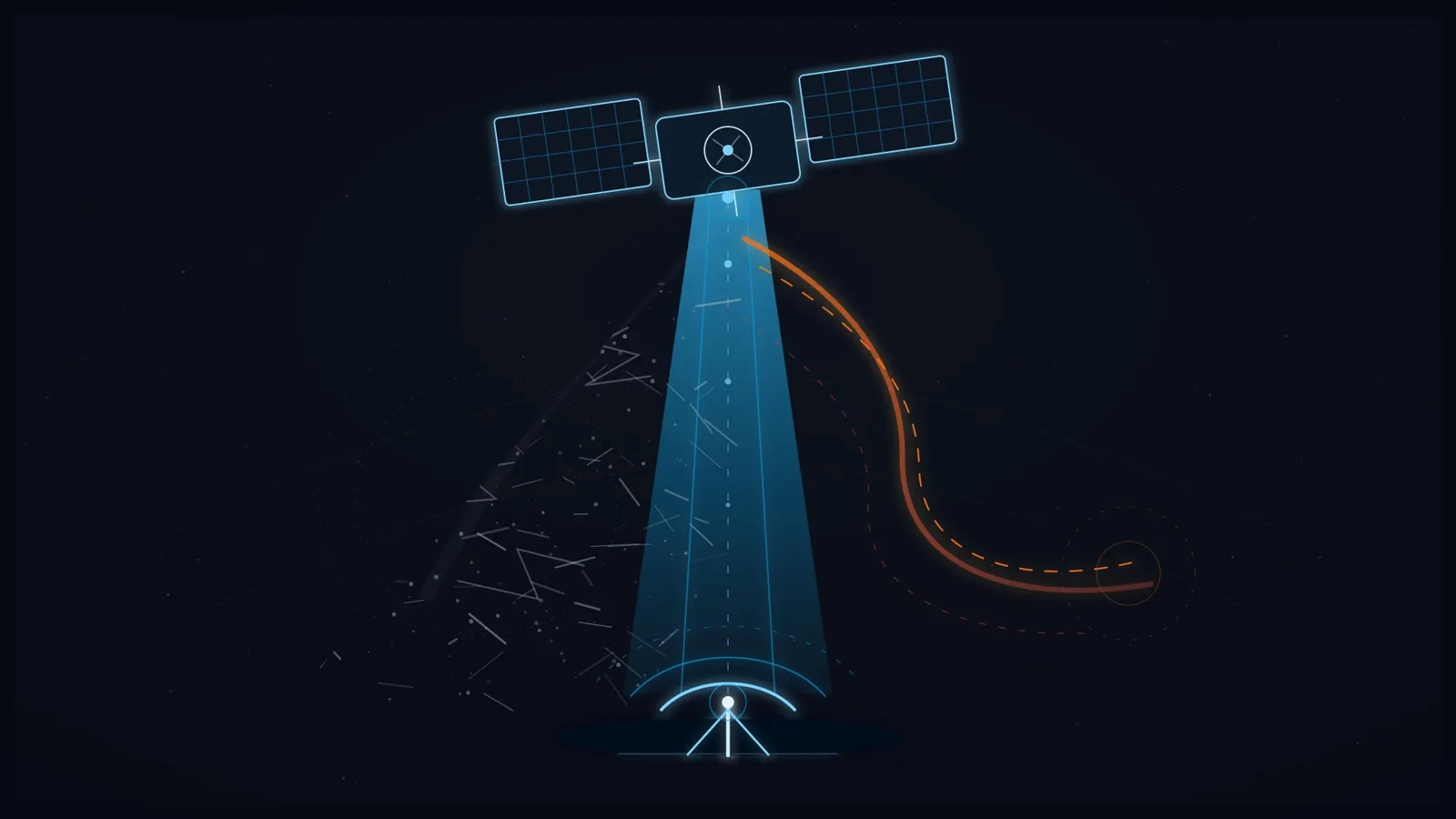
A spoofer doesn’t shout over the satellites — it impersonates them. It broadcasts signals engineered to look like authentic GNSS transmissions, matching their structure closely enough that the receiver locks onto them instead of the real thing. Once the receiver is tracking the counterfeit signals, the spoofer can slowly drag the computed position, velocity, or time toward whatever value it wants — often gradually, so no alarm trips.
This is why spoofing is the more sinister attack. The counterfeit signals deceive the receiver into calculating an incorrect position, and — unlike a jammer’s brute-force denial — the deception is difficult to detect without dedicated anti-spoofing checks. The receiver isn’t broken — it’s confidently wrong. For a timing application, a spoofed clock can drift a power grid or a financial timestamp without any outward sign. For navigation, it can place an aircraft or ship somewhere it isn’t.
Spoofing also degrades into jamming at the edges: many real-world “spoofing” events knock the receiver off the real signal first (a brief denial) before the counterfeit takes over. The two attacks live on a spectrum.
The threat is not theoretical anymore
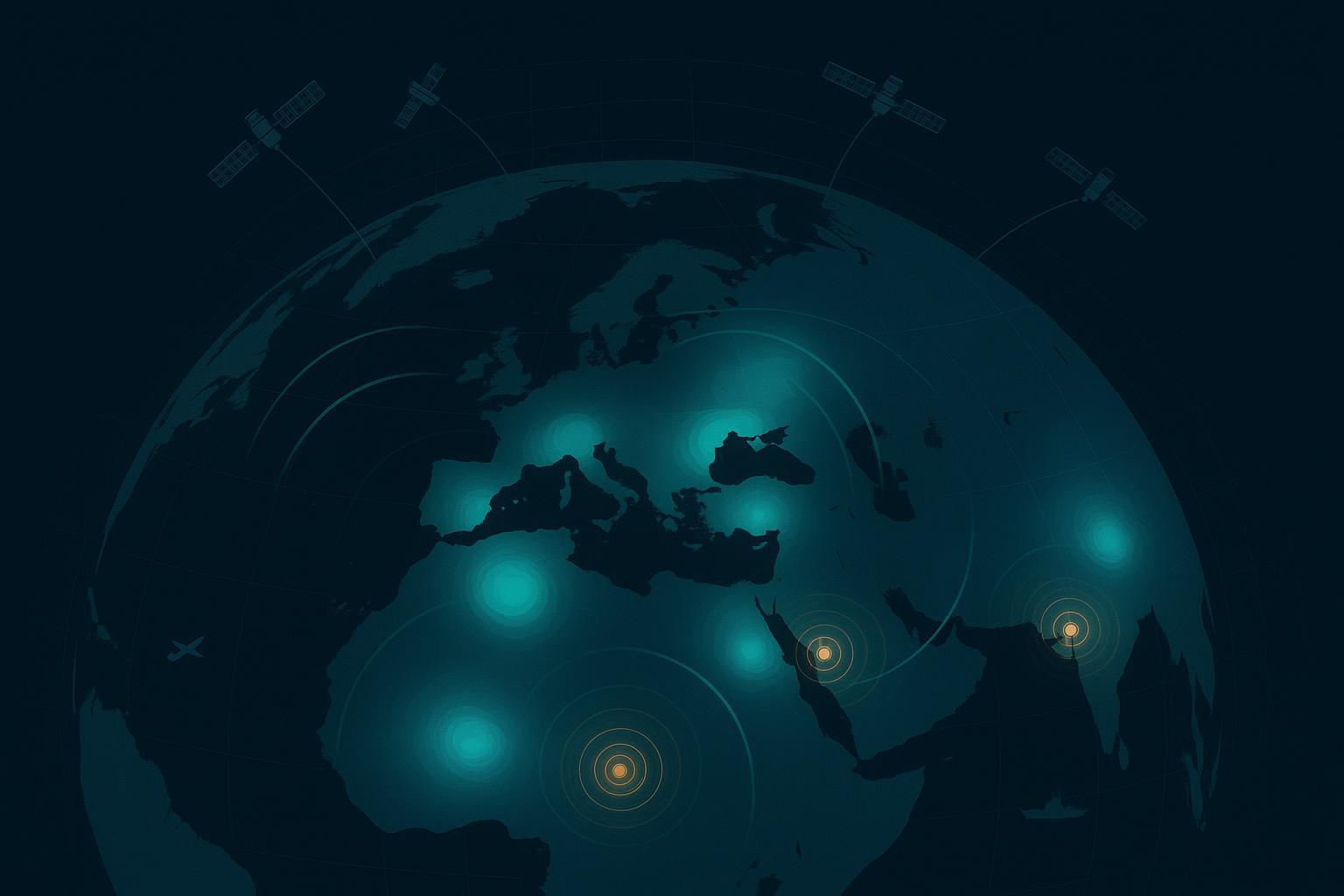
Spoofing moved from research curiosity to daily operational hazard in 2024. The aviation-ops community tracked the jump directly: flights encountering spoofing rose from an average of about 200 per day in the first quarter of 2024 to roughly 900 per day by the second quarter — peaking around 1,350 flights on the worst days, a jump of roughly 400% that prompted a cross-industry workgroup (IFALPA, IFATCA, FAA, Eurocontrol and others) (OPSGROUP).
The consequences reach the cockpit: crews increasingly report being unable to trust satellite navigation in interference-heavy corridors, forcing a fallback to inertial and ground-based aids at exactly the moments precision matters most. This is no longer a defense-only problem — it reaches civil aviation, maritime, surveying, timing infrastructure, and autonomous systems.
How you defend against each — and why it’s different hardware
The single most important thing to understand: the defense against jamming does little against spoofing, and vice versa. They’re different problems.
Against jamming — reject by direction. Because interference arrives from a physical direction, a multi-element CRPA steers nulls toward the jammers while preserving gain toward the satellites. More elements mean more simultaneous nulls — the trade-off is covered in how many CRPA elements you need. Adaptive nulling is the workhorse of jamming resistance; see adaptive beamforming and null steering for the mechanism.
Against spoofing — verify authenticity and cross-check. Nulling doesn’t help when the attack comes from the same direction as, or mimics, real satellites. Spoofing defenses instead ask “is this signal real, and is this solution consistent?”:
- Signal authentication — Galileo’s OS-NMA cryptographically signs navigation data so a receiver can verify it originated from the real constellation and hasn’t been modified.
- Multi-antenna / angle-of-arrival checks — genuine satellite signals arrive from many directions; a spoofer usually transmits from one, so a multi-antenna receiver can flag signals that all share an implausible bearing.
- RAIM and consistency monitoring — with five or more satellites, the receiver can spot outliers that don’t fit a consistent solution (more on anti-spoofing).
- Independent cross-checks — an inertial measurement unit, a known clock, or a second sensor catches a GNSS position that has quietly wandered.
A resilient system usually layers both: a CRPA to survive the jamming that often precedes or accompanies an attack, plus authentication and cross-checking to catch the deception. Neither alone is sufficient against a determined adversary.
Which threat should you design for?
Work from your failure cost, not the headline:
- Can you tolerate downtime but not a wrong answer? (aviation, autonomous vehicles, timing) → prioritize spoofing detection and integrity monitoring, backed by anti-jam hardware.
- Is denial your main risk in a contested RF environment? (defense platforms, drones near conflict zones) → a CRPA is the front-line requirement; add authentication as available.
- Are you in a benign environment today but exposed as threats grow? → at minimum, choose an antenna and receiver that support multi-band and multi-constellation, which raises the bar for both attacks.
If your platform operates anywhere near a contested or high-interference region, the practical starting point is anti-jam antenna hardware. Our anti-jamming CRPA line covers 4- to 32-element arrays; to see spatial nulling in action, the CRPA glossary entry includes an interactive null-steering visualizer.
Frequently asked questions
What’s the simplest way to tell jamming from spoofing? Jamming makes your receiver report that it has no fix; spoofing lets it keep reporting a fix that’s wrong. If positioning fails outright, suspect jamming. If the position or time looks plausible but drifts or disagrees with another sensor, suspect spoofing.
Why is spoofing considered more dangerous than jamming? Because it attacks integrity, not availability. A jammed system knows it’s blind and can fall back to other navigation. A spoofed system believes a false position or time and acts on it — routing toward the wrong place, or stamping the wrong time — with no obvious warning.
Does an anti-jamming antenna stop spoofing? Partly. A CRPA rejects interference by direction, which helps against spoofers transmitting from a single location and against the jamming that often accompanies spoofing. But it can’t, on its own, verify that a signal is authentic — full spoofing resistance also needs authentication (e.g. Galileo OS-NMA), multi-antenna angle checks, and independent cross-checks like an IMU.
Is GPS spoofing actually affecting civilian systems? Yes. Flights encountering spoofing rose from about 200 a day in early 2024 to roughly 900 a day by mid-year, peaking near 1,350 on the worst days — enough for the aviation industry to convene a dedicated workgroup. The impact extends beyond aviation to maritime, timing infrastructure, and surveying. It has moved from a defense-specific concern to a broad operational one.
Written by GNSource Engineering. GNSource manufactures anti-jamming CRPA antennas for contested and safety-critical GNSS environments. Talk to our engineers about protecting your platform against interference and spoofing.