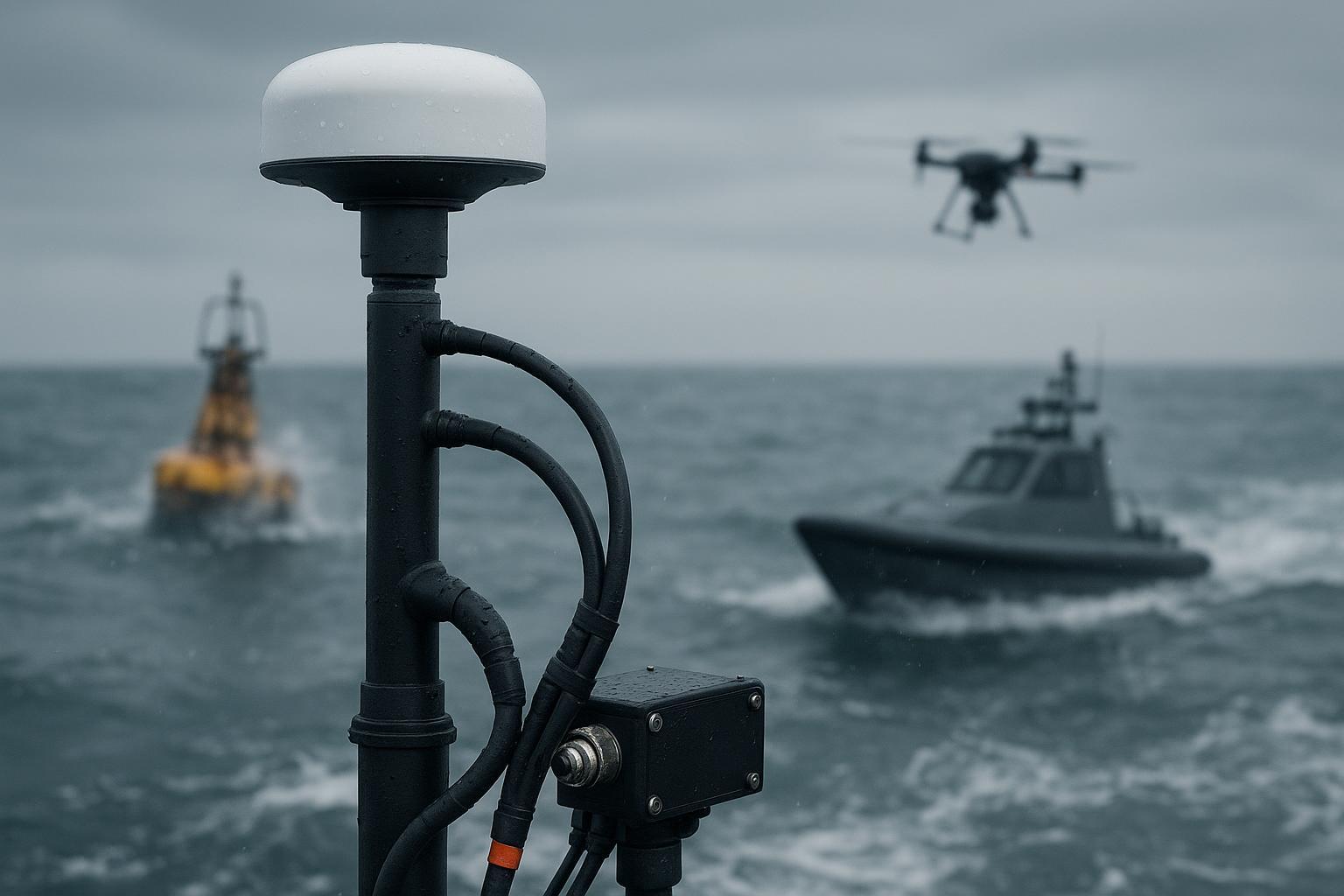
Put a GNSS antenna on a masthead and you have chosen the hardest environment the product will ever see, and the one least willing to forgive a shortcut. It will sit in salt fog for years between dockings. It will be shaken every time the hull takes a sea. It will look down at a flat, wet reflector that bounces every satellite it needs. And when it fails, it fails a long way from a spare.
Marine work also spans a lot of ground — hydrographic survey, offshore construction and energy, dynamic positioning, USVs and coastal drones. What unites them is not the application; it is the environment and the physics. This guide is the hub for that: what makes an antenna genuinely marine-grade, why the sea is an RF problem and not just a corrosion problem, and where to go deeper.
Everything in the marine GNSS antenna library
This guide is the hub. Below it sits the full library — branch left for your application, right for the engineering that keeps the antenna alive. Each article links back here.
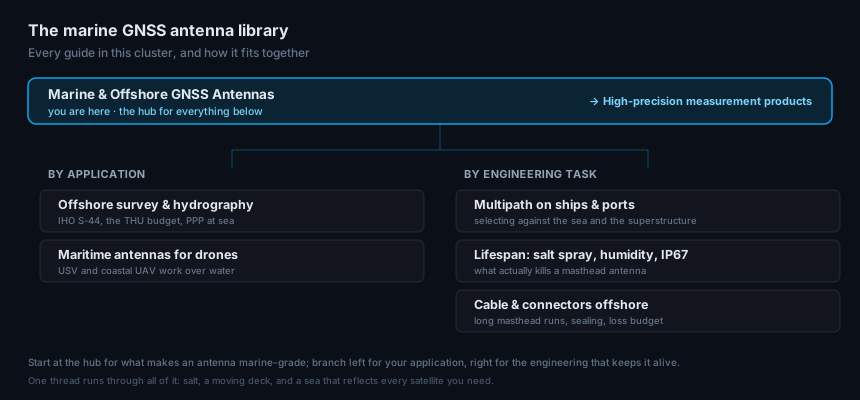
By application
- GNSS for offshore survey & hydrography — IHO S-44, the THU budget, and PPP where there is no base station
- Maritime GNSS antennas for drones — USV and coastal UAV work over water
By engineering task
- Antenna selection to reduce multipath on ships & ports — choosing against the sea and the superstructure
- Marine antenna lifespan: salt spray, humidity, IP67 — what actually kills a masthead antenna
- Cable & connector practice for offshore RTK — long runs, sealing, and the loss budget
When you’re ready to spec hardware, the high-precision measurement line covers survey- and marine-grade antennas.
What makes an antenna marine-grade
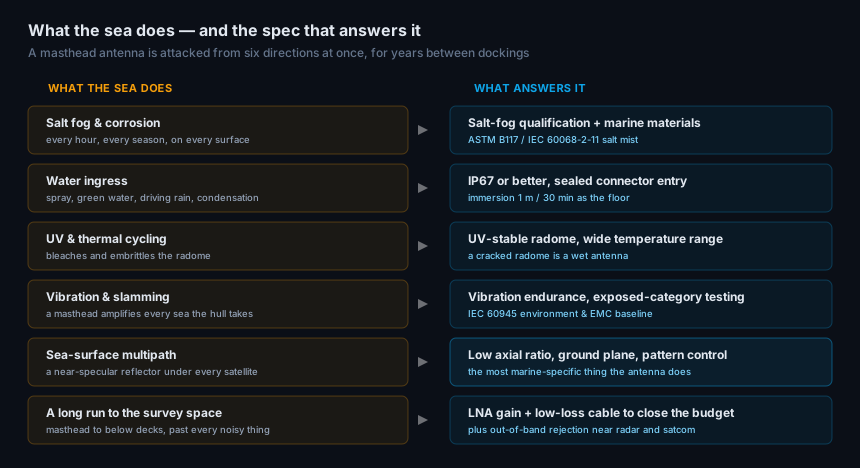
“Marine-grade” gets used loosely. In practice it means the antenna answers four environmental attacks — plus two RF ones, covered in the sections below — and each maps to something you can ask a vendor to evidence.
Salt fog and corrosion work on every surface continuously — the housing, the mount, the connector interface. The answer is marine materials plus salt-mist qualification, typically to ASTM B117 or IEC 60068-2-11. Water ingress follows: spray, green water, driving rain, and the condensation that forms inside a poorly sealed housing. IP67 — immersion to 1 m for 30 minutes — is the sensible floor, and the connector entry matters as much as the radome. UV and thermal cycling bleach and embrittle the radome, and a cracked radome is simply a wet antenna. Vibration and slamming are amplified by the masthead, which is the worst place on the ship for it.
For shipborne equipment, the framing standard is IEC 60945 — Maritime navigation and radiocommunication equipment and systems: general requirements, methods of testing and required test results — which defines the environmental and EMC regime for exposed and protected equipment categories. Marine GPS receivers additionally reference IEC 61108-1 for performance (the 61108 series is split by constellation). Ask what the antenna has actually been tested to; “marine” on a datasheet is not a test result. The failure modes and the evidence to demand are worked through in marine antenna lifespan.
The sea is an RF problem, not just a corrosion problem
The part people underestimate: the ocean is a near-specular reflector sitting under every satellite you are trying to track. Sea-surface multipath is the signature marine error, and it is nastier than the land equivalent in a specific way — you cannot site away from it. A land installation can be moved off a reflective façade; a vessel carries its reflector everywhere, and it moves with the swell, right beneath the low-elevation satellites that give you geometry.
The superstructure adds its own share: masts, radar, and satcom domes block sky and re-radiate energy into the antenna, which is why masthead placement is a negotiation rather than a free choice. The antenna’s defences are RF, not mechanical — clean right-hand circular polarization with a low axial ratio across elevations (a reflection reverses the polarization sense, so a clean RHCP antenna with low axial ratio rejects much of it), a proper ground plane, and a controlled low-elevation pattern. Choosing on those grounds is the subject of antenna selection to reduce multipath on ships and in ports.
Why corrections change what you need from the antenna
Offshore, the correction problem changes shape: RTK needs a base station within reach and there isn’t one, so the work runs on PPP instead. That has one direct consequence for the front end — PPP has to converge, and re-converge after every interruption, so multi-band, multi-constellation reception and anything that keeps tracking unbroken stop being nice-to-haves and start being schedule.
How that plays out — the corrections, the convergence, and how it all fits inside the IHO S-44 uncertainty budget — is the subject of GNSS for offshore survey and hydrography.
Specifying a marine antenna
| Spec | Why it matters at sea |
|---|---|
| Multi-band, multi-constellation (L1/L2/L5) | fast PPP convergence and re-convergence; better low-elevation geometry |
| Low axial ratio across elevations, ground plane, pattern control | rejects the sea-surface reflection — the core marine RF job |
| Documented, stable phase center | it is the origin of every lever arm to the sounder or motion sensor |
| IP67 or better, sealed connector entry | spray, green water, and condensation are constant |
| Salt-mist qualified (ASTM B117 / IEC 60068-2-11), marine materials | years of salt fog between dockings |
| UV-stable radome, wide temperature range | a cracked radome is a wet antenna |
| Vibration endurance; IEC 60945 environmental regime | the masthead amplifies every sea the hull takes |
| Adequate LNA gain for a long masthead run | closes the budget from mast to the space below decks |
The general selection framework — the specs to put in an RFQ and how they trade against each other — is covered in the buyer’s guide to high-precision GNSS antennas; this cluster is the marine-specific layer on top of it.
Frequently asked questions
What makes a GNSS antenna “marine-grade”? Evidence, not a label. It should be salt-mist qualified (ASTM B117 or IEC 60068-2-11), sealed to at least IP67 including the connector entry, built from marine materials with a UV-stable radome, and able to survive masthead vibration — with IEC 60945 as the framing environmental and EMC standard for shipborne equipment. On the RF side it needs a low axial ratio and controlled pattern to reject sea-surface multipath.
What standards should a marine GNSS antenna be tested to? IEC 60945 is the framing standard for shipborne equipment — it defines the environmental and EMC regime and splits equipment into exposed and protected categories. Under it, ask specifically for salt-mist testing (ASTM B117 or IEC 60068-2-11), an ingress rating of IP67 or better, UV exposure, and vibration endurance. Marine GPS receivers separately reference IEC 61108-1 for performance.
Is IP67 enough for a masthead antenna? It is the sensible floor, not the whole answer. IP67 covers immersion to 1 m for 30 minutes, but salt-mist corrosion, UV embrittlement, and vibration endurance are separate failure modes with separate tests. An antenna can be IP67 and still fail in three years of salt fog if the materials and the connector interface aren’t right.
Can I just use a survey antenna at sea? Sometimes, but check the evidence rather than the grade. A good geodetic antenna already has the RF properties you want — low axial ratio, a stable phase center, multi-band. What it may not have is the qualification: salt mist, UV, ingress at the connector, and masthead vibration endurance. Marine duty is the survey spec plus an environmental file.
Where should the antenna go on a vessel? As high and as clear of the superstructure as the naval architecture allows — masts, radar, and satcom domes both block sky and re-radiate into the antenna. The trade-off is that a masthead maximises sky view while also maximising vibration and the length of the cable run, so placement is a negotiation between RF, structure, and the link budget rather than a free choice.
Written by GNSource Engineering. GNSource manufactures marine-grade, multi-band GNSS antennas for offshore survey, vessel positioning, and maritime platforms. Talk to our engineers about a masthead antenna that will still be working in five years, or explore the high-precision measurement line.