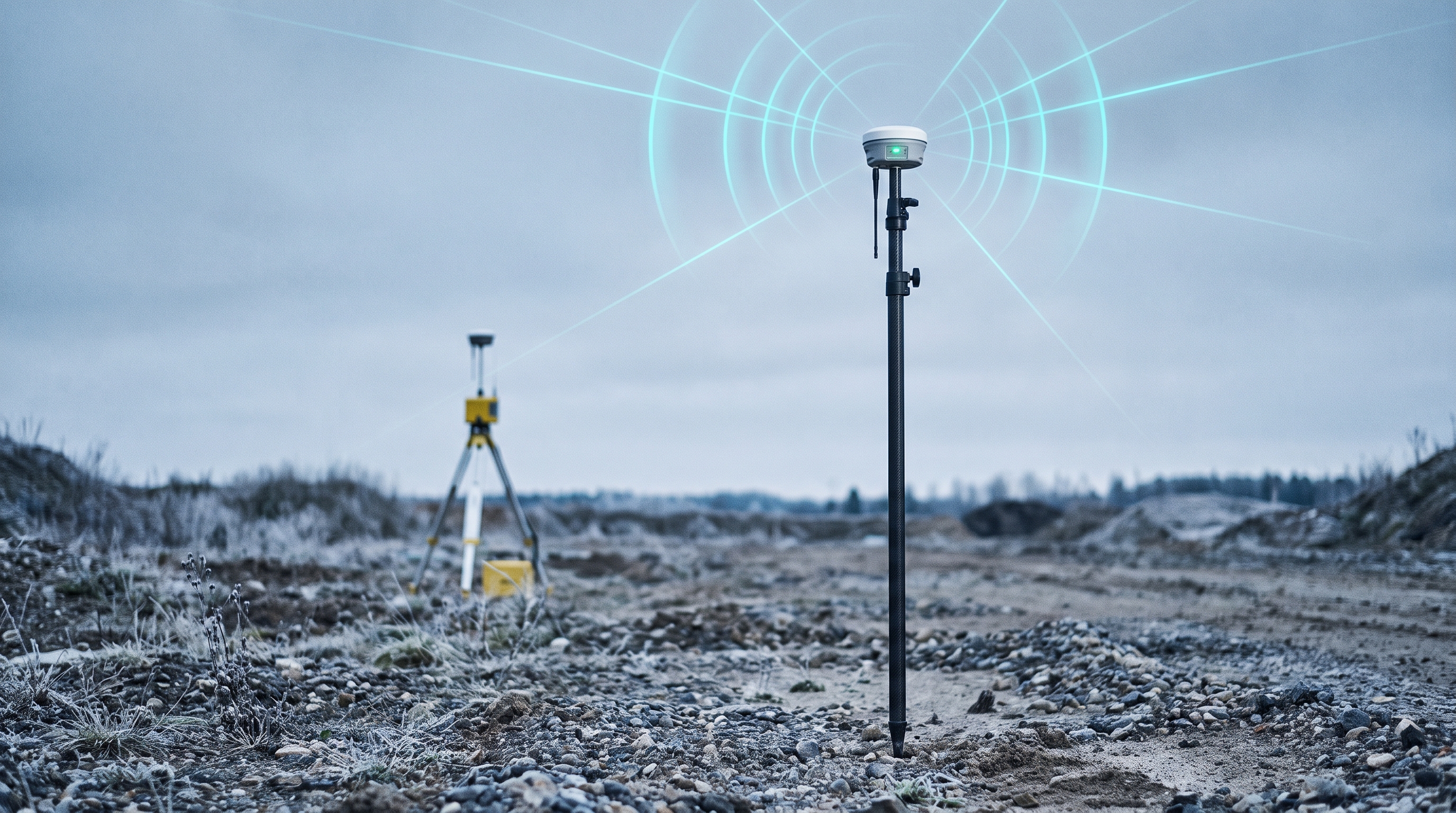
Search for an “RTK antenna” and you get a wall of products that all claim centimeter accuracy. The useful first question isn’t which brand — it’s which role you’re buying for. RTK (real-time kinematic) positioning runs on two antennas doing two different jobs: a base on a known point and a rover where you actually measure. They share a spec baseline but optimize for opposite things, and picking the wrong one for the role is the most common way an RTK setup underperforms.
This guide is the RTK-specific slice of antenna selection — the rover-versus-base decision, what RTK asks of the hardware that static or post-processed work doesn’t, and the specs that actually move your fix rate. For the broader framework across all high-precision work, start at the buyer’s guide to high-precision GNSS antennas; this page zooms into RTK.
Why RTK needs two antennas — and the antenna sits at both ends
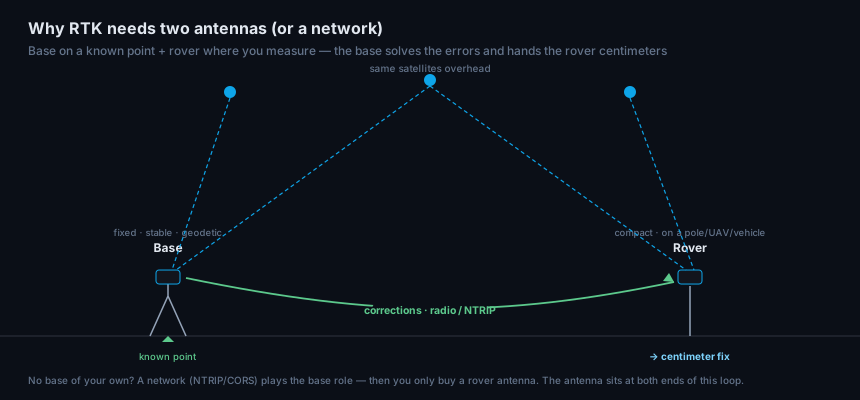
RTK gets centimeters out of a system that, on its own, is meters off. The trick is differencing: a base antenna sits on a precisely known point and tracks the same satellites as the rover. Because the base knows exactly where it is, it can measure the errors in the signals — atmosphere, orbits, clocks — and broadcast a correction. The rover applies that correction in real time and collapses its own error to the centimeter level.
Two consequences follow, and both are about the antenna. First, the antenna is at both ends of that loop — the quality of the base’s measurement and the rover’s measurement both feed the result, so a weak antenna at either end caps the whole system. Second, if you don’t run your own base, a network — NTRIP over a CORS reference network — plays the base role, and you only buy a rover. Either way, the rover-versus-base distinction is the first fork in the decision.
Rover vs base: two roles, two antennas
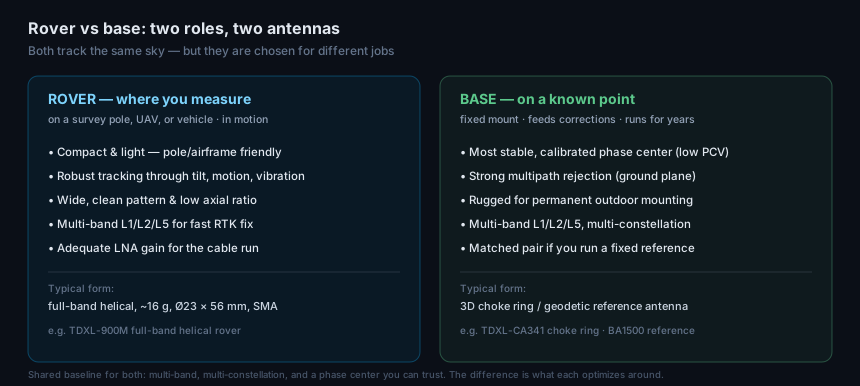
The two roles pull the design in different directions.
The rover is chosen for motion and portability. It rides a survey pole, a UAV, or a vehicle, and it has to hold a clean fix while it tilts, moves, and vibrates. That favors a compact, light antenna with a wide, clean pattern and good polarization purity so it keeps tracking low satellites through movement — typically a full-band helical you can put on a pole without it becoming top-heavy. Weight and form factor matter here as much as raw RF, especially on a drone, where the RTK antenna requirements are their own discipline.
The base is chosen for stability. It sits on a fixed point and its job is to be the trustworthy reference, often for years. That means the most stable, well-calibrated phase center you can get, strong multipath rejection from a real ground plane, and rugged construction for permanent outdoor mounting — which is exactly the brief a choke ring antenna is built to. If you run a permanent reference, you also want the right base antenna consistently — and getting the base sited and mounted correctly is its own job, covered in setting up an RTK base station antenna.
The specs that decide an RTK antenna
Both roles share a baseline; the emphasis shifts between them.
| Spec | Why it matters for RTK | Rover | Base |
|---|---|---|---|
| Multi-band, multi-constellation (L1/L2/L5) | more frequencies and satellites resolve the ambiguity faster and hold the fix — the single biggest driver of RTK performance | ✔ essential | ✔ essential |
| Stable, calibrated phase center (low PCV) | PCV wander goes straight into position error; the base especially must be a rock | important | ✔ critical |
| Multipath rejection / ground plane | reflected signals corrupt the fix; the fixed base can carry a big ground plane, the rover can’t | good pattern | ✔ choke ring / large plane |
| Low axial ratio, clean RHCP | keeps tracking low-elevation satellites through motion and near reflectors | ✔ critical | important |
| Size, weight, form factor | a pole/airframe rover lives or dies on SWaP; the base has no such limit | ✔ compact | not constrained |
| LNA gain for the cable run | closes the link over the cable from antenna to receiver | match to run | match to run |
| Matched pair | a permanent reference benefits from matched base antennas so corrections stay consistent | — | ✔ for fixed refs |
If you take one thing from the table: multi-band, multi-constellation reception is the highest-leverage spec for RTK on both ends — it’s what makes the fix fast and keeps it. Where the roles diverge is the phase center and ground plane (the base’s obsession) versus size and motion-robustness (the rover’s).
Network RTK / NTRIP: when you don’t run a base
Plenty of RTK today never touches a base you own. If a CORS reference network covers your area, you subscribe to NTRIP corrections and run a rover only — the network is the base. That simplifies the buy to a single good rover antenna, but it doesn’t change what the rover needs: multi-band, multi-constellation, clean pattern, stable phase center. And whether cm accuracy is worth it at all — versus a survey-grade vs low-cost trade-off — is the question to settle before you spec either end.
Where the antenna fits
Reduced to a buying rule:
- Rover — compact, light, multi-band and multi-constellation, robust tracking through motion, adequate LNA gain for the run. A full-band helical is the workhorse.
- Base — the most stable, calibrated phase center you can afford, strong multipath rejection and a proper ground plane, rugged for permanent mounting. A choke ring or geodetic reference antenna.
- Both — never compromise the phase center or the band coverage; that’s where RTK accuracy is won or lost.
The rover helicals and the choke-ring / reference base antennas for exactly this sit in the high-precision measurement line — full-band multi-constellation rovers and geodetic base references, matched where a permanent reference needs it.
Frequently asked questions
What is an RTK antenna? It’s a GNSS antenna used in a real-time kinematic setup, where centimeter accuracy comes from a base antenna on a known point sending corrections to a rover antenna where you measure. “RTK antenna” isn’t a special antenna type so much as a survey-grade, multi-band antenna chosen for the rover or base role — the key traits are multi-band/multi-constellation reception and a stable phase center.
Do I need one RTK antenna or two? Two, unless you use a network. Classic RTK needs a base antenna on a known point and a rover antenna where you measure. If a CORS/NTRIP network covers your area, it plays the base role and you only buy a rover antenna.
What’s the difference between a rover and a base antenna? The role and what it optimizes for. The rover is compact and light, mounts on a pole/UAV/vehicle, and must track cleanly through motion. The base is fixed on a known point and prioritizes the most stable phase center and multipath rejection — often a choke ring or geodetic antenna. Both should be multi-band and multi-constellation.
Does an RTK antenna need L1/L2/L5 / multiple constellations? It’s the single most important spec. More frequencies and more satellites let the receiver resolve the carrier-phase ambiguity faster and hold the fix through obstructions — the difference between a snappy, reliable RTK fix and one that drops. Single-band antennas can do RTK but converge slower and lose fix more easily.
Can I use the same antenna for the base and the rover? You can if it’s a good survey-grade multi-band antenna, and for a temporary base many people do. But the base rewards a more stable phase center and a bigger ground plane (a choke ring), while the rover rewards compactness and motion robustness — so a permanent setup usually pairs a geodetic base with a lighter rover rather than two of the same.
Written by GNSource Engineering. GNSource manufactures survey-grade, multi-band GNSS antennas for RTK — full-band helical rovers and choke-ring / geodetic base references. Talk to our engineers about matching a rover and base to your workflow, or explore the high-precision measurement line.
![How to Set Up an RTK Base Station Antenna [2026 Guide]](/blog/_assets/upload/aaacdd5rjxygrxhc/2026/06/17/image_1781704508-i4v1t4p5.jpeg)