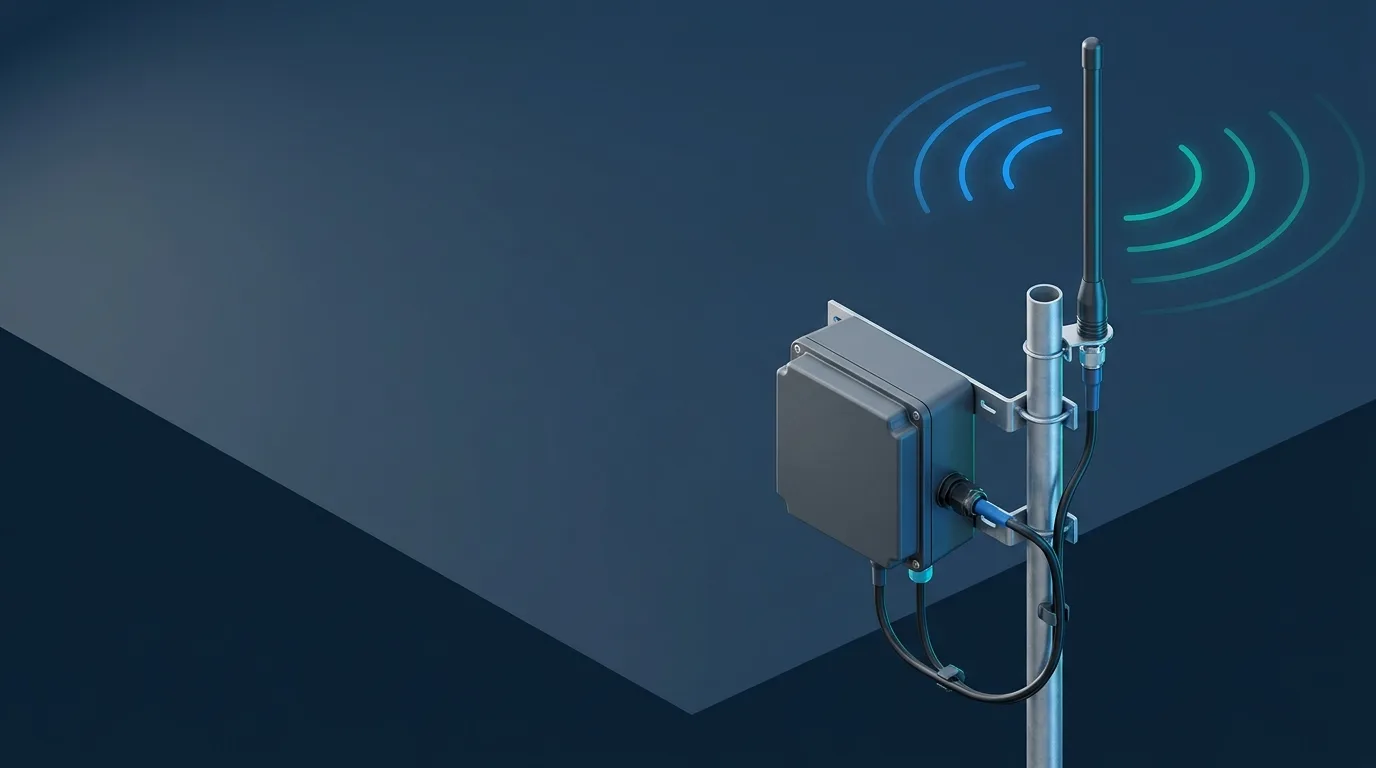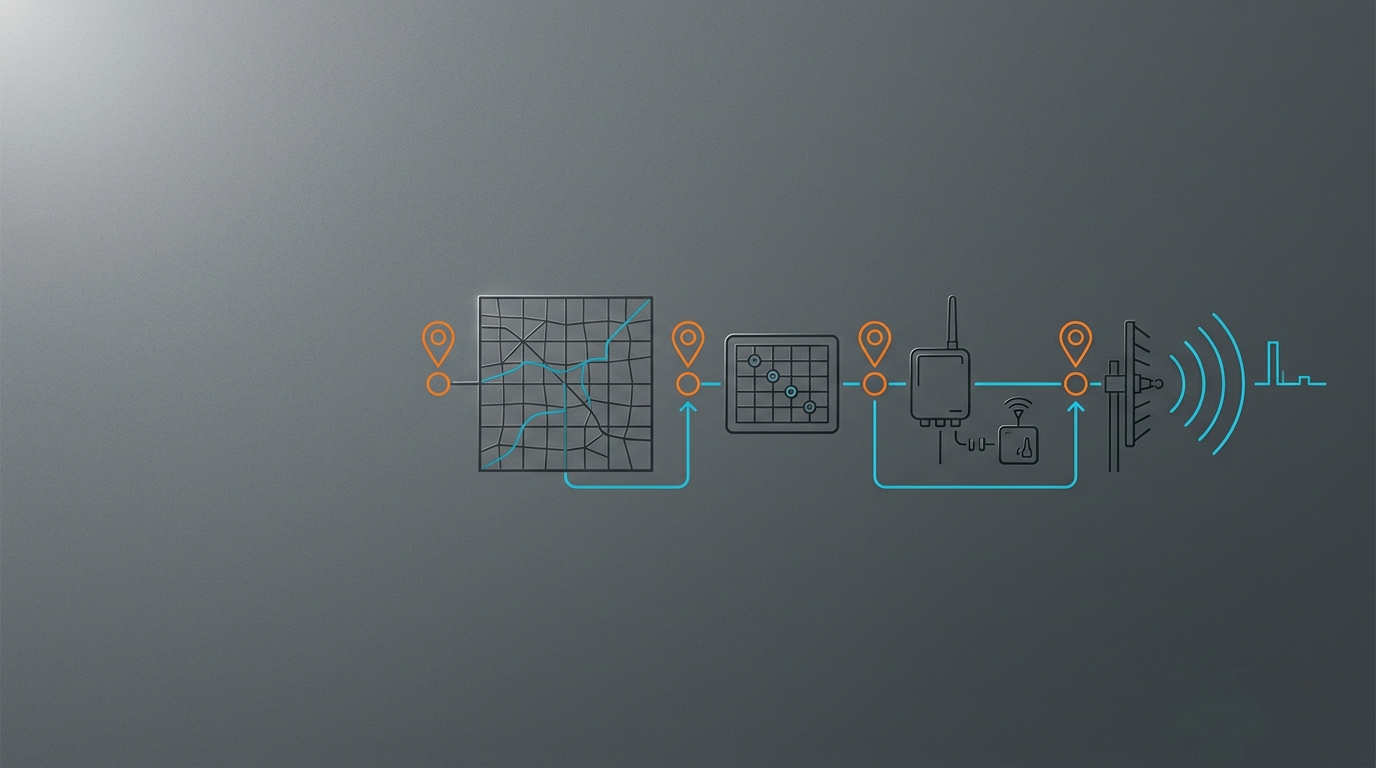
LTE-M vs NB-IoT antenna selection starts with the network and module, not an antenna label. LTE-M and NB-IoT are complementary 3GPP cellular IoT technologies, but neither name specifies the LTE bands a finished device will use. First confirm the deployment country, chosen network service, module variant and enabled bands. Then choose an antenna whose evidence and installed performance cover that real RF requirement.
The decision has two layers. The first is connectivity: LTE-M versus NB-IoT, expected mobility, payload behaviour, power-saving configuration and any roaming requirement. The second is the antenna path: active LTE bands, required ports or chains, cable, connector, mounting surface and enclosure. The second layer cannot correct an unresolved first layer.
| Decision input | Close this question first | What it becomes in the antenna brief |
|---|---|---|
| Deployment | Which country, operator and sites will the device use? | Network and regional evidence to verify |
| Cellular service | Is the release target LTE-M, NB-IoT, or a documented fallback combination? | Required module configuration |
| Module | Which exact SKU, regional variant and firmware are approved? | Supported-band list |
| Installation | Where will the element, cable and device sit? | Pattern, mount and feed-path requirements |
| Acceptance | What result must the installed unit demonstrate? | Prototype test method and RFQ evidence |
1. Confirm the network decision and deployment footprint
Treat LTE-M vs NB-IoT as a service decision before treating it as a hardware shopping term. The GSMA describes the two as complementary licensed-spectrum Mobile IoT technologies; their practical behaviour can differ in data handling, mobility, power options and operator availability. Those differences can influence the device and module choice, but they do not make an antenna intrinsically “LTE-M only” or “NB-IoT only.”
Start a one-page deployment record with the country or countries, the selected operator or private-network owner, the intended service, whether the product is stationary or mobile, and whether roaming or technology fallback is part of the product requirement. The GSMA Mobile IoT deployment map is useful for an initial country-and-technology check. It is not a substitute for confirmation from the network operator and the documentation for the specific module.
That final confirmation matters because deployment settings, supported features and frequency bands can differ across networks. GSMA’s Mobile IoT deployment guidance specifically identifies differences in bands, architecture and supported features as factors that can affect device performance, roaming and cost. Record the answer rather than assuming a technology name carries it.
If the broader radio choice is still open, use the IoT antenna buyer’s guide to put cellular, LoRaWAN and Wi-Fi decisions in the right order. Once the network choice is closed, the task becomes more concrete: turn the exact module into an actual-band list.
2. Turn the module variant into an actual-band list
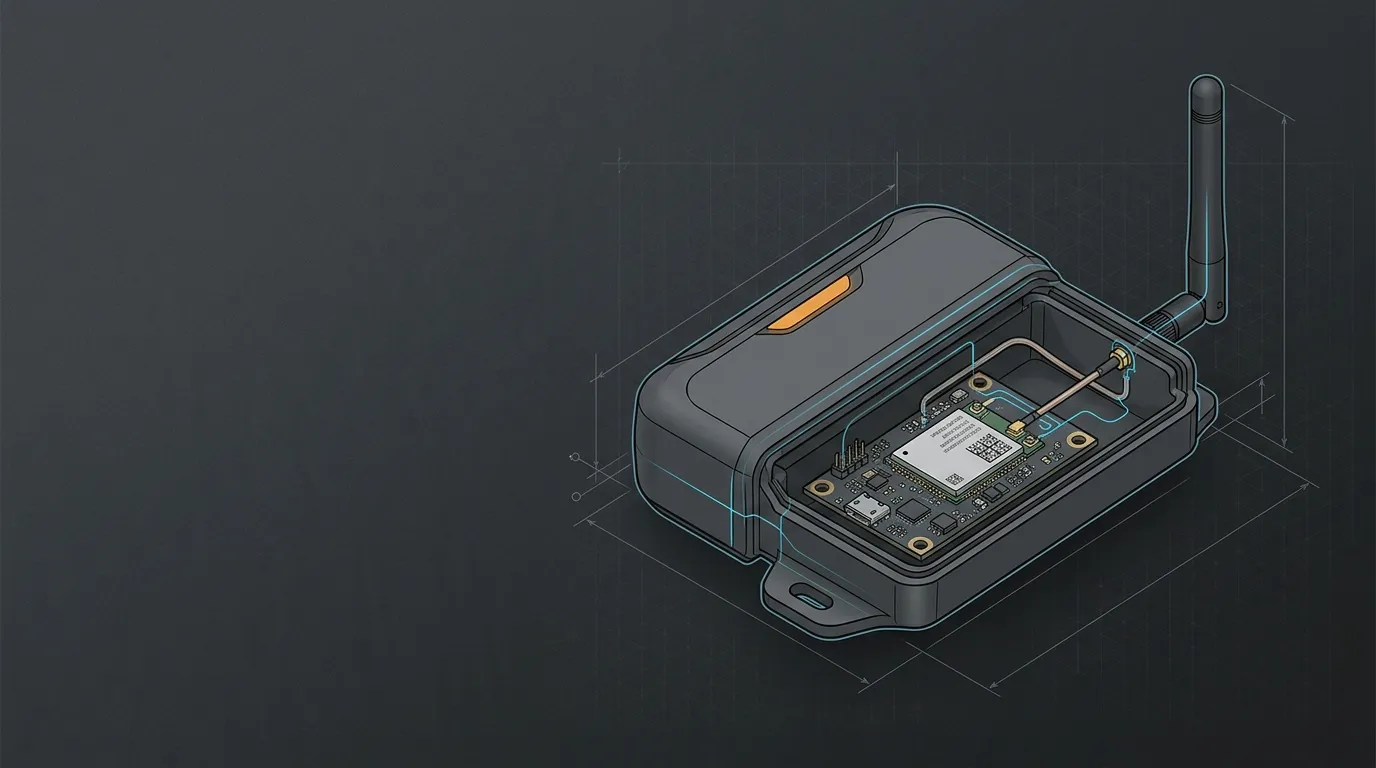
An antenna requirement begins with an exact part number. Ask for the modem or module manufacturer, full SKU, regional variant, hardware revision, firmware/configuration version and the documented LTE bands enabled for the deployment. Do not replace that list with “supports LTE-M” or “NB-IoT capable.” Those are service capabilities, not a complete frequency specification.
For a device that can use both technologies, also record which RAT is selected in the intended market and what fallback behaviour is approved. Power-saving functions such as PSM or eDRX, mobility expectations and payload size can be relevant to the connectivity decision. They do not change the need to cover the bands the radio is actually permitted and configured to use.
| Requirement field | Useful entry | Why it prevents a bad antenna order |
|---|---|---|
| Module identity | Manufacturer, part number, regional SKU and revision | Similar module names can have different documented band support |
| Network decision | Operator, country, selected LTE-M/NB-IoT service and approved fallback | Stops an unverified deployment assumption becoming an RF requirement |
| Band list | The active LTE bands from the applicable documentation | Gives the antenna supplier a checkable coverage target |
| RF path | Cellular port labels, number of active paths and approved external option | Keeps cellular, Wi-Fi, GNSS and auxiliary ports separate |
| Unknowns | Any value not yet confirmed | Makes the next engineering question visible instead of guessed |
This record is also the fastest way to distinguish a plausible cellular IoT antenna from a compatible one. A marketplace label such as “4G,” “LTE-M,” or “NB-IoT antenna” can be a useful search filter, but it is not proof that the component covers the bands your configured module will use. The external antenna compatibility checklist adds the adjacent port, connector, chain-count and cable checks before an order is released.
3. Ask for antenna evidence across those bands
Once the actual-band list is known, ask for evidence that addresses that list rather than a nominal protocol label. For a candidate LTE-M antenna or NB-IoT antenna, request the stated coverage range and the RF information the supplier can provide across the relevant bands. Depending on the antenna type and application, that may include match data, efficiency or realised-gain information, pattern or polarisation information, and the conditions under which it was measured.
The target is not a universal specification threshold. It is evidence that lets the device team judge a candidate against its own bands, physical installation and link objective. A wideband antenna may be a good candidate when its documented performance spans the required range. It is still only a candidate if the connector, cable, active-chain count and installation arrangement also fit the device.
Use this short acceptance screen before comparing headline dBi values:
- Does the published frequency coverage include every documented active band?
- Is there RF evidence relevant to those bands, rather than only a centre-frequency label?
- Does the radiation pattern suit a fixed cabinet, tracker, meter, gateway or other intended installation?
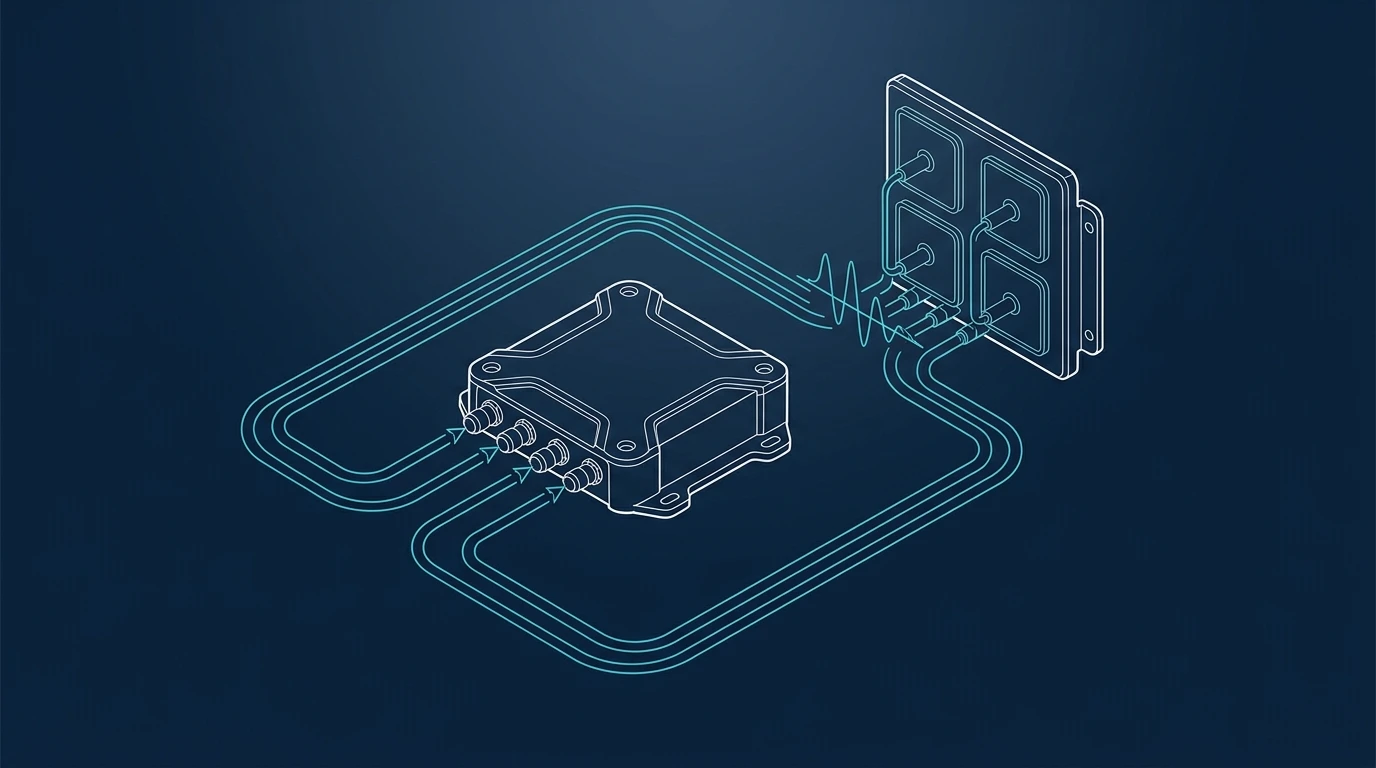
- Does the proposal preserve each required cellular RF path and use a documented mating interface?
- Can the supplier state the cable assembly, mounting assumptions and any limits that affect the result?
For the broader cellular antenna trade-offs behind that screen, see what actually matters for an external 4G LTE antenna. It explains why band coverage, cable loss and placement deserve more attention than a single gain number. The same principle applies here: a strong catalogue figure outside the bands or conditions that matter to the device is not useful margin.
4. Validate the installed antenna path
Catalogue evidence is not the final test. The finished device changes the RF environment through its enclosure, battery, nearby metal, ground reference, cable route, bulkhead and mounting position. An antenna that is appropriate in one arrangement can behave differently when placed against a cabinet, inside a compact housing or on a different mounting surface.
Keep the first prototype comparison controlled. Hold the module, firmware, selected service, antenna model, cable assembly and representative endpoint conditions stable. Record a baseline observation, install the intended assembly, then repeat the same practical traffic or telemetry test. Use a device-appropriate result such as a documented received-level, link-quality, registration or connection-stability observation. The purpose is to compare the completed RF path, not to promise a universal range increase.
| Installation record | What to retain |
|---|---|
| Device state | Module SKU, firmware/configuration, selected service and active port |
| Antenna assembly | Antenna model, cable type and length, connectors, adapters and bulkheads |
| Physical geometry | Enclosure material, mount type, orientation, nearby conductive parts and photos |
| Test conditions | Representative sites or endpoints, message pattern, time window and baseline/final results |
| Decision | Keep, revise the feed path, reposition, or request further engineering review |
For this stage, the guide to metal enclosure antenna detuning and validation is a useful companion. It does not prescribe a universal clearance because the answer depends on the antenna, band, enclosure and mount. That restraint is valuable: an installation result should be documented for the actual assembly, not turned into a rule for every product.
5. Send an RFQ another engineer can use
The final deliverable is a compact RFQ or engineering handoff, not a loosely worded request for “an LTE-M antenna.” A supplier can evaluate an incomplete brief only by making assumptions. Labeling unknowns is usually more useful than filling them with familiar-looking values.
| RFQ item | Minimum detail to send |
|---|---|
| Deployment | Countries, operator or network owner, stationary/mobile use and any roaming requirement |
| Module and service | Exact module SKU/variant, firmware, chosen LTE-M or NB-IoT service and documented fallback |
| RF requirement | Active LTE bands, cellular port labels and every required RF path or chain |
| Antenna target | Required band coverage, pattern/polarisation needs, form factor and mounting location |
| Feed and enclosure | Cable type/length, both interfaces, adapters/bulkheads, enclosure material and mount geometry |
| Validation | Prototype baseline, acceptance observation, representative test conditions and target quantity |
When those facts are available, the IoT antenna compatibility checker can turn them into a downloadable English PDF or an inquiry for engineering review. Use it to package an informed RF requirement—not to replace the operator, module or installed-device checks.
Frequently asked questions
Can a standard LTE antenna work for NB-IoT?
It can be a candidate if its documented coverage and RF evidence include the bands the configured NB-IoT module will actually use, and if the completed cable, port and installation path is appropriate. “LTE” on its own does not establish either point.
Do LTE-M and NB-IoT need different antennas?
Not automatically. The technologies are not antenna-band names. One antenna may serve an LTE-M and NB-IoT product when the required bands, RF paths and installed conditions agree. Separate antennas may be appropriate when their actual band requirements or physical installations differ.
What should I confirm before ordering an LTE-M antenna?
Confirm the target country and operator, the module SKU and enabled configuration, the documented active LTE bands, cellular port and chain count, connector/cable assembly, enclosure and mount, and the acceptance test. Then request evidence tied to those inputs.
Does choosing LTE-M or NB-IoT guarantee coverage or roaming?
No. Coverage, roaming and service behaviour depend on the network, module configuration and deployment conditions. Antenna selection can support the actual RF path, but it cannot by itself establish a service, regulatory status or roaming agreement.