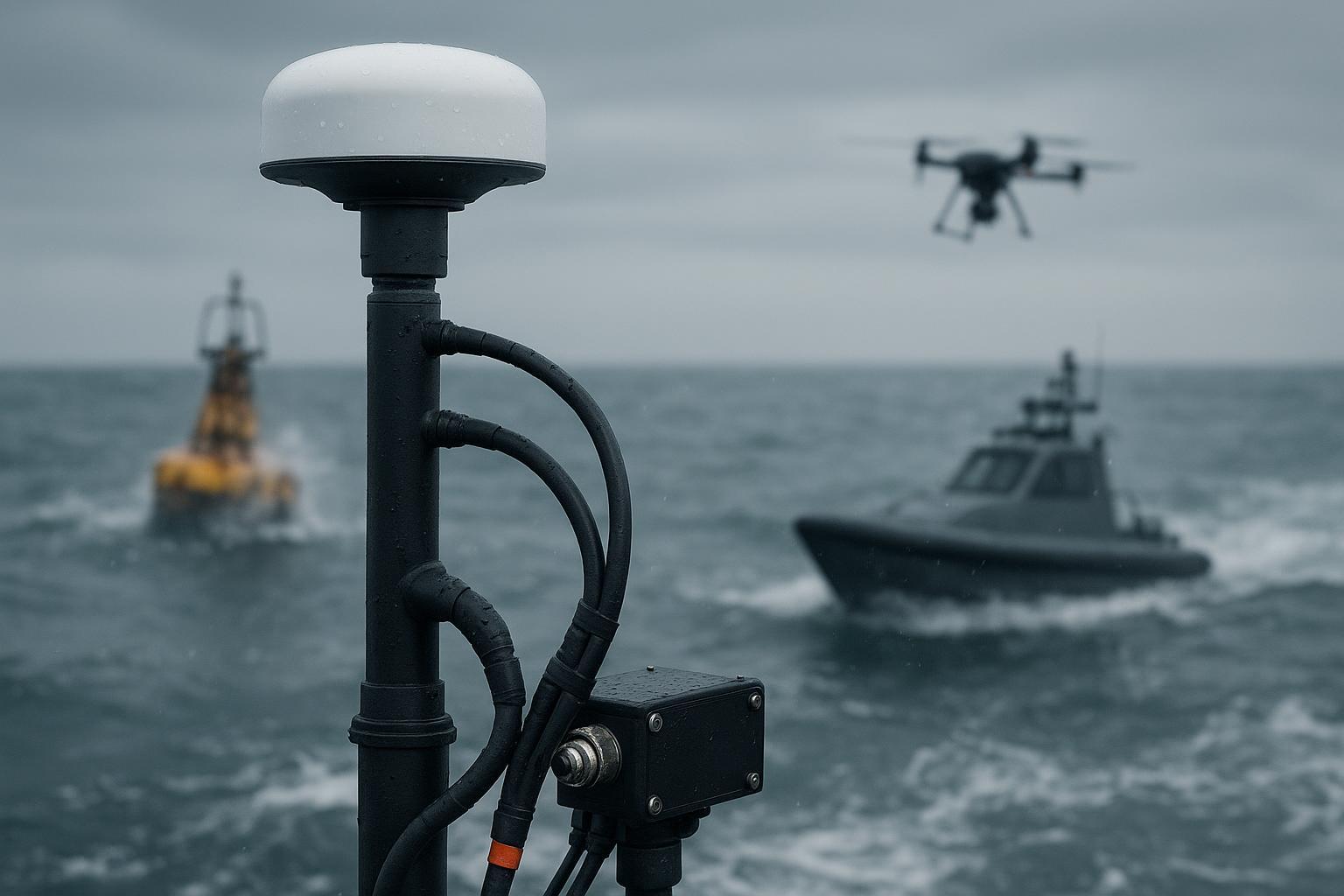
On a pier trial last fall, we kept losing RTK fixes whenever the UAV crabbed into a crosswind over open water. The logs told the story: SNR dips at low elevations, sudden carrier-phase jumps, and a connector whose contact resistance drifted after two weeks in salt air. That day is a good reminder of what actually breaks precision over water—reflections and corrosion—and why your antenna system needs as much attention as your flight stack.
Why over‑water GNSS is hard
The sea is a giant mirror. A smooth surface produces strong specular reflections that add a delayed, phase‑shifted copy of the signal to what the antenna should receive directly. The receiver then sees a distorted correlation peak (code) and a biased carrier phase, which makes RTK ambiguity resolution wobble—longer time‑to‑fix, more float, and random‑looking position jitter. The physics is well documented, and the consistent recommendation is to prioritize physical mitigation first; see ESA’s GNSS reference on multipath and its mitigation.
Salt air is the other saboteur. It creeps into threads and backshells, increases contact resistance, and slowly detunes the front end. IP67 keeps water out during immersion, but it addresses ingress, not long‑term corrosion resistance. Combine ingress protection with salt‑fog/corrosion testing and proper materials selection; the IP rating itself is defined by IEC 60529, which specifies ingress protection only and says nothing about corrosion. See also standard summaries from Ascott/ULMEKA on MIL‑STD‑810H 509.7.
Selecting a maritime GNSS antenna for drones
You don’t beat over‑water multipath with firmware alone. Start with an antenna that makes fewer bad measurements—the broader marine antenna guide covers what that means across marine platforms; here I’ll keep it to drones.
-
Multi‑frequency, multi‑constellation: Track L1/L2/L5 (or regional equivalents) on GPS, Galileo, GLONASS, and BeiDou. More diverse frequencies and signals help ambiguity resolution and dilute problematic reflections. The EUSPA User Technology Report (2025) outlines why multi‑band, multi‑constellation front ends are now the sane default.
-
RHCP pattern quality: Look for tight axial ratio and stable gain at low elevations without deep azimuth notches. For small UAVs, compact helix or high‑grade patch antennas with predictable patterns usually integrate cleanly.
-
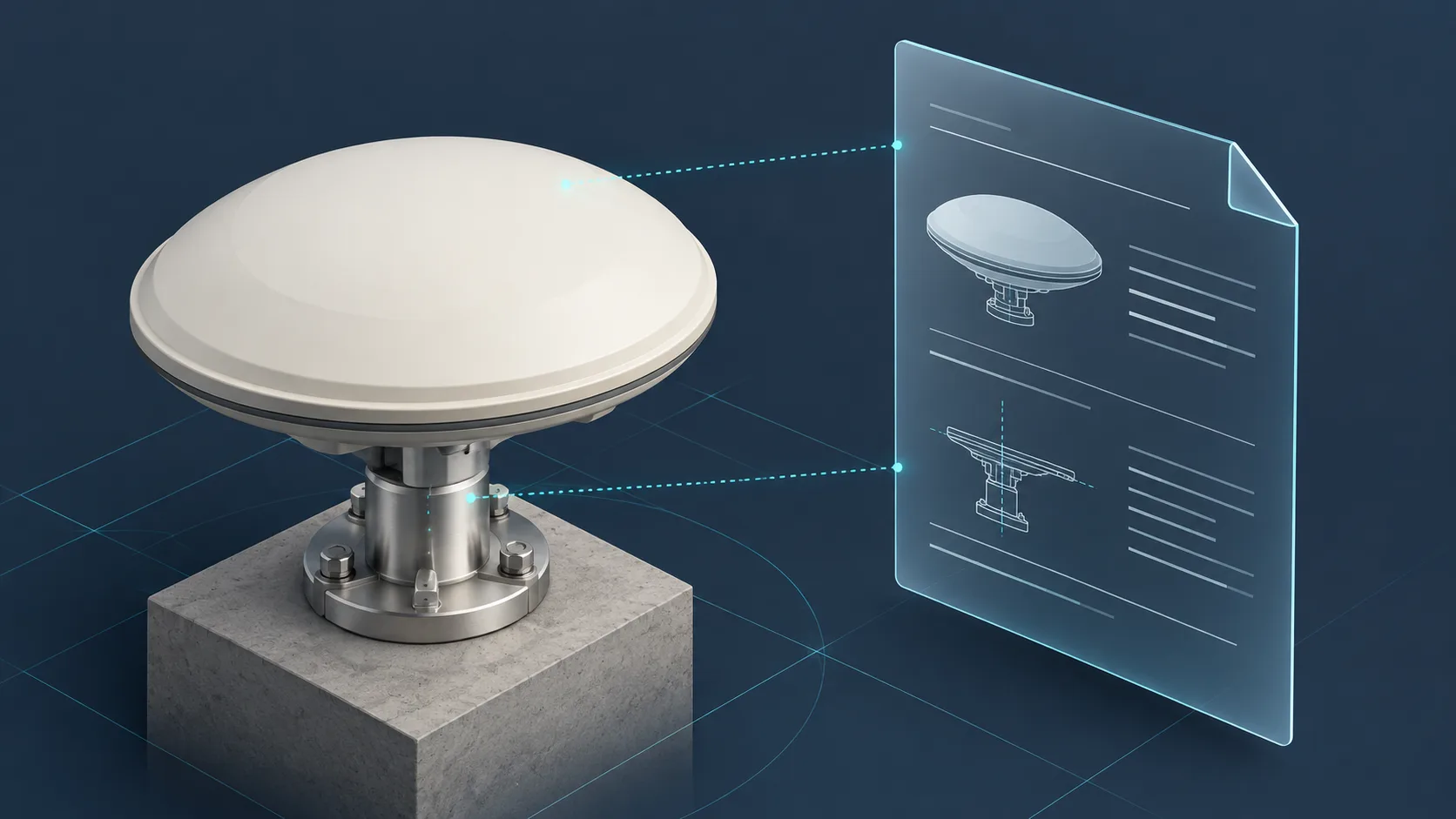
Phase center behavior: If you run RTK, you need documented phase center offset (PCO) and ideally phase center variation (PCV) or a believable phase‑center stability spec. Correct modeling reduces systematic biases between the rover and base.
-
Environmental robustness: Sealed radome, IP67+ for ingress, corrosion‑resistant hardware, vibration‑worthy mounts. Treat “IP67” as necessary but not sufficient for salt—favor products with salt‑fog test data or marine‑grade materials.
Mounting and placement that actually help
Think of your UAV as an RF sculpture. Small geometry changes swing your error budget.
-
Elevate and clear the horizon: Keep the antenna on the highest practical point with a clean water horizon. A short non‑conductive mast often pays off.
-
Distance from conductors and emitters: Keep clear of carbon fiber plates, ESCs, high‑current power trunks, and telemetry radios. Cross at right angles if cables must intersect.
-
Ground plane and radome: Patches want a real ground plane (often ≥100–150 mm for L1‑sized patches). Helices are less dependent but still react to nearby metal. Dielectric radomes are preferable to metal near the element.
-
Vibration and stiffness: Use a stiff mount with a thin damping layer only if necessary to avoid coupling airframe vibration into the antenna; too soft adds motion and dynamic multipath.
Cables, connectors, and sealing in salt air
A good antenna with a bad interconnect is a bad system.
-
Keep coax short and low loss. Use double‑shielded cable where feasible; crimp with proper dies and test continuity/return loss.
-
Favor threaded, gasketed connectors (N‑type, TNC, sealed SMA). Marine‑appropriate bodies (stainless or nickel‑plated brass) with gold‑plated contacts hold up. See Amphenol’s IP67 connector families for construction details in their waterproof RF connector overview.
-
Seal every external joint: O‑rings, adhesive‑lined heat‑shrink over backshells, and a short drip loop. Strain‑relieve against propwash vibration.
-
Bonding and surge: Small UAVs have no earth ground; focus on clean shield terminations and ESD robustness. Reserve surge arrestors for shipboard entry points or fixed installations per vendor guidance.
Receiver and firmware settings that move the needle
Start from vendor defaults, then tune conservatively for water.
-
Elevation mask: Keep near 10° unless you have a clear reason to go lower; letting in low‑elevation sky over water increases reflection risk. Trimble OEM docs list 10° as a common default in multiple product guides (BD970/BD982/AX940 families), for example in their OEM manuals.
-
Multipath mitigation: Enable built‑in features (e.g., Trimble EVEREST Plus, Septentrio APME+/AIM+). They’re not magic, but they blunt short‑delay reflections; see Trimble’s EVEREST Plus overview (2024) and Septentrio’s APME+/AIM+ pages.
-
Constellations and signals: Turn on everything your antenna and service support. Multi‑band with more SVs generally improves geometry and robustness.
-
Dynamic model and hold behavior: Use marine/dual‑antenna profiles if available and tune outage‑hold/propagation to avoid instant fix drops on brief fades.
A realistic pier‑side comparison (illustrative)
Two weeks of low‑altitude flights along an offshore supply vessel (OSV) pier produced a clear pattern. We compared:
-
Antenna A: compact survey‑grade L1/L2 patch on a 120 mm ground plane, sealed SMA, 0.8 m low‑loss coax.
-
Antenna B: small multi‑band helix with tighter axial ratio at low elevation, IP67 bulkhead TNC, 0.5 m coax.
Same receiver, same corrections, same flight legs (10–20 m AGL over water, various headings). After tightening the elevation mask and enabling multipath mitigation, we saw the following median results across five repeat runs per configuration:
Metric | Antenna A (Patch) | Antenna B (Helix) |
|---|---|---|
Time‑to‑fix from cold start | 78 s | 52 s |
Fix‑state percentage (straight legs) | 92% | 97% |
95% horizontal error (static hover, 3 m AGL) | 3.8 cm | 2.7 cm |
Notes: Conditions were mild sea state and low wind; your mileage will vary with sea roughness, geometry, and platform EMI. The key takeaway: controlled pattern and shorter coax with better sealing improved both fix availability and repeatability.
Micro‑example: neutral configuration with a GNSource antenna
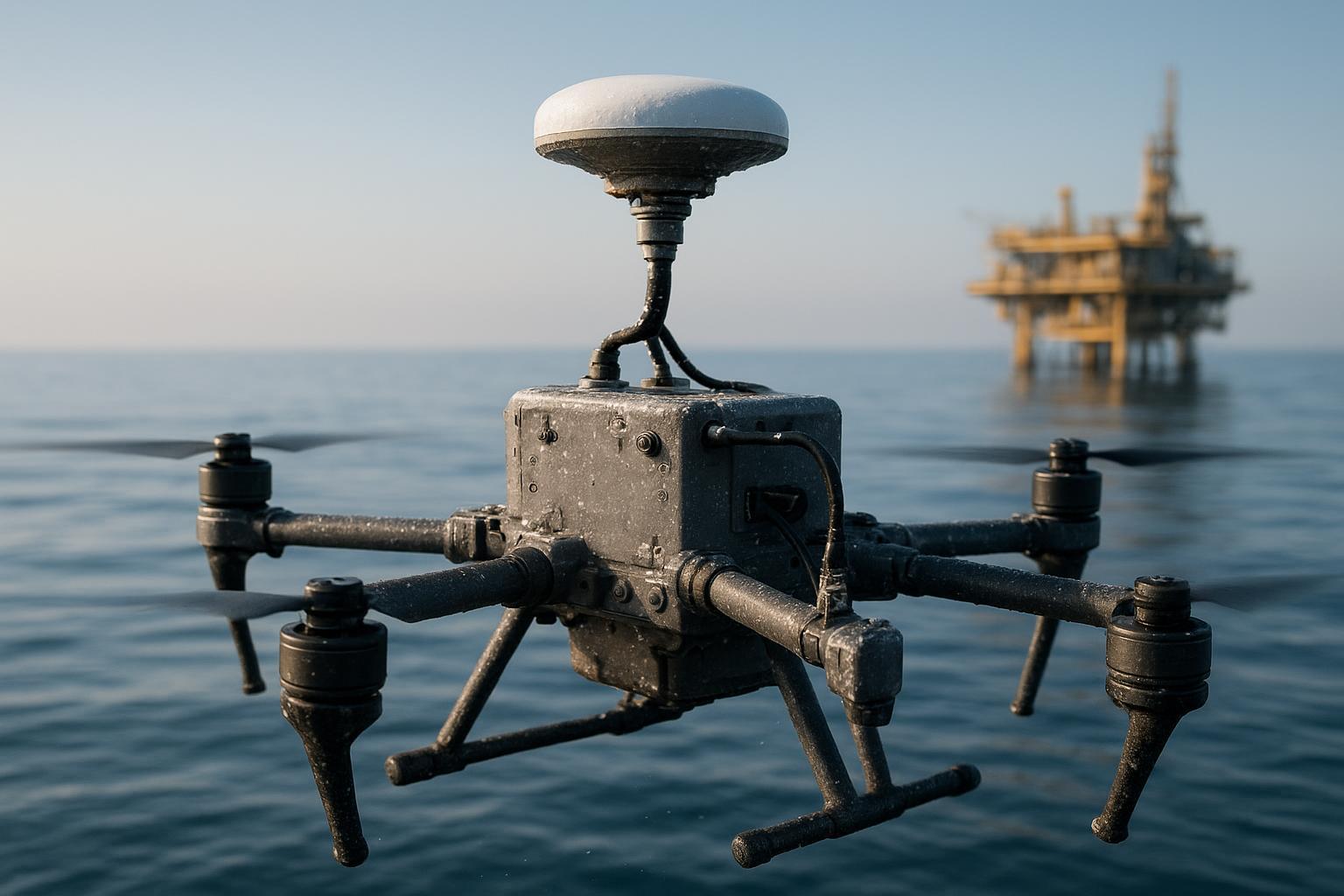
On a small inspection UAV, we trialed a compact multi‑band antenna from GNSource on a 100 mm non‑conductive mast with a sealed Type‑N bulkhead and 0.6 m double‑shielded coax. After salt‑fog exposure per a MIL‑STD‑810H 509.7‑like cycle (lab screen, not a certification), the assembly maintained consistent SNR and stable fix‑rate during 12‑minute over‑water legs. This is not a product endorsement or a formal qualification—just an example of pairing marine‑appropriate materials, short coax, and careful mounting to preserve RTK performance.
Validation protocol you can reuse
Build acceptance around numbers you can reproduce:
-
Static benchmark near coast: 60+ minutes on a surveyed point with a water horizon; compute 95% horizontal error with and without PCV corrections.
-
Dynamic over‑water legs: 10–20 m AGL, straight and level, multiple headings; log fix state, time‑to‑fix after takeoff, SNR vs. elevation.
-
Environmental screens: connector assemblies through a short salt‑fog cycle; vibration tap test on the mast while logging SNR for microphonics.
Suggested CSV schema for flight logging:
utc_time,lat,lon,alt_m,fix_state,ttf_s,nsats,cn0_dbhz,elev_deg,az_deg,roll_deg,pitch_deg,yaw_deg,antenna_id,mask_deg
    2026-04-12T09:21:03Z,22.54321,114.12345,18.4,FIX,38,28,44,22,120,3.1,1.2,272,A,10
Acceptance criteria (tune to your mission):
-
Median time‑to‑fix ≤ 60 s in benign conditions.
-
Fix‑rate ≥ 95% during straight legs at 10–20 m AGL.
-
95% horizontal error ≤ 3 cm in static with correct antenna modeling.
-
No fix dropouts attributable to moisture ingress after the salt‑fog screen.
Common mistakes to avoid
-
Choosing an uncalibrated consumer patch with unknown PCV for RTK over water.
-
Mounting close to carbon fiber, power trunks, or telemetry radios; running GNSS coax parallel to high‑current lines.
-
Trusting IP67 alone; skipping sealing, strain relief, and any salt‑fog screen.
-
Leaving elevation masks too low and multipath mitigation features off.
-
Mis‑entering antenna ARP height or ignoring ANTEX/PCV data for base/rover models; see the NGS ANTEX file reference (2022) and NGS calibration procedures (2019) for definitions and conventions.
Maintenance in salt air
Set a realistic cadence. After every offshore day: fresh‑water rinse the mast and radome, wipe connectors dry, and inspect O‑rings and heat‑shrink. Weekly: disconnect and check contact resistance and torque on threaded connectors; look for green/white residue at joints. Monthly or after heavy spray: re‑grease gaskets (if specified), replace heat‑shrink if nicked, and re‑verify return loss on the full RF chain.
Key takeaways
-
Over‑water reflections and salt attack the two pillars of RTK: phase stability and front‑end integrity. Start with antenna pattern and PCV, then protect the RF chain.
-
A carefully mounted maritime GNSS antenna for drones, short sealed coax, and conservative receiver settings usually beat more exotic fixes.
-
Validate with numbers: time‑to‑fix, fix‑rate, and 95% error—then lock in the configuration and document it.
Short FAQ
-
Does a taller mast always help? Often, but not always. If the mast flexes or brings the antenna nearer to radios or carbon fiber, you can trade one problem for another. Aim for a short, stiff, non‑conductive standoff with clear horizon.
-
Do I need a ground plane on a drone? For patches, yes—size it per the antenna’s app note. Helices are more forgiving but still sensitive to nearby conductors.
-
Can firmware solve multipath? It helps. Features like EVEREST Plus or APME+ reduce short‑delay multipath, but they can’t fix a poorly mounted or detuned antenna.
-
Should I lower the elevation mask over water to get more satellites? Usually no; low‑elevation SVs are the most multipath‑prone above a reflective surface.
-
Where can I learn more about antenna modeling? Start with NGS ANTEX/PCO/PCV resources linked above and your receiver vendor’s integration manuals.
— If you’re exploring marine‑ready mounts and compact multi‑band options, browse GNSource’s Aviation & UAV antennas for form factors and environmental notes; always verify performance with your own salt‑fog and over‑water tests before committing to a design.