A 5G network keeps time to within a rounding error of a millionth of a second — and if it doesn’t, capacity collapses. Time-division duplex (TDD), which carries most of 5G’s mid-band traffic, splits uplink and downlink onto the same frequency by alternating them in time. Neighboring cells therefore have to agree on when those slots begin. Miss the agreement by much more than a microsecond and one cell’s uplink lands in another’s downlink; the interference eats exactly the capacity TDD was meant to buy.
That agreement is anchored, almost everywhere in the world, to GNSS. The satellites carry atomic time, a timing receiver on the ground recovers it, and standards-defined equipment distributes it across the transport network to every radio. This guide walks that chain end to end — what 5G actually requires, how GNSS, PTP, and SyncE deliver it, and why the antenna, sitting at the very top of the chain, is the link most able to quietly wreck it.
Why 5G needs time, not just frequency
Frequency synchronization answers how fast does the clock tick; phase and time synchronization answer what time is it. Older FDD networks mostly needed the first — hold every carrier to about ±50 ppb and the air interface behaves. TDD needs the second. Because uplink and downlink share a channel and take turns, every cell in earshot of another must start its slots at the same instant against a common time reference.
Advanced features tighten the demand further. Massive MIMO, carrier aggregation, and coordinated transmission combine signals that only add up correctly if the transmitters are aligned in time. So a 5G site actually faces two different alignment requirements at once: a network-wide time budget shared with its neighbors, and a much tighter intra-site budget among its own antenna ports.
What “synchronized” actually means
Two numbers get quoted most, and they measure different things.
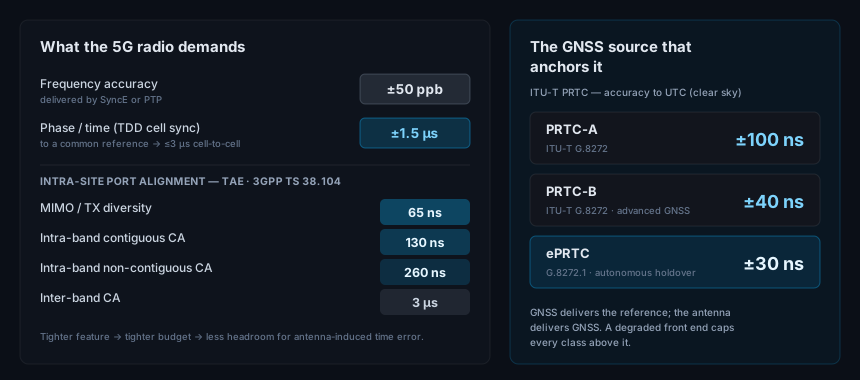
The network requirement is ±1.5 µs of time error at each cell relative to a common reference. Because two neighbors can each sit at opposite edges of that window, the specification is usually stated the other way round — cell phase synchronization better than 3 µs between cells, the figure in 3GPP TS 38.133. ITU-T G.8271.1 frames the same ±1.5 µs as the network limit at the end application.
The intra-site requirement is the Time Alignment Error (TAE) between a single base station’s own transmitted signals, from 3GPP TS 38.104. It is far tighter than the network budget, because it governs whether MIMO and carrier aggregation work at all:
| Requirement | Value | Scope | Standard |
|---|---|---|---|
| Frequency accuracy | ±50 ppb | air interface, all bands | 3GPP / ITU-T — SyncE or PTP |
| Phase / time (TDD cell sync) | ±1.5 µs to a common reference (≤3 µs cell-to-cell) | network-wide | 3GPP TS 38.133; ITU-T G.8271.1 |
| TAE — MIMO / TX diversity | 65 ns | intra-site | 3GPP TS 38.104 |
| TAE — intra-band contiguous CA | 130 ns | intra-site | 3GPP TS 38.104 |
| TAE — intra-band non-contiguous CA | 260 ns | intra-site | 3GPP TS 38.104 |
| TAE — inter-band CA | 3 µs | intra-site | 3GPP TS 38.104 |
The takeaway isn’t the individual figures — it’s how little slack sits at the top of the chain. Every one of these budgets is measured against a reference the antenna is responsible for recovering, so error introduced there is common to the whole site and comes straight out of the ±1.5 µs budget — before PTP, before any downstream engineering that might have recovered it. That source is the antenna.
How the network delivers it: GNSS, PTP, and SyncE
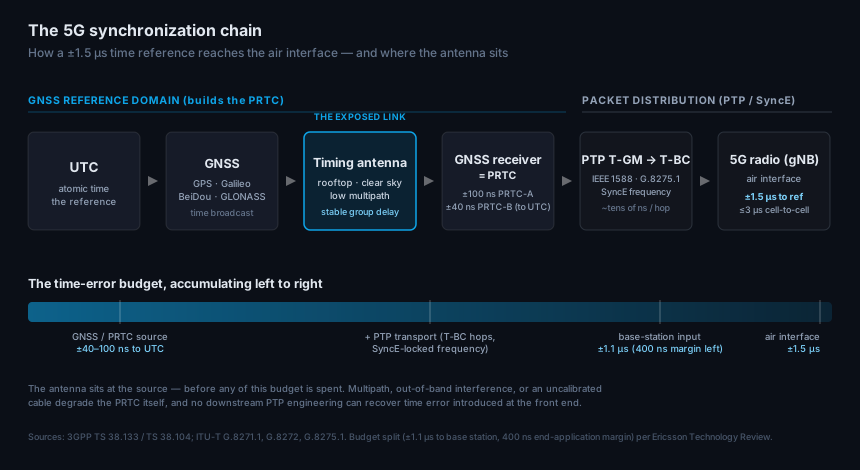
At the top of the chain sits the Primary Reference Time Clock (PRTC) — in practice, a GNSS timing receiver disciplined by the satellites. ITU-T G.8272 defines its accuracy classes to UTC: PRTC-A at ±100 ns and PRTC-B at ±40 ns. The enhanced ePRTC of G.8272.1 tightens that to ±30 ns and adds autonomous holdover from a caesium standard. Whichever class you deploy, the number is measured under clear-sky GNSS conditions — an assumption the antenna is responsible for keeping true.
From the PRTC, two mechanisms carry synchronization across the transport network. PTP (IEEE 1588, in the telecom profile ITU-T G.8275.1) distributes phase and time hop by hop; every switch and router is a boundary clock (T-BC) that re-timestamps in hardware to keep its own contribution small. SyncE carries frequency at the physical layer underneath, giving PTP a stable rhythm to ride on.
The budget is engineered, not hoped for. As Ericsson’s synchronization overview lays it out, the transport network is planned to deliver about ±1.1 µs to the base-station input, leaving roughly 400 ns for the end application to still make ±1.5 µs. With each boundary clock contributing only tens of nanoseconds, a chain can run ten or more hops and stay inside the window — provided the PRTC at the top was clean to begin with.
Centralized PRTC or GNSS at the edge?
There are two ways to get GNSS time to the radios, and the choice drives how many antennas you own.
- Centralized PRTC. A small number of resilient PRTC or ePRTC sites feed PTP across the whole transport network. Fewer GNSS antennas to install and secure — but it demands full on-path timing support end to end, every node a boundary clock running G.8275.1. One gap in that chain and time stops flowing.
- Distributed (edge) GNSS. A GNSS receiver and antenna at each site, or many of them. Each node makes its own reference and depends on no one else’s transport timing — but it multiplies the number of exposed rooftop antennas, and every one is a potential multipath, interference, jamming, or lightning problem.
Most real networks are hybrid: a resilient timing core with GNSS at the edge where it earns its keep. Either way GNSS is the anchor, and wherever there is a GNSS receiver there is an antenna carrying the entire budget on its shoulders.
Where the antenna decides your budget
The antenna sits at the source, before PTP and before any of the transport budget is spent. Time error introduced here is invisible to everything downstream — no boundary clock, no clever profile, no holdover oscillator can remove a bias that entered with the signal. Four antenna-domain contributors do the damage:
- Multipath. A reflected signal travels farther and arrives late; every extra metre of path length is about 3.3 ns of pseudorange error, and code multipath biases the timing solution directly. It is the hardest GNSS error to remove and the most site-specific, which is exactly why siting and multipath rejection matter more for a timing antenna than for a navigation one.
- Out-of-band interference. Rooftops are crowded with cellular, microwave, and Wi-Fi transmitters. Without strong pre-LNA filtering, that energy desenses the front end, drops C/N0, and spreads the time-error histogram until the budget quietly vanishes.
- Group-delay and phase-center stability. Timing depends on a stable, known path through the antenna. Group-delay variation or phase-center wander shifts the receiver’s measurements — a bias no clock discipline can back out.
- Cable delay. The feed adds roughly 4–5 ns per metre and must be calibrated out inside the receiver. A 50 m rooftop-to-rack run is about 250 ns of fixed delay — a common-mode bias on the whole site’s recovered time, roughly a sixth of the entire ±1.5 µs network budget, gone before PTP even starts if it is left uncompensated or keyed in wrong.
None of this is a reason to over-buy; it is a reason to treat the antenna as part of the timing chain rather than an accessory. The hardware side is covered in depth in the ultimate specifier’s guide to GNSS timing antennas, the rooftop installation guide, and the note on 1 kV lightning protection.
Specifying a 5G timing antenna
For a telecom or data-centre timing source, the specification follows straight from the failure modes above. A timing antenna is a different product from a positioning antenna — the timing-vs-positioning comparison explains why — and these are the specs that decide whether it holds the reference:
| Spec | Why it matters for timing |
|---|---|
| Multi-band, multi-constellation (L1/L2/L5; GPS, Galileo, BeiDou, GLONASS) | more satellites and dual-frequency ionosphere correction → a steadier, more available reference |
| Strong multipath rejection (ground plane / choke, tuned element) | reflections map straight to time error — the antenna’s first job |
| Out-of-band rejection with a pre-LNA SAW filter | survives crowded rooftops without desense |
| Documented, stable group delay and low phase-center variation | keeps the timing bias small and modelable |
| Adequate LNA gain for the cable run | long rooftop-to-rack spans need the link budget to close |
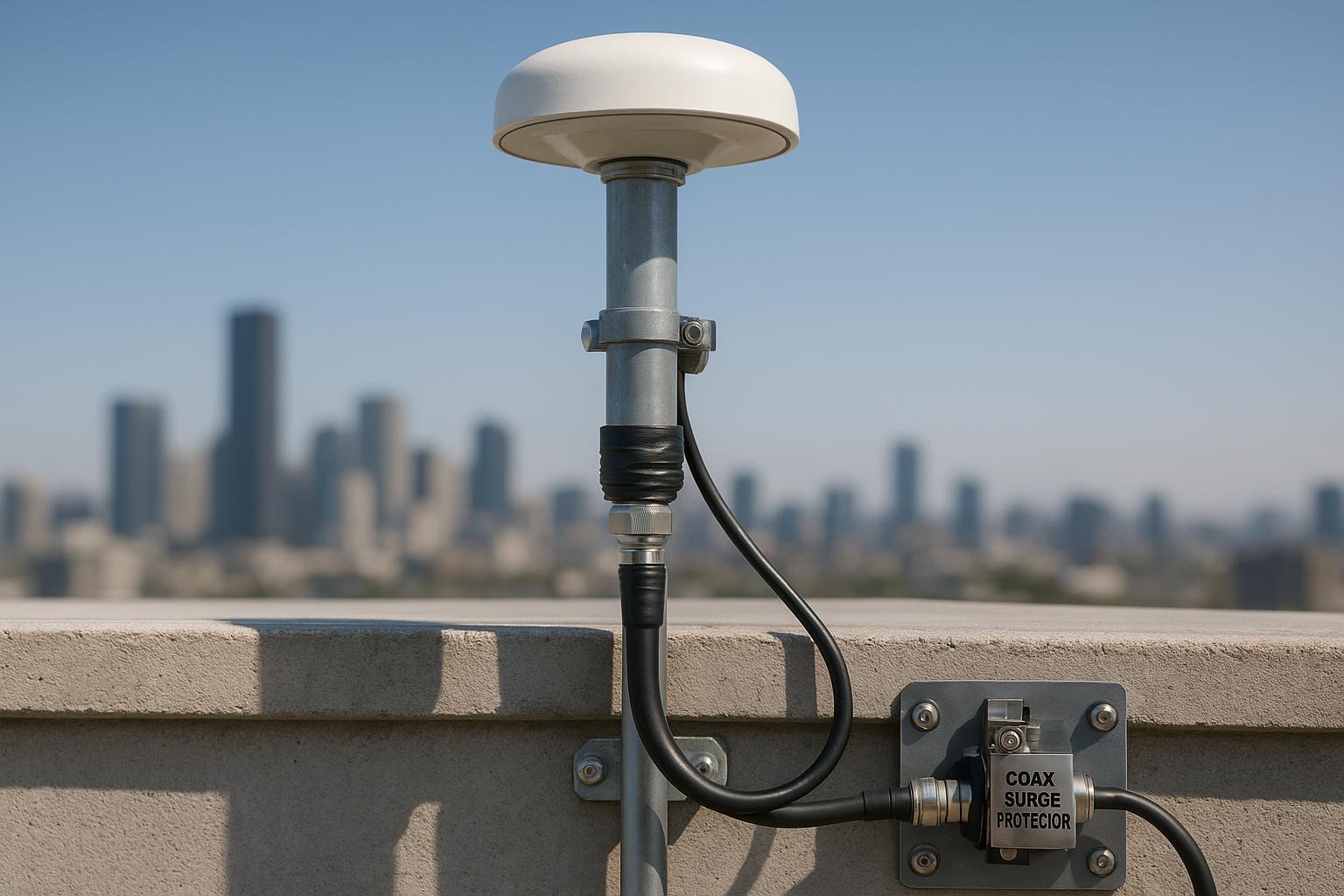
| Integrated lightning / surge protection | rooftop exposure demands it, and it protects the receiver front end |
| IP67, wide temperature range, UV/salt rating | multi-year unattended rooftop life |
During commissioning, if you need to sanity-check GPS week-and-second against UTC, the GPS time converter does the conversion. And when it comes time to match a part to a PRTC and a rooftop, the timing & synchronization antenna line is specified for exactly this duty.
Holdover: when GNSS drops
When the antenna loses the sky — jamming, a construction crane, an ice-loaded radome — the local oscillator holds time on its own. An OCXO typically holds within budget for minutes to about an hour, rubidium for hours, and a caesium-backed ePRTC for well over a day; that autonomous holdover is the whole point of G.8272.1. But holdover is a fallback, not a plan: every hour spent in it is drift you are spending down against the ±1.5 µs window.
The antenna’s real contribution to resilience is keeping GNSS locked in the first place — reliable multi-constellation tracking and interference rejection so holdover events stay rare and short. Squeezing more margin out of a marginal site is its own discipline, covered in how to improve GNSS antenna SNR and holdover.
Frequently asked questions
What time synchronization does 5G require? 5G TDD requires phase/time synchronization of ±1.5 µs to a common reference at each cell — so neighboring cells differ by no more than about 3 µs (3GPP TS 38.133; ITU-T G.8271.1) — plus ±50 ppb frequency accuracy. Advanced features tighten intra-site alignment further: 3GPP TS 38.104 sets the time alignment error (TAE) between a base station’s own antenna ports as low as 65 ns for MIMO.
Why does 5G need GNSS if it already has PTP? PTP distributes time; it doesn’t create it. Every PTP grandmaster must be traceable to a Primary Reference Time Clock (PRTC), and GNSS is the practical, globally available source of that reference. PTP and SyncE carry GNSS-derived time and frequency across the transport network to the radios — they can’t invent it if the source is missing.
What is a PRTC? A Primary Reference Time Clock is the top of the sync chain. ITU-T G.8272 defines PRTC-A (±100 ns to UTC) and PRTC-B (±40 ns); G.8272.1 defines the enhanced ePRTC (±30 ns with autonomous holdover). In practice a PRTC is a GNSS timing receiver disciplined by the satellites, so its real-world accuracy depends on the antenna feeding it.
Does the antenna really affect timing accuracy? Yes — arguably more than any other single element, because it sits at the source. Multipath, out-of-band interference, an unstable group delay, or an uncalibrated cable all inject time error before PTP ever sees the signal, and downstream engineering cannot remove it. A 50 m feed alone is about 250 ns of cable delay that must be calibrated out.
Can I put a GNSS receiver at every cell site, or should I centralize it? Both architectures are used. A centralized PRTC feeding PTP minimizes the number of GNSS antennas but requires full on-path timing support end to end. Edge GNSS at each site is simpler per node but multiplies the exposed rooftop antennas you have to site, protect, and maintain. Most networks run a hybrid of the two.
Written by GNSource Engineering. GNSource manufactures GNSS timing and synchronization antennas for telecom, data-center, and utility infrastructure. Talk to our engineers about matching an antenna to your PRTC and rooftop, or explore the timing & synchronization line.