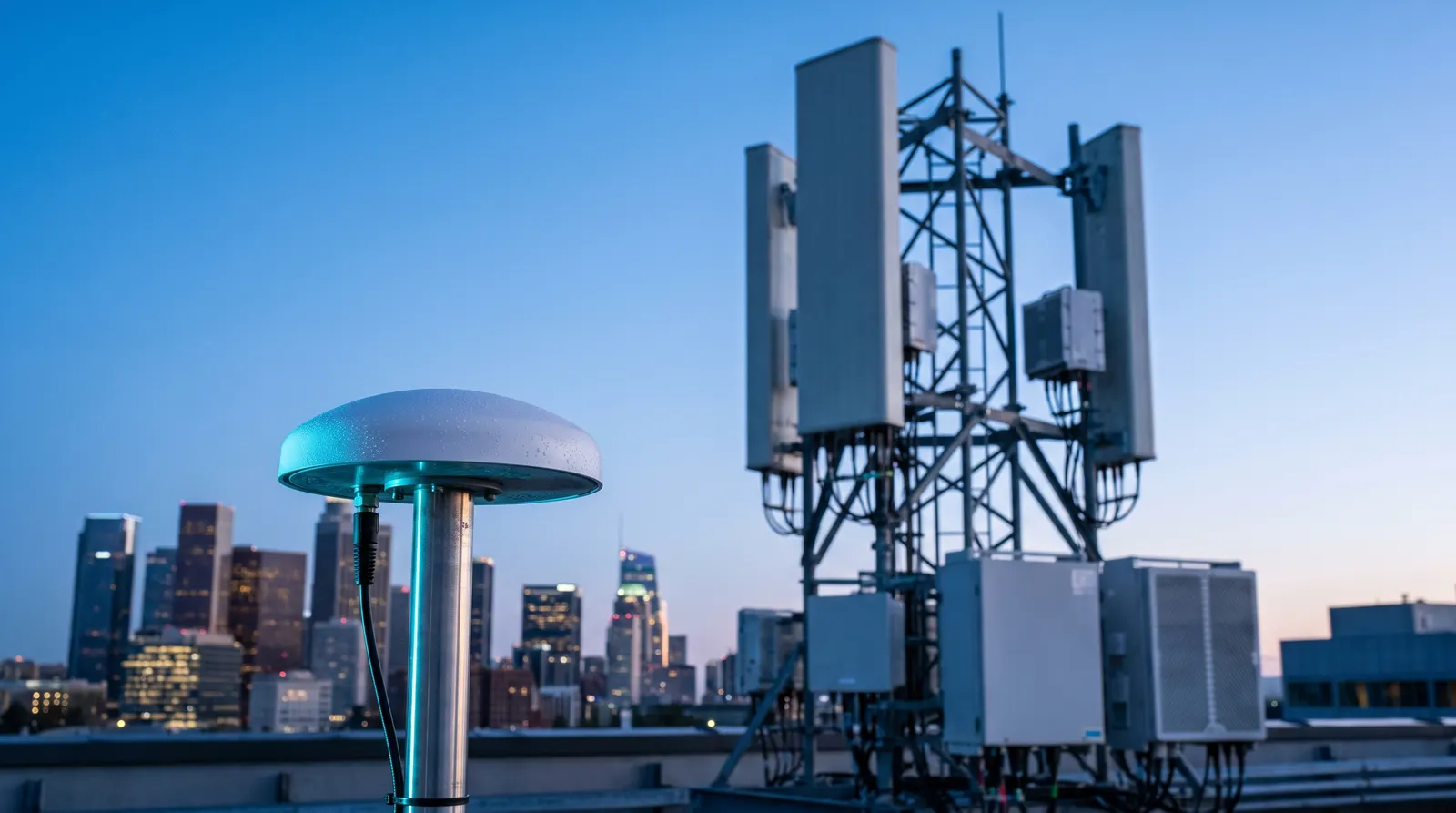
For a trading firm or a data-center operator, time is not just something you measure — it is something you have to prove. When a regulator asks which order arrived first, or an audit reconstructs a transaction sequence months later, the answer rests on timestamps that are demonstrably traceable to a national time standard. Accuracy matters, but provenance matters more: you have to show where your time came from and that it never quietly drifted.
That chain of proof starts, for almost every serious operator, at GNSS. A satellite-disciplined clock recovers UTC, a timing protocol distributes it across the facility, and every server stamps its events against it. This guide covers the two reasons data centers and financial venues need GNSS time — compliance and engineering — what the standards actually require, why real systems run far tighter than the rules demand, and why the rooftop antenna is the exposed root of the whole traceable chain.
Two reasons data centers need GNSS time
The first is compliance. Financial regulation requires that business clocks be synchronized to a reference time and that the synchronization be documented and auditable. In the EU, MiFID II’s RTS 25 sets the accuracy classes; in the US, FINRA’s Consolidated Audit Trail (CAT) sets its own. Both name a traceable time standard, and both expect you to prove conformance, not just assert it.
The second is engineering, and it is usually the tighter constraint. Distributed databases need a consistent order of events to stay coherent. Trading engines compete on latency measured in microseconds and reconstruct fills in nanoseconds. Log correlation across thousands of machines only works if their clocks agree. None of that is imposed by a regulator — it is imposed by the physics of running a large, fast, distributed system.
The compliance floor: MiFID II and FINRA
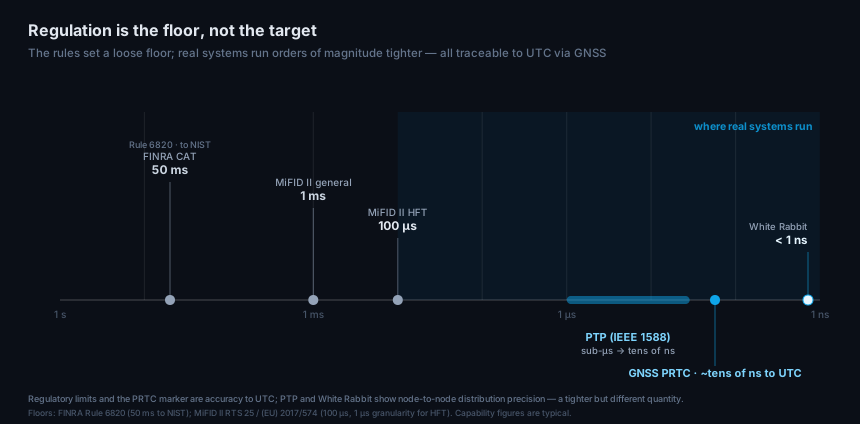
The headline numbers are looser than most people expect. Under MiFID II RTS 25, the maximum divergence from UTC is 100 µs with 1 µs timestamp granularity for high-frequency algorithmic trading, relaxing to 1 ms for other on-venue activity and 1 s for voice and negotiated trades. Under FINRA Rule 6820, business clocks must sit within 50 ms of the NIST atomic clock, with a one-second allowance for manual order events, re-synchronized each business day.
| Regime | Requirement | Reference |
|---|---|---|
| MiFID II RTS 25 — HFT | 100 µs divergence, 1 µs granularity | UTC |
| MiFID II RTS 25 — other on-venue | 1 ms divergence and granularity | UTC |
| MiFID II RTS 25 — voice / negotiated | 1 s | UTC |
| FINRA CAT (Rule 6820) | 50 ms to NIST | UTC(NIST) |
| FINRA CAT — manual order events | 1 s to NIST | UTC(NIST) |
Read the rules closely and the real obligation isn’t the microseconds — it’s the traceability. RTS 25 requires firms to operate to UTC and to keep a documented system design that demonstrates traceability, reviewed for compliance. FINRA frames its tolerance as covering the whole error path: the offset from NIST, transmission delay, and clock drift. The number is the easy part. Proving, on demand, that your time is anchored to a national standard and stayed there is the hard part — and it is the part the antenna underwrites.
Why real systems run far tighter
If the rules only ask for 100 µs, why do exchanges and hyperscalers chase nanoseconds? Because the rule is a floor, not a target. A GNSS-disciplined PTP grandmaster delivers sub-microsecond time across a data-center fabric as a matter of course, and the technologies used to demonstrate compliance already run three to six orders of magnitude below the legal limit.
At the leading edge, White Rabbit — an IEEE 1588 extension developed at CERN and now common in finance and research — combines synchronous Ethernet with PTP to reach sub-nanosecond distribution, with published data-center results showing a bias under a nanosecond and jitter of tens of picoseconds. As Inside GNSS describes, the same GNSS-plus-White-Rabbit approach that guarantees transaction ordering also holds a facility to better than 10 ns versus UTC. Once you can distribute time that tightly, the limiting factor is no longer the network — it is how cleanly the reference was recovered at the source.
How the time actually arrives: GNSS, PTP, and holdover
The architecture is a hierarchy. A GNSS receiver acts as the grandmaster — the Primary Reference Time Clock (PRTC) — disciplining a high-stability oscillator to satellite time and tagging it as traceable to UTC. From there, PTP (IEEE 1588) — the same protocol that synchronizes 5G networks — carries time hop by hop across the fabric to PTP-capable network cards in the servers; White Rabbit is the sub-nanosecond variant of the same idea.
Two properties make the grandmaster trustworthy, and both depend on GNSS. One is traceability — an unbroken, documented path from the servers back through PTP to the GNSS reference and on to UTC. The other is holdover: when the satellites are lost, a rubidium or oven-controlled oscillator inside the grandmaster keeps time with sub-microsecond stability for hours, buying time to restore GNSS before the facility drifts out of its window. Holdover protects you during an outage; it does not replace the reference, and every hour spent in it is confidence you are spending down against the next audit.
The data-center reality: long runs and the roof
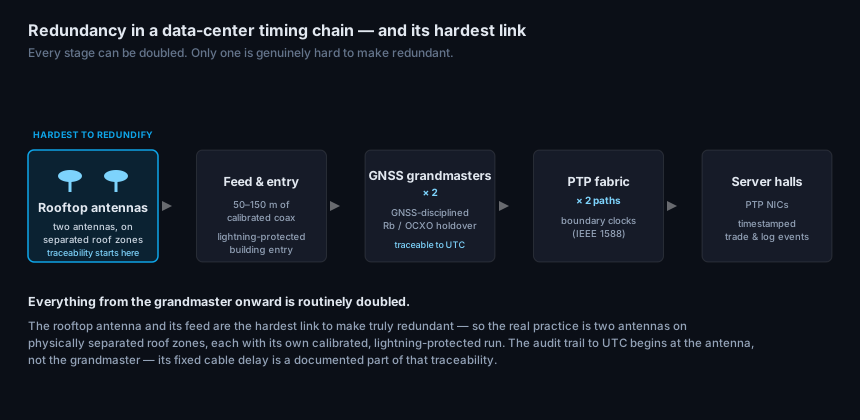
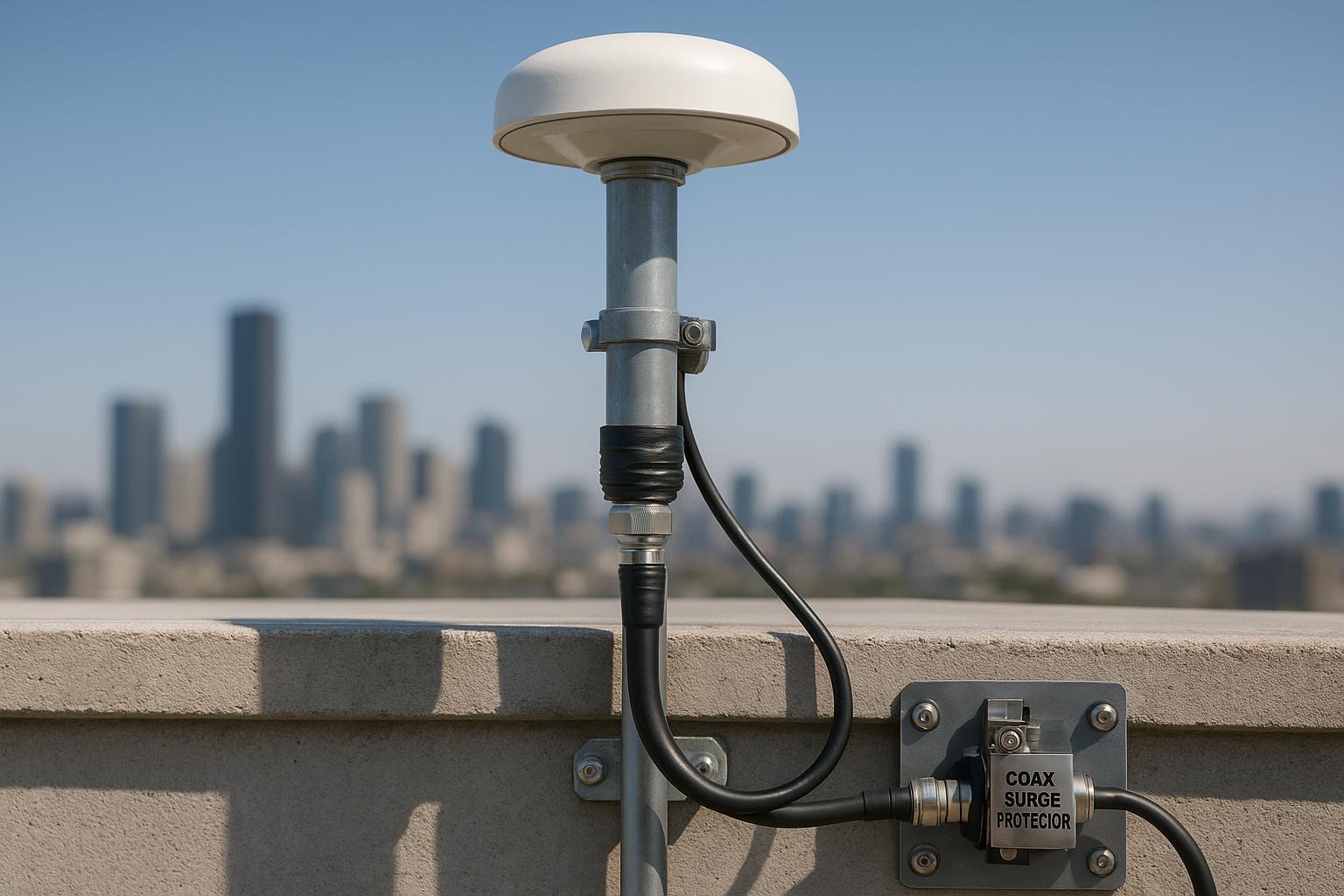
On paper the chain is tidy. In a building the size of a data center, it is a civil-engineering problem. The antenna has to see clear sky, so it goes on the roof; the grandmaster lives in a secure meet-me or timing room, often many floors and a long horizontal run away. Fifty to a hundred and fifty metres of coax between them is normal, and every metre of it is fixed delay that must be measured and calibrated out — because that cable delay is itself part of the documented traceability path, not an afterthought. Rooftops in dense campuses add multipath from neighbouring structures, out-of-band energy from co-sited radios, and the full exposure of a lightning strike.
Redundancy is where the antenna’s special status shows. Operators routinely run two grandmasters, dual PTP paths, and PTP cards in every server — that part is standard practice. The one link that resists easy duplication is the rooftop antenna and its feed. Doing it properly means two antennas on physically separated roof zones, each with its own calibrated, surge-protected run into an independent receiver, so that no single mount, cable fault, or local interference source can take the reference down. Downstream you buy resilience with a second box; at the roof you buy it with real estate and careful siting.
Where the antenna carries the compliance
Everything the regulators ask you to prove begins at a component most timing diagrams draw as a small triangle. Traceability to UTC is only as sound as the signal the antenna hands the receiver: a reflected path adds pseudorange error, out-of-band interference erodes the carrier-to-noise ratio the receiver needs to hold lock, and an unstable group delay biases the very measurement your audit trail depends on. When the front end degrades, the grandmaster falls back to holdover — and holdover is a clock quietly drifting away from the reference you are contractually bound to.
That makes the specification for a data-center timing antenna a compliance decision as much as an RF one — the kind of trade-off the broader GNSS timing antenna specifier’s guide works through in full. The traits that matter map straight onto the failure modes above — the same set that a timing-grade antenna is built for and a positioning antenna is not:
| Spec | Why it matters here |
|---|---|
| Multi-band, multi-constellation | more satellites and a steadier, more available UTC reference |
| Strong multipath rejection | reflections become timing error — worst on cluttered rooftops |
| Out-of-band rejection, pre-LNA filtering | survives co-sited radios without desense |
| Documented, stable group delay | keeps the traceable measurement honest |
| High LNA gain for long feeds | closes the link budget over a 50–150 m run |
| Integrated surge protection, IP67, wide temperature | rooftop exposure and years of unattended service |
During commissioning, when you are reconciling GPS week-and-second against UTC for your records, the GPS time converter handles the arithmetic. And when it is time to match hardware to a grandmaster and a roof, the timing & synchronization antenna line is built for exactly this duty — long runs, hostile rooftops, and a signal clean enough to underwrite an audit.
Frequently asked questions
What clock accuracy do financial regulations require? Under MiFID II RTS 25, high-frequency algorithmic trading must stay within 100 µs of UTC with 1 µs timestamp granularity; other on-venue activity is 1 ms, and voice or negotiated trades 1 s. FINRA’s CAT rules require business clocks within 50 ms of the NIST atomic clock, with a one-second allowance for manual order events. Both demand documented traceability to the reference, not just accuracy.
If the rule is only 100 µs, why run in nanoseconds? Because the rule is a floor. Distributed databases, trade-order reconstruction, and latency-sensitive systems need far tighter agreement than any regulator mandates. A GNSS-disciplined PTP grandmaster delivers sub-microsecond time routinely, and White Rabbit reaches sub-nanosecond — so real systems run three to six orders of magnitude below the legal limit.
Does the antenna affect regulatory compliance? Yes. Traceability to UTC is an unbroken chain that begins at the antenna. Multipath, out-of-band interference, an unstable group delay, or an uncalibrated cable all inject error before the grandmaster ever sees the signal — and when the front end fails, the clock drops into holdover and starts drifting from the reference you must demonstrate you are tracking.
Why are the cable runs such a big deal in a data center? Because the buildings are huge. The antenna must be on the roof and the grandmaster in a secure timing room, often 50–150 m of coax apart. That run is fixed delay that has to be calibrated out and documented as part of the traceability path, and its length drives the LNA gain and low-loss cable you need to close the link budget.
How do you make GNSS timing redundant in a data center? Downstream is easy: dual grandmasters, dual PTP paths, and PTP cards in every server are standard. The hard part is the antenna. Best practice is two antennas on physically separated roof zones, each feeding an independent receiver through its own calibrated, surge-protected run, so no single mount or interference source can take down the reference.
Written by GNSource Engineering. GNSource manufactures GNSS timing and synchronization antennas for data-center, financial, and telecom infrastructure. Talk to our engineers about redundant rooftop timing for a compliant facility, or explore the timing & synchronization line.