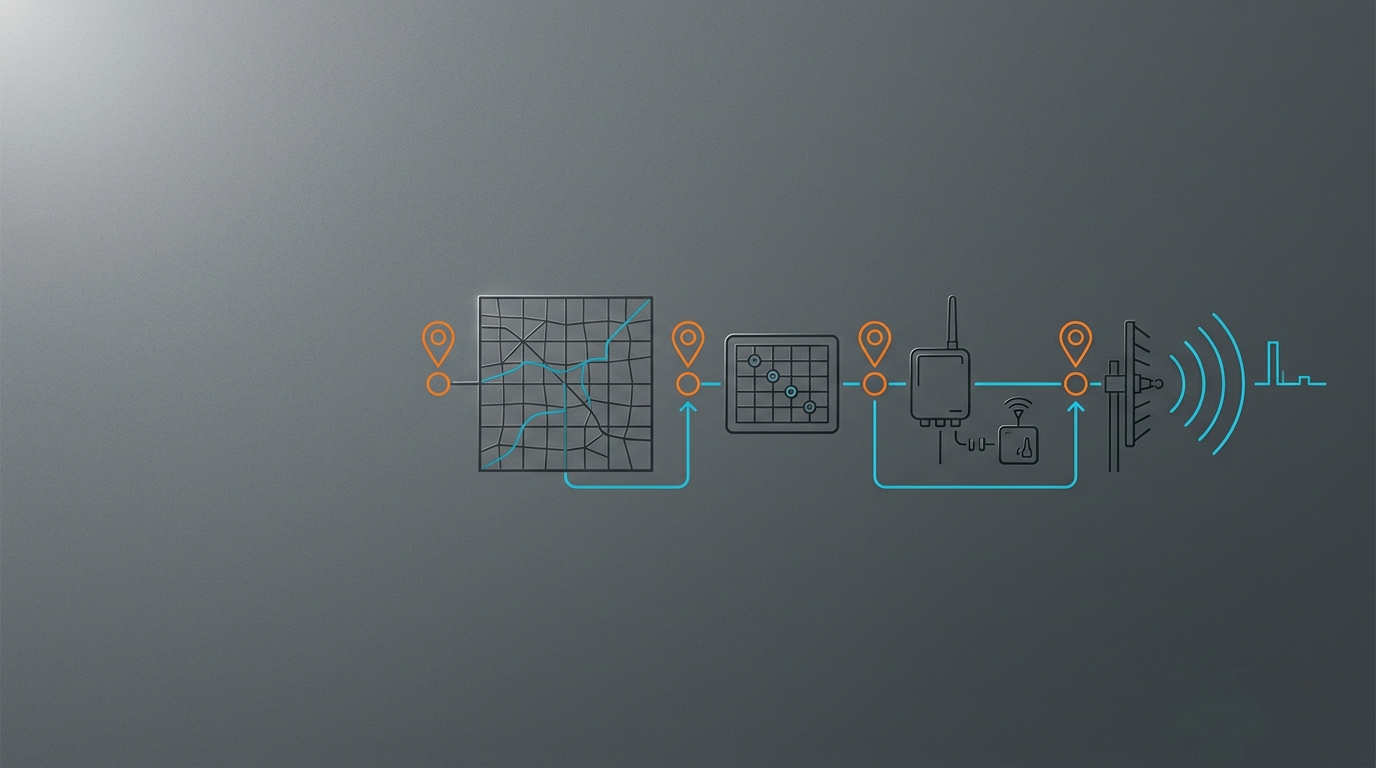
Choose a 5G antenna for an IoT or M2M device by the bands your modem actually uses, then by the mounting surface, then by gain — in that order. An external 5G antenna that covers 700 MHz through 5 GHz and is mounted in the clear will beat a higher-gain antenna that only covers 3.5 GHz or sits on a metal shelf. This guide gives you the band table, the two specs that matter more than dBi, and a decision framework for magnetic mount vs whip vs fiberglass omni, with a link-budget worked example at the end.
The 5G bands an IoT antenna actually has to cover
5G NR splits into FR1 (sub-6 GHz) and FR2 (mmWave). For IoT, M2M terminals and fixed wireless access (FWA) gateways, FR1 is the whole story. Which FR1 bands you need depends on the network your device connects to — and that is the first question to answer before you look at any antenna datasheet.
| Band | Duplex | Downlink (MHz) | Where it matters | What it means for the antenna |
|---|---|---|---|---|
| n28 | FDD | 758–803 | 700 MHz coverage band, EU / APAC / LatAm | Longest wavelength; forces wideband or multiband designs |
| n1 | FDD | 2110–2170 | Global 2100 MHz mid-band | Core 5G anchor; easy for any wideband antenna |
| n3 | FDD | 1805–1880 | Global 1800 MHz mid-band | LTE anchor reused for 5G |
| n77 | TDD | 3300–4200 | Global 3.x GHz mid-band | Wide TDD channel; antenna should cover 3.3–4.2 GHz |
| n78 | TDD | 3300–3800 | Europe / Asia workhorse (3.5 GHz) | The most common 5G band outside mmWave |
| n79 | TDD | 4400–5000 | Japan, China, some APAC | Stresses antenna bandwidth at the top end |
Band frequencies follow the 3GPP 5G NR definitions; the reference table is on Wikipedia’s 5G NR frequency bands page, with a compact summary on Everything RF.
The practical takeaway: an IoT antenna for global 5G needs to span roughly 700 MHz to 5 GHz — a 7:1 bandwidth ratio. That rules out narrowband specialists and points at wideband designs. A magnetic-mount antenna like the GNSource LGW-5G-JBXP01 (824–5800 MHz, 2 dBi) is sized exactly for this: one antenna, every FR1 band a 5G modem is likely to use.
mmWave (n257/n258/n260/n261) is a different antenna class entirely — arrays with beamforming, not a single omni element — and it is not where battery- powered IoT lives. If a supplier pushes mmWave for a sensor or gateway antenna, the conversation has gone off track.
Why the dBi number is the least reliable spec on a 5G antenna
Datasheets lead with gain because it is the easiest number to sell. For an external 5G antenna, three things matter more:
- Matching (VSWR). A “3 dBi” antenna that reflects 18% of the power (VSWR 2.5) delivers less real signal than a “1.5 dBi” antenna with VSWR 1.5 (4% reflected). Band-edge VSWR is where cheap antennas quietly fail — check the spec at the edges of the bands you need, not just mid-band.
- Efficiency, not just pattern concentration. Gain is directivity times efficiency. A tiny loaded antenna can show reasonable dBi on paper while losing the signal to resistive losses; the number is only meaningful when the radiating element is properly sized for its lowest band.
- Ground plane and placement. A magnetic-mount antenna’s pattern depends on the metal surface under it. On a vehicle roof it radiates as designed; clamped to a plastic bracket with no ground plane underneath, the same antenna loses several dB and the published gain becomes fiction.
Gain itself is not free either. The 5–6 dBi of a collinear or panel antenna comes from concentrating the pattern — which narrows the vertical beam and punishes tilt or movement. For a moving vehicle or a gateway whose alignment you cannot babysit, a broad-pattern 2 dBi omni is usually the better engineering choice.
Cable loss eats the budget before the signal leaves the roof
The antenna gain you paid for is measured at the antenna terminals. Between the antenna and the modem sits a cable, and at 5G frequencies coax is lossy. Typical per-metre losses for common cables:
| Cable | ~700 MHz | ~3.5 GHz |
|---|---|---|
| RG174 | ≈0.6 dB/m | ≈1.3 dB/m |
| RG58A/U | ≈0.35 dB/m | ≈0.7 dB/m |
| LMR-400 | ≈0.1 dB/m | ≈0.22 dB/m |
Figures are typical — verify against the cable manufacturer’s datasheet.
Three metres of RG58A/U at 3.5 GHz costs you about 2 dB. Ten metres costs about 7 dB — more than the gain of most antennas in this class. If the modem must sit far from the antenna, specify a lower-loss cable and accept the cost, or place a powered LNA stage at the antenna where one is offered. The same math applies to the 4G LTE antennas covered in our external 4G antenna guide.
Magnetic mount, whip or fiberglass: decide by mounting surface
Form factor is a mounting decision, not a fashion choice. The table below starts from the surface the antenna will live on.
| Situation | Form factor | Why | Typical spec |
|---|---|---|---|
| Vehicle, machine roof or temporary rig | Magnetic mount | Tool-free, removable, roof acts as ground plane | 2 dBi, 824–5800 MHz, 3 m RG58A/U, SMA |
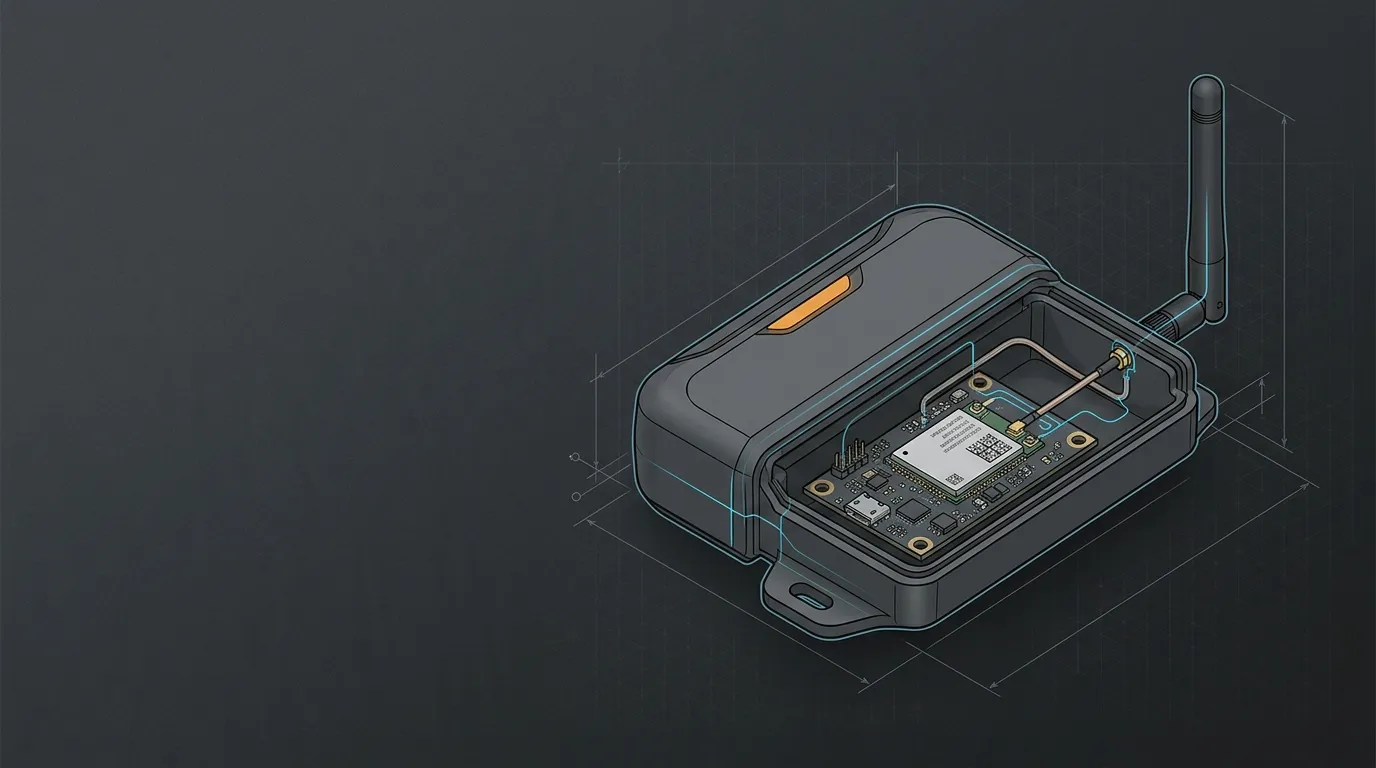
| Device in a cabinet, CPE on a desk | Whip / paddle | Low profile, direct mount, easy connector | 700–5850 MHz, SMA, ~20 cm |
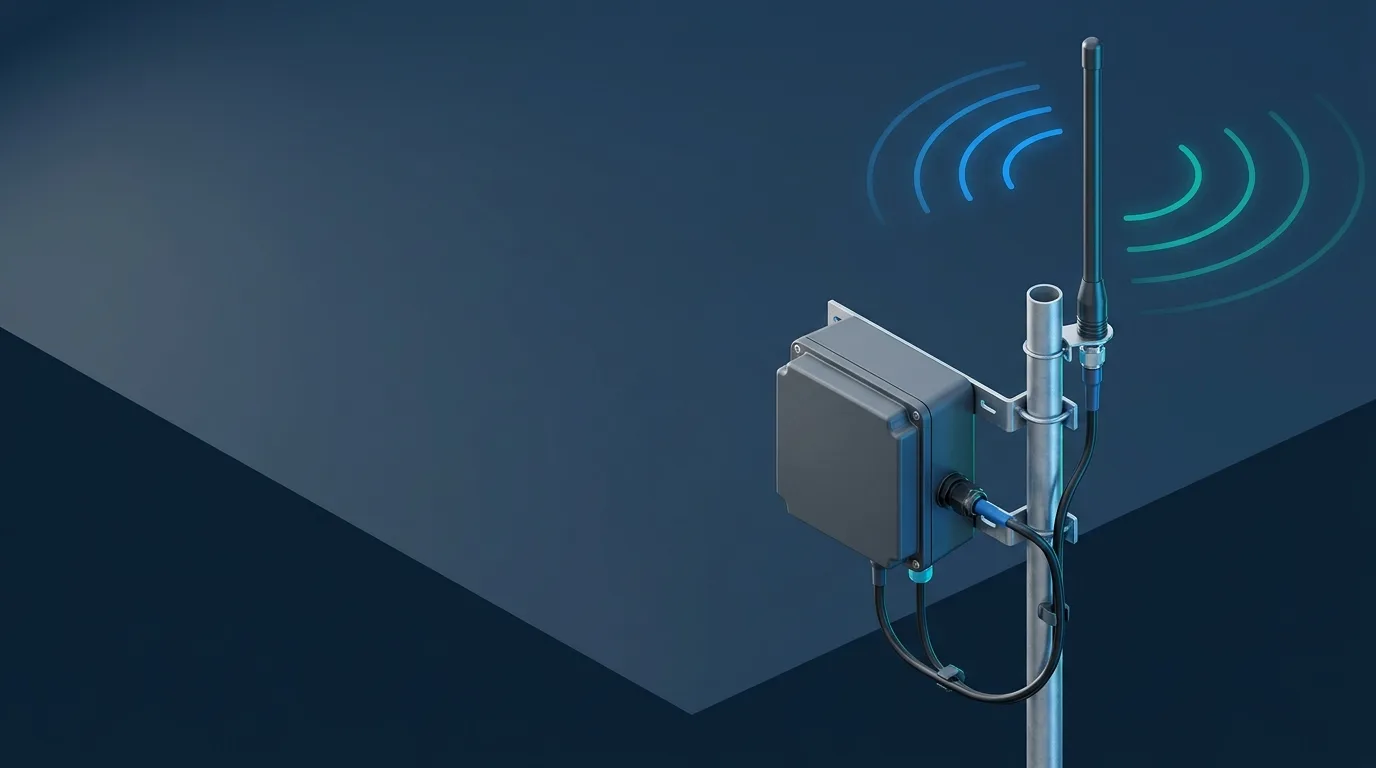
| Fixed outdoor gateway on mast or wall | Fiberglass omni | Weatherproof, DC-grounded, N connector | 360° H / ~30° V pattern, IP-rated |
| Fixed CPE at long range, known tower direction | Directional panel | Highest gain, but needs alignment | 8–12 dBi, narrow beam |
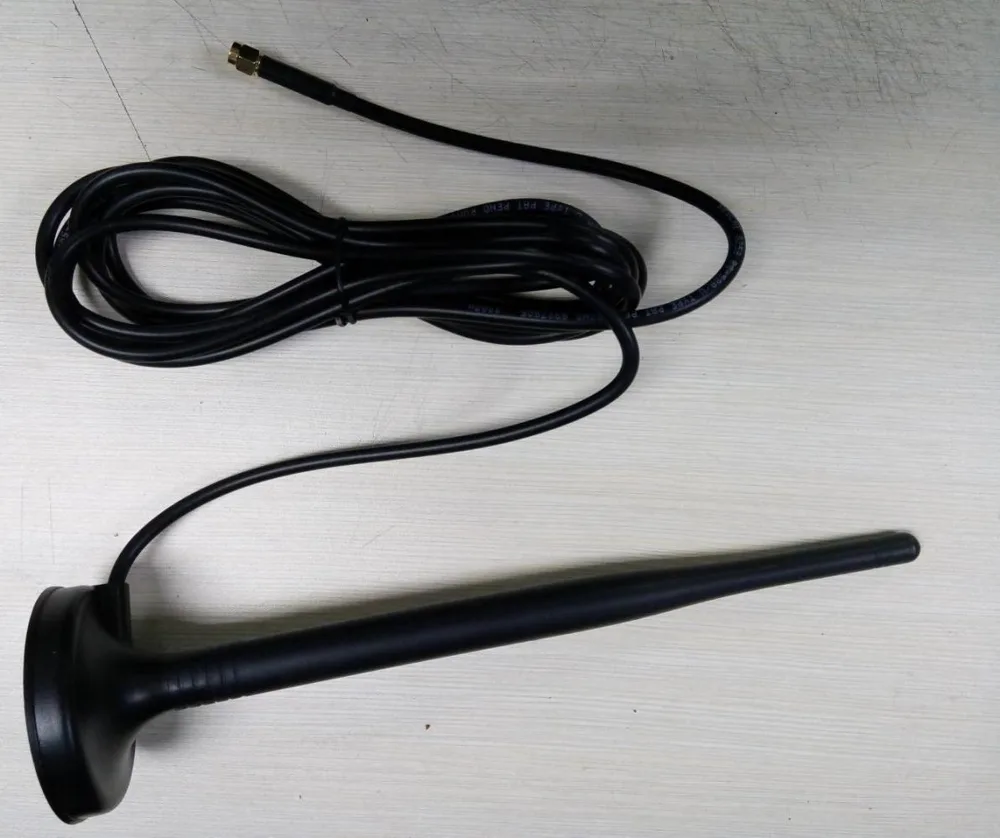
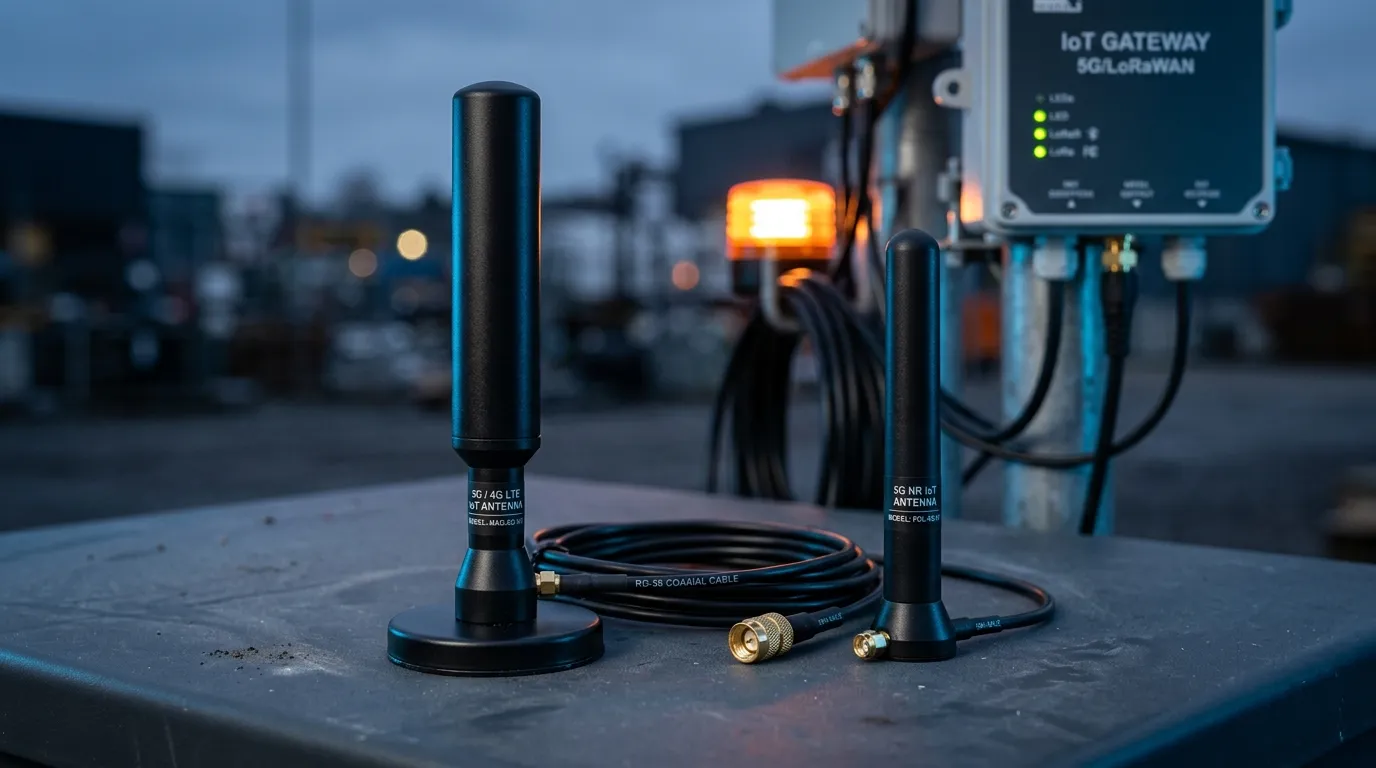
Magnetic-mount 5G antenna — the vehicle, machine and temporary-deployment option.
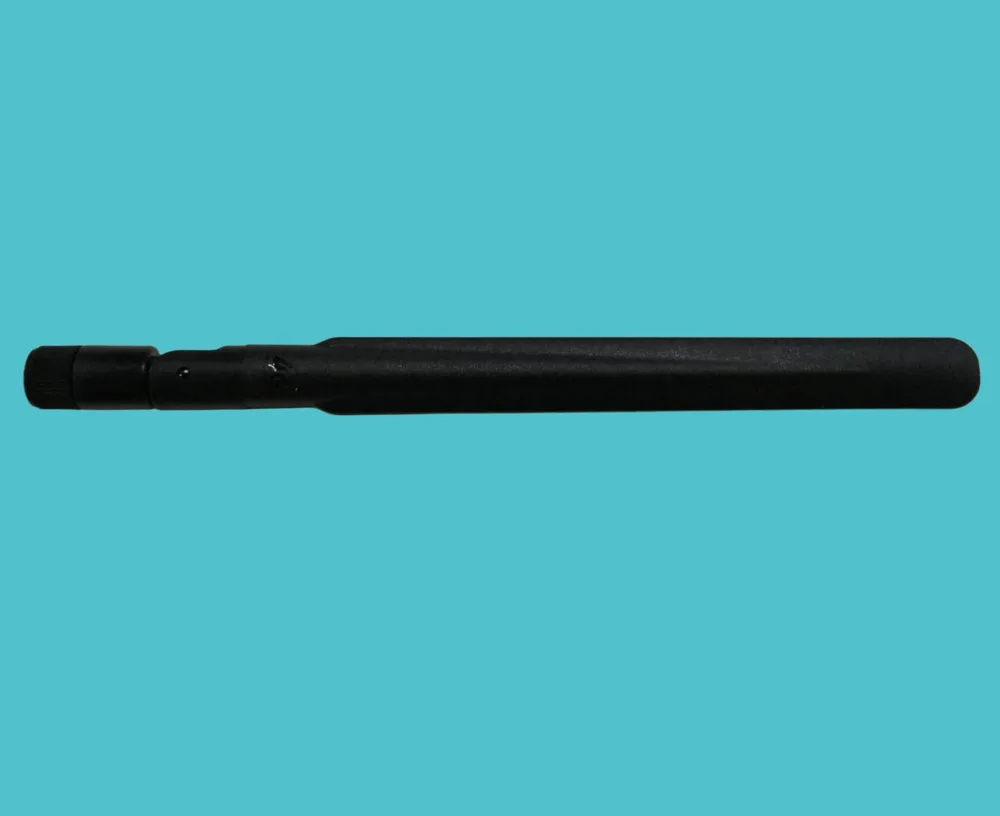
Paddle whip 5G antenna — the low-profile option for terminals and CPE.
Two GNSource examples map directly onto the table: the LGW-5G-JBXP01 magnetic mount covers 824–5800 MHz in a TPEE housing rated for outdoor exposure, and the LGW-5G-CJ-05 paddle whip (700–5850 MHz) covers terminals. Both are part of the IoT & M2M antenna series, which walks the full radio-first selection framework — LoRa through Wi-Fi — if you are deciding between connectivity standards, not just antennas.
A link-budget sanity check before you buy
Before spending on gain, run the link math. Free-space path loss at 3.5 GHz over 100 m is about 83 dB. A worked example for a typical IoT gateway:
- Modem output: +23 dBm
- Antenna gain: 2 dBi (magnetic mount)
- Cable: 3 m RG58A/U at 3.5 GHz ≈ 2 dB loss
- Received power: 23 − 2 + 2 − 83 = −60 dBm
That is a healthy link — a 5G modem with a −95 dBm sensitivity floor has 35 dB of margin. Now swap in 10 m of RG174 (≈13 dB at 3.5 GHz) and the same antenna indoors with one wall between it and the window (10–20 dB penetration loss), and the same radio lands at −83 to −93 dBm: marginal to broken. The antenna did not change; the installation did. Run your own numbers in our RF link-budget calculator before you commit to a cable run.
MIMO: the antenna count is a system decision
If your modem is 2×2 or 4×4 MIMO, the antenna is not one element — it is two or four, and they need separation. Space the elements at least half a wavelength at the lowest band you use (about 21 cm at 700 MHz) so the two signal paths stay decorrelated. The practical consequences: dual-antenna kits double the cable loss and connector count, and a single high-gain “5G antenna” that ignores MIMO leaves half your modem’s throughput potential on the table. Match the antenna count to the modem’s MIMO configuration — no more, no less.
What to send your antenna supplier
A supplier can spec an antenna in one pass if you send five lines:
- The bands (or the modem module and network operator) — n1/n3/n28 and/or n77/n78/n79.
- Cable length needed and connector on the modem side (SMA, N, IPEX…).
- Mounting surface and clearance — roof, mast, cabinet, plastic or metal.
- MIMO count: 1, 2×2 or 4×4.
- Environment: indoor, outdoor, IP rating, vibration, temperature.
That is the condensed version of the 8-point RFQ checklist in the IoT & M2M buyer’s guide; send it to GNSource Engineering via the contact page and you get a band-matched recommendation rather than a catalogue.
Frequently asked questions
Do external 5G antennas actually improve signal? Yes, when the internal antenna is the weak link — which is most of the time inside a metal or RF-hostile enclosure. Moving from an internal PCB antenna to a correctly mounted external antenna typically buys 10–20 dB of effective link improvement, because you fix detuning, gain and placement in one move.
What is the best antenna for 5G reception? For IoT and M2M devices, a wideband omni covering the bands your modem uses — magnetic mount for vehicles and temporary sites, fiberglass omni for fixed outdoor gateways, paddle whip for terminals. For a fixed CPE at the edge of coverage with a known tower direction, a directional panel antenna.
Is a 5G antenna different from a 4G antenna? Only in bandwidth. 5G NR reuses the 700/1800/2100 MHz LTE bands and adds the 3.3–5 GHz range. An antenna that covers 700–5800 MHz handles both 4G and 5G; a 4G-only antenna will not.
Does 5G need two or four antennas? It depends on the modem’s MIMO configuration, not on 5G itself. Match the external antenna count to the modem’s 2×2 or 4×4 ports and keep the elements separated by at least half a wavelength at the lowest band.
How do I choose an antenna for a 5G router or gateway? Answer four questions first: which bands, how long a cable, where it mounts, and how many MIMO ports. Then pick the form factor that fits the mounting surface — the table above covers the common cases.
This guide is part of the IoT & M2M antenna series introduced in the buyer’s guide above. For a 5G antenna on your gateway, vehicle or machine, see the magnetic-mount and whip antenna ranges — or talk to GNSource Engineering with your bands, cable length and mounting surface.