On our inspection fleet last spring, two identical mapping drones flew the same lawn‑mower pattern fifteen minutes apart. The first pass lined up, the second showed a lateral offset that walked from ~2 cm to ~6 cm across the flight. Nothing changed in corrections or wind. What changed was the antenna: one airframe had the GNSS antenna on a short boom; the other was flush‑mounted on the carbon top plate. That small mechanical choice amplified multipath and phase‑center quirks into visible RTK guidance drift.
I’ve spent the last few years designing and measuring GNSS antennas and then living with them on aircraft. In this post I’ll show, in practical terms, how gain patterns and mounting geometry translate into pass‑to‑pass accuracy—plus exactly what we changed to make the drift disappear. If you’re still choosing the antenna itself, our high-precision GNSS antenna buyer’s guide covers that groundwork.
What’s really drifting in RTK guidance?
RTK position holds only when the carrier‑phase integers remain stable. If your antenna admits too much low‑elevation energy or has an asymmetric back‑lobe, reflections and phase‑center variation (PCV) perturb the measurements. Integer validation hesitates or flips, and the solution “walks” even though the vehicle flies the same track.
A few concepts in plain language:
-
Realized gain vs. free‑space gain: the pattern you get on‑airframe, not in a chamber. Nearby carbon or metal reshapes the lobes, often boosting the rear hemisphere and horizon sensitivity.
-
Front‑to‑back ratio: how much weaker the back‑hemisphere response is than the forward hemisphere. Poor front‑to‑back means rear reflections reach the front end, increasing carrier‑phase residuals.
-
Low‑elevation sensitivity: signals near the horizon carry more multipath; suppressing them often improves stability even if total C/N0 drops slightly.
-
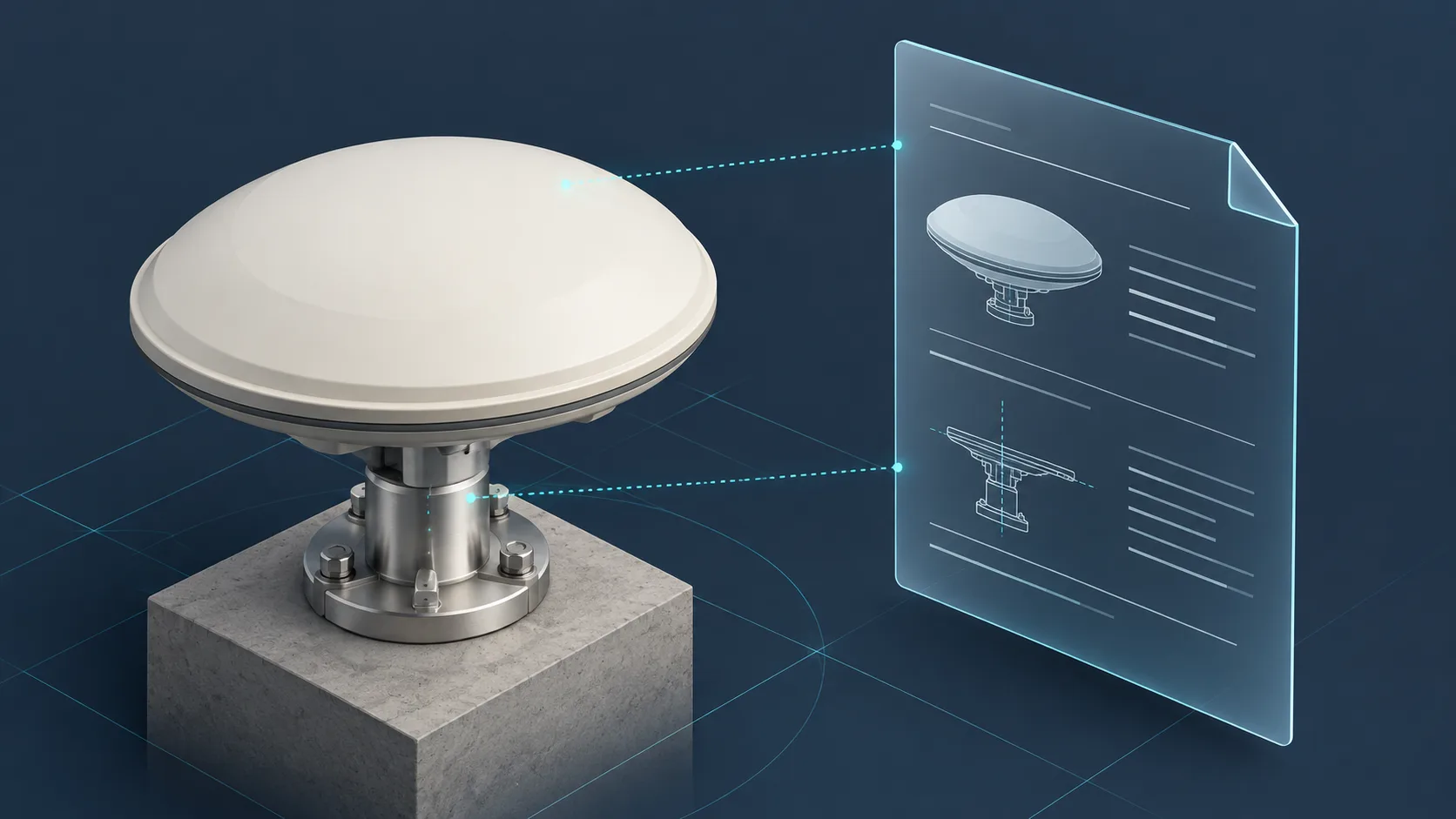
Phase center offset/variation (PCO/PCV): the effective electrical “point” of the antenna moves a few millimeters with direction; when unmodeled or distorted by the airframe, those millimeters can project into centimeter‑class horizontal bias.
For a concise background on how precision antennas shape horizon sensitivity, polarization purity, and PCV calibration in practice, see u‑blox’s application guidance for GNSS antennas: integration guidance and horizon suppression.pdf).
How mounting turns pattern and PCV into heading‑dependent error
Mount the antenna flush on a conductive or carbon surface and you invite two problems. First, the airframe becomes part of the radiator—distorting the pattern, often strengthening back‑lobes. Second, the near field couples into props, motors, landing gear, batteries, and surrounding radios, adding moving reflectors into the mix. As the aircraft headings change on alternating passes, the distorted lobes sample different geometry, and the effective phase center shifts in a repeatable way. That’s your pass‑to‑pass “drift.”
Unmodeled PCV on the order of 5–10 mm routinely shows up in calibration literature; depending on satellite geometry, that error easily maps to about a centimeter of lateral bias, particularly when low‑elevation measurements are included. ESA’s Navipedia explains the phase‑center fundamentals and why mm‑level mismodeling leads to cm‑level position changes in kinematic solutions: phase center fundamentals and position impact.
A/B field test: boom vs flush on a mapping UAV (reducing RTK guidance drift)
To make this concrete, here’s the reproducible comparison I use with new airframes.
Setup
-
Same receiver firmware and corrections, dual‑frequency multi‑constellation.
-
Antenna A: mounted on a 0.5 m non‑conductive boom above the fuselage center.
-
Antenna B: flush‑mounted on the carbon top plate, 15 mm standoff ring, no shield.
-
Flight plan: two 1.2 km lawn‑mower runs, 15 minutes apart, same altitude and speed; log per‑satellite C/N0, residual RMS, fix/float, and heading.
What we measured (typical open‑field day, light wind):
-
Low‑elevation C/N0: B showed a ~3–6 dB‑Hz deficit on 10–25° satellites compared to A.
-
Carrier‑phase residual RMS: +20–40% higher on B during cross‑wind legs.
-
Ambiguity behavior: A stayed fixed throughout; B exhibited intermittent float transitions at the end of each turn.
-
Pass‑to‑pass lateral bias: A clustered 1.3–2.1 cm median; B walked 2.7–7.9 cm depending on heading.
Metric | Boom (A) | Flush (B) |
|---|---|---|
Median lateral offset (cm) | 1.7 | 4.6 |
95th percentile offset (cm) | 3.1 | 8.2 |
Low‑elev C/N0 delta vs A (dB‑Hz) | 0 | −4.1 |
Phase residual RMS delta | 0 | +31% |
Micro‑example note: On one airframe we used a compact aviation‑class antenna from the GNSource portfolio and repeated the same A/B geometry. The boom configuration matched the stronger front‑to‑back performance we measured in the lab and held sub‑2 cm median pass‑to‑pass. The same antenna, flush on carbon with minimal standoff, reproduced the 3–6 cm heading‑dependent bias until we changed the mount. Installation references for similar UAV‑focused models are shown on the GNSource Aviation & UAV page. This is not a claim about universal performance—just a reproducible setup and outcome you can test on your own fleet.
Mounting and cabling recipes that shrink RTK guidance drift
Pattern integrity first, then signal quality. The geometry that protects the front end from horizon and rear‑hemisphere clutter almost always pays back more than chasing raw C/N0.
Practical tolerances and tips
-
Standoff and clearance: Target ≥0.3–0.5 m vertical separation from conductive/carbon structure. If you must stay close, add a modest ground plane or RF skirt; deeper shields can suppress low‑elevation arrivals by tens of dB but trade off high‑elevation gain, as shown in a UAV shielding study: shield depth trade‑offs with horizon suppression.
-
Back‑lobe control: Favor mounts that block the rear hemisphere (toward the airframe). DLR’s UAV antenna‑array work demonstrates how structural shielding reduces multipath from below and behind: UAV array with built‑in multipath suppression.
-
Cable loss budget: Keep total RF loss ≈≤1 dB for short UAV runs. Times Microwave lists LMR‑240 at ~9.9 dB/100 ft (≈0.32 dB/m) near 1.5 GHz—use this to size your coax and length: LMR‑240 datasheet.
-
Connector torque and strain relief: Loose SMA/TNC changes VSWR in flight. Amphenol RF specifies ~3–5 in‑lbf for brass SMA and ~7–10 in‑lbf for stainless SMA. Use preset torque tools and add a drip‑loop + tie‑downs: SMA connector specs.
-
Common‑mode control: Add a ferrite choke near the antenna or bulkhead, and bond the shield at the feedthrough so the coax doesn’t become a radiating element. TDK’s EMC notes on grounding and lossy chokes are a solid baseline: grounding and EMC filter practices.
Checklist: fast integration hits
-
Mount above clutter with ≥0.3 m vertical clearance; add a small ground plane or skirt if flush is unavoidable.
-
Keep end‑to‑end RF loss ≤1 dB; choose LMR‑240 for runs over ~1–2 m; avoid kinked micro‑coax.
-
Torque SMA 3–5 in‑lbf (brass) or 7–10 in‑lbf (SS); strain‑relieve and avoid in‑flight cable motion.
-
Add a ferrite choke near the antenna or bulkhead and bond shields at the entry; separate GNSS coax from power ESC bundles.
Receiver settings that play nicely with imperfect view angles
If your mount can’t fully avoid horizon clutter, let firmware help.
-
Elevation mask: I start at 10–13° in open sky and raise toward 15–20° in harsher multipath, consistent with Trimble’s guidance for excluding the noisiest low‑elevation observations: practical elevation mask settings.
-
Measurement weighting: Elevation‑dependent—and better yet, elevation + C/N0—weighting reduces the influence of poor‑quality observations. A 2024 PPP‑RTK study shows stability gains from elevation‑aware weighting, and the principle carries into dynamic RTK estimators: why elevation/CN0 weighting improves stability.
Validate like a metrologist: repeat‑pass recipe and quick analysis
Here’s the simple, repeatable workflow we use to confirm that a mount is “good enough.”
Flight plan and logging
-
Two or more identical passes, separated by 10–20 minutes, same altitude and speed.
-
Log per‑satellite C/N0, elevation/azimuth, carrier‑phase residuals, fix/float state, and vehicle heading.
-
Export solution track as XYZ/ENU with a pass index.
Quick analysis pseudocode
# Inputs: track.csv with fields [pass_id, t, East, North, Up, fixflag]
    # Goal: compute lateral offset per pass in a common corridor and summarize bias
    corridor = select_segment(track, start_wp, end_wp)
    passes = groupby(corridor, 'pass_id')
    ref = fit_centerline(passes[0].East, passes[0].North)

    results = []
    for pid, seg in passes.items():
        s_along, d_cross = project_to_centerline(ref, seg.East, seg.North)
        window = select_window(s_along, s0, s1)  # consistent portion across passes
        median_bias = median(d_cross[window])
        rms = sqrt(mean((d_cross[window] - median_bias)**2))
        fix_rate = mean(seg.fixflag[window] == 1)
        results.append((pid, median_bias, rms, fix_rate))

    print_summary_table(results)
What good looks like
-
Median lateral bias clustered within ~1–2 cm with stable fix rate ≥0.98.
-
Residual RMS flat across headings; no systematic sign flip between out‑ and back‑legs.
-
Low‑elevation C/N0 not disproportionately lower than mid‑elevation (indicates over‑shielding or cable loss).
Key takeaways
-
Mounting geometry routinely dominates “RTK guidance drift.” Even 5–10 mm of unmodeled PCV can project to ~1 cm lateral bias, and poor back‑lobe control can double that.
-
Raising the antenna on a short non‑conductive boom and controlling rear‑hemisphere energy cuts multipath and stabilizes ambiguities.
-
Keep the RF path clean: ≤1 dB end‑to‑end loss, correct SMA torque, and proper strain relief.
-
When you can’t fix the airframe, help the estimator: elevate the mask to ~15° in clutter and use elevation + C/N0 weighting.
-
Validate changes with a repeat‑pass recipe and a simple bias calculation; don’t ship a mount you haven’t flown A/B.
Short FAQ
Is “RTK guidance drift” a correction service problem? Often not. If one airframe drifts and the other doesn’t on the same corrections, look at antenna pattern and mounting first.
Do I need a choke‑ring on a drone to fix this? No. A well‑behaved UAV antenna with good front‑to‑back and reasonable standoff usually beats a heavy choke structure for airborne use. The goal is controlled horizon and rear‑hemisphere response, not maximum physical size.
What cable length is too long? For most UAVs, keep loss under ~1 dB. At 1.5 GHz that’s roughly 3+ meters of LMR‑240 including connector and bend penalties. Measure, don’t guess.
How can I tell if common‑mode currents are hurting me? If rotating the coax near the antenna changes C/N0 or residuals on the ground, you need a choke and a better shield bond at the bulkhead.
Where to go next
If you’re refining a mount or need phase‑center stability data for a specific airframe, start a short technical thread with our team here: GNSource Contact.
Author: A senior GNSS antenna engineer who has designed, measured, and flown mounted systems on commercial UAVs across mapping, inspection, and delivery fleets.