
A GNSS antenna can cost $20 or $12,000, and the spread is not about brand markup — it’s about capability. Price climbs with the number of bands the antenna receives, whether its phase center is calibrated, how well it rejects multipath, the quality of its built-in amplifier, and how much ruggedization it carries. A consumer patch and a choke-ring reference antenna are different products solving different problems, and most of the money sits in a handful of concrete engineering decisions.
This guide breaks down what drives the number on the quote, roughly what each class of antenna costs, and — the part that actually saves you money — how to spec to your accuracy and environment instead of over- or under-buying.
The price ladder
Antenna prices cluster into four broad tiers. These are typical street ranges for the antenna alone; professional pricing is quote-based and moves with volume, configuration, and lead time.
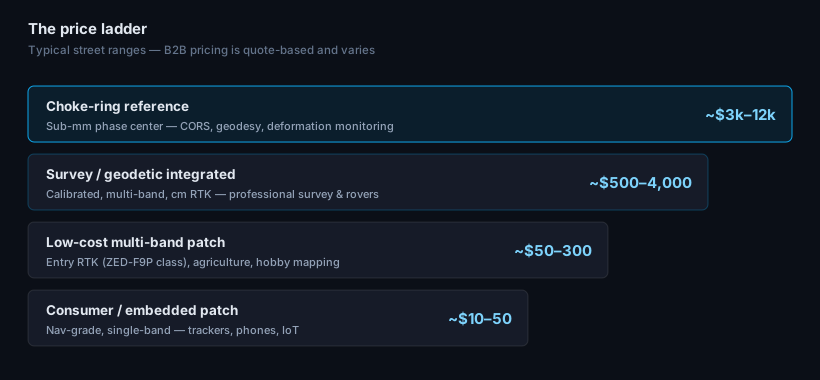
The jump from one tier to the next isn’t arbitrary. Each step buys a specific capability the tier below can’t deliver — and if your work doesn’t need that capability, you’re paying for nothing. If it does, skipping it costs far more than the antenna (see survey-grade vs low-cost accuracy).
What builds the price
Strip a datasheet down and the cost comes from six stackable layers. Every layer you add is a real component or a real qualification step — and a real line on the price.
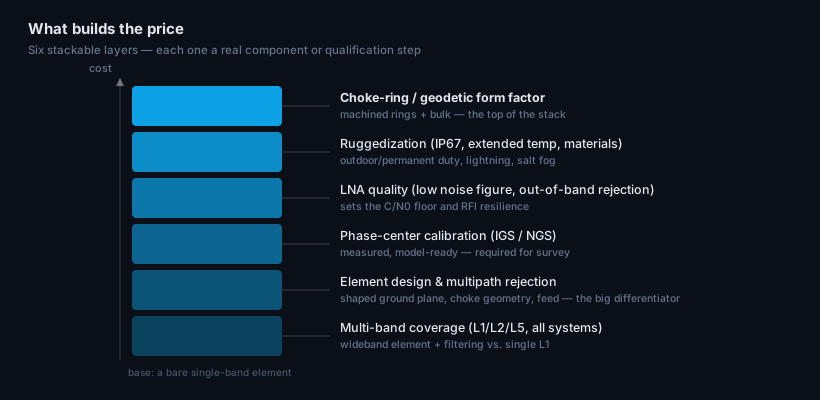
Multi-band coverage. A single-band L1 element is cheap. Receiving L1/L2/L5 cleanly across GPS, GLONASS, Galileo, and BeiDou needs a wideband element and more filtering — and it’s what lets the receiver resolve ambiguities fast and correct the ionosphere. This is usually the first big step up in price.
Phase-center calibration. A survey antenna’s phase center is measured (IGS or NGS) so processing software can apply a known correction. That calibration is lab time and traceability you’re paying for — and it’s non-optional for survey and reference work, because an uncalibrated antenna leaves the error in your solution.
Element design and multipath rejection. Getting from “an element that works” to one with a stable phase center and strong multipath rejection takes real RF design — shaped ground planes, choke geometry, careful feed. This is much of what separates a $100 patch from a $2,000 geodetic antenna.
LNA quality. The built-in low-noise amplifier sets your carrier-to-noise floor and your resistance to nearby interference. A low noise figure and aggressive out-of-band filtering cost more than a generic gain block, and they show up directly in tracking performance.
Ruggedization. IP67 sealing, a −40 to +85 °C range, salt-fog and vibration qualification, lightning protection, and marine- or aviation-grade materials all add cost. A benchtop prototype antenna and one certified for a decade on a CORS mast are priced worlds apart.
Form factor. The choke-ring’s machined concentric rings and sheer bulk sit at the top of the stack — materials and manufacturing you only pay for when you genuinely need reference-grade multipath rejection.
Why the cheap option is sometimes the expensive one
The temptation is always to buy down. Sometimes that’s right — see the next section. But for professional survey work, the antenna is rarely where you should economize, because the failure cost dwarfs the saving. A patch that can’t hold a fix in an urban canyon turns into a re-mobilization; an uncalibrated antenna on a base station injects error into every rover that depends on it; a missing band slows every ambiguity resolution across the whole project. The antenna is a one-time cost measured in hundreds or low thousands; a re-survey is measured in days and crews.
When buying down is the right call
Overspending is just as real a mistake as underspending. You are wasting money when you buy:
- A choke-ring for a moving rover — its reference-grade stability is unusable on a pole, and its weight is dead loss.
- A calibrated geodetic antenna for open-sky, decimeter-grade GIS or asset mapping — the calibration and multipath design earn nothing there.
- Full military ruggedization for a benign, temperature-controlled install.
Match the tier to the job: if your accuracy target is decimeter and your sky is open, a low-cost multi-band patch is the correct answer, not a compromise.
How to spec so you don’t overpay
Price the capability, not the brand. Before you request a quote, pin down four things — they map directly onto the cost layers above:
| Decide first | Which cost layer it sets | Don’t pay for it if… |
|---|---|---|
| Accuracy target (dm / cm / mm) | Element design, calibration | decimeter is fine |
| Bands your receiver uses | Multi-band coverage | you’re truly L1-only |
| Environment (open / urban / marine / airborne) | Ruggedization, multipath design | it’s a benign indoor/bench install |
| Permanent vs. mobile | Form factor, sealing | it’s a short-term rover |
Answer those and the right tier — and the honest price — falls out. A vendor who returns a measured spec sheet against your four answers is quoting you a product; one who just quotes a premium part number is quoting you a brand.
What you can cut, and what you can’t
| Safe to economize on | Rarely worth cutting |
|---|---|
| Ruggedization for benign, indoor, or short-term use | Phase-center calibration for any survey/reference work |
| Choke-ring form factor for anything that moves | Multi-band coverage if your receiver is multi-band |
| Military/marine qualification for open commercial sites | LNA quality — it caps every measurement downstream |
GNSource prices to the specification, not to a badge: tell us your accuracy target, bands, environment, and mount, and we quote the antenna that meets it — nothing more. See the high-precision measurement line or the full selection framework for the eight specs to put in an RFQ.
Frequently asked questions
How much does a good GNSS antenna cost? For professional survey work, a calibrated multi-band geodetic antenna typically runs a few hundred to a few thousand dollars; choke-ring reference antennas for CORS and geodesy run roughly $3,000–12,000. Consumer and low-cost multi-band patches sit well below that, from tens to a few hundred dollars. Exact pricing is quote-based and varies with configuration and volume.
Why are survey GNSS antennas so expensive? You’re paying for capability, not brand: multi-band coverage, a measured and calibrated phase center, strong multipath rejection from real RF design, a low-noise-figure amplifier, and outdoor ruggedization. Each is a concrete engineering or qualification cost that a consumer patch skips.
Is a more expensive antenna always more accurate? Only if your workflow can use what it adds. A choke-ring is not “more accurate” on a moving rover — its advantages are unusable there. Accuracy comes from matching the antenna’s capabilities to the job, not from spending more.
Can I use a cheap antenna and still get centimeter accuracy? Sometimes — a quality low-cost multi-band patch can hold a centimeter RTK fix under open sky. It fails in multipath-heavy environments and should never anchor a base station. Match the tier to your environment, not just your accuracy target.
Written by GNSource Engineering. GNSource manufactures GNSS antennas across every tier and quotes to your exact specification. Talk to our engineers about the right antenna for your accuracy target and budget.
![How to Set Up an RTK Base Station Antenna [2026 Guide]](/blog/_assets/upload/aaacdd5rjxygrxhc/2026/06/17/image_1781704508-i4v1t4p5.jpeg)