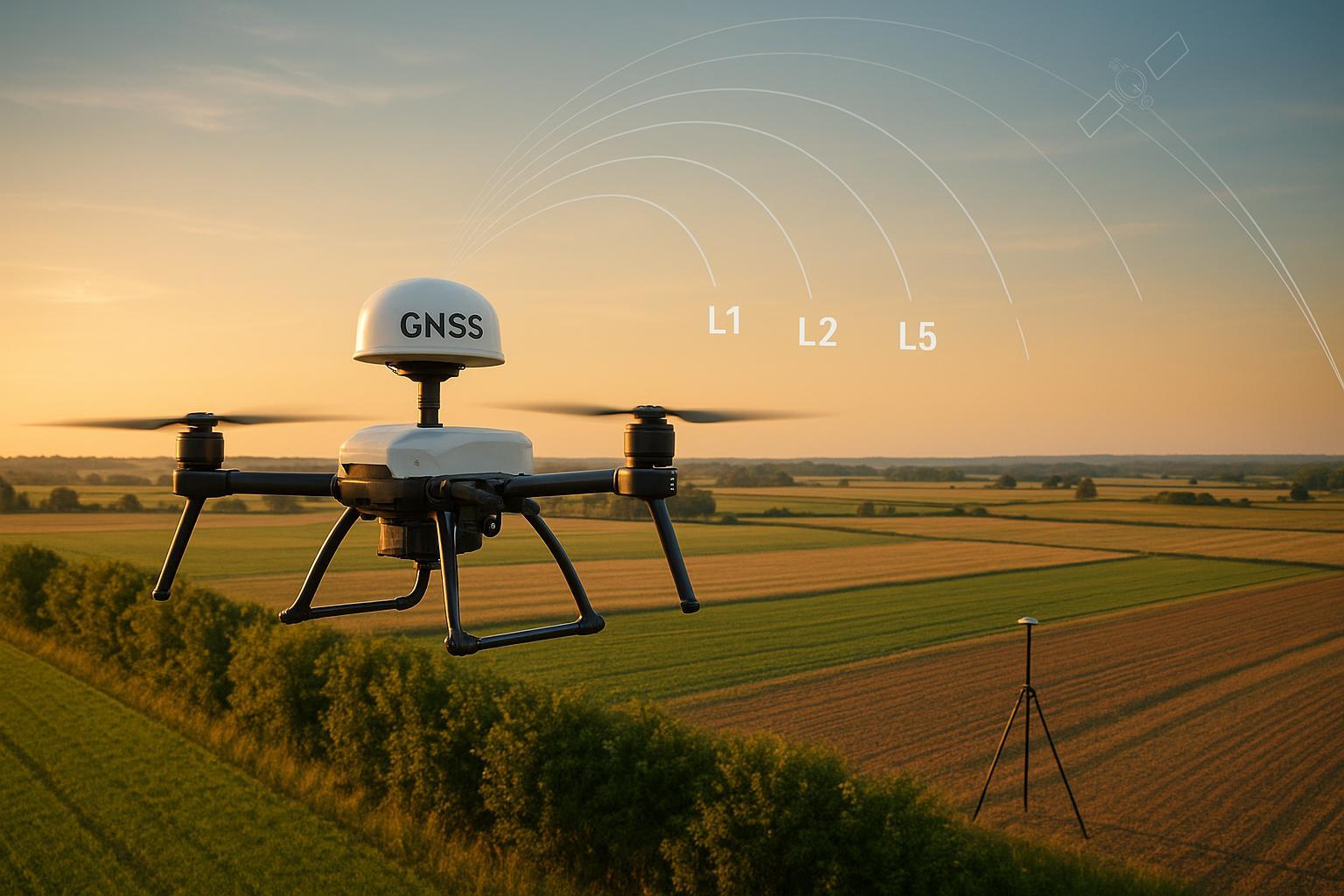
When a spray drone clips the edge of a dense canopy, you can almost hear the RTK solution flinch. Fix turns to float, the guidance line wanders a few decimeters, and now your overlap and chemical coverage are off. In my field integrations, the single most decisive factor hasn’t been the brand of receiver or corrections service. It’s the antenna choice and how it’s installed.
This guide distills what consistently works on UAVs operating over dusty, wet, reflective farm environments so you can hold centimeter-class RTK more of the time and recover faster when you inevitably lose it for a moment.
What actually limits RTK on farm UAVs
Think of the antenna as the front-end gatekeeper. If it passes clean, high‑CN0 signals into the receiver, ambiguity resolution has the raw material it needs. If it feeds multipath‑ridden or weak signals, the solver spends more time guessing.
-
Phase center variation and correction: Every antenna has a three‑dimensional phase center that shifts with frequency and elevation. Using a matching antenna model or PCV file keeps lever arms honest so your georeferencing doesn’t “breathe” as the satellite geometry changes.
-
CN0 and interference: Higher carrier‑to‑noise density ratio means more stable carrier lock. Good antennas also act as the first RF filter, boosting in‑band signals while attenuating junk. As NovAtel explains, the antenna’s built‑in filtering is literally the first line of defense against interference and multipath in real deployments, and placement dominates multipath exposure according to their foundational guidance in 2020–2024 primers and application notes. See the overview on interference and mitigation from NovAtel’s knowledge base in Interference and Multipath primers for context: according to the Interference primer, the antenna provides critical in‑band gain while rejecting out‑of‑band energy and their multipath resources emphasize siting and ground plane effects (NovAtel interference primer).
-
Ambiguity resolution basics: To get and keep RTK fixed, you need stable carrier lock on a sufficient set of satellites with good geometry and consistent measurement weights. When quality dips—low elevation signals, canopy attenuation, or self‑interference—cycle slips spike and the solution flips to float.
Selecting GNSS antennas for precision agriculture
For UAV RTK, multi‑band, multi‑constellation antennas consistently outperform single‑band options in variable sky and canopy edges. You also want strong out‑of‑band rejection and published phase‑center stability so you can model it.
-
Match the antenna to the receiver. For example, u‑blox’s ZED‑F9P integration notes call for an active antenna with appropriate gain and low noise figure, and they stress keeping the lead short to preserve CN0. Their integration manual provides concrete guidance on gain, noise figure, and cable loss budgets that I use as a design checklist (u‑blox ZED‑F9P Integration Manual).
-
Favor designs with well‑controlled phase‑center behavior. You don’t need a reference‑station choke ring on a 3 kg multicopter, but the closer you get to stable PCV across bands and elevations, the less your solution will wobble under geometry changes.
-
Validate filtering claims on your platform. Antennas with robust SAW/ceramic filtering and well‑engineered LNAs help suppress LTE/ISM/RF noise bleeding into GNSS bands. This matters on airframes with HD video downlinks and companion computers nearby.
Use the keyword here naturally: well‑chosen GNSS antennas for precision agriculture keep the receiver fed with higher‑quality observations through dust, mist, and reflections.
Mounting, ground planes, and EMI separation
Mounting makes or breaks a good antenna.
-
Height and sky view: Put the antenna as high and as clear as practical. Avoid propeller disks and camera housings in the horizon band where multipath is strongest.
-
Rigid structure: A flexible mast creates micro‑accelerations that show up as cycle slips during turns. Use a stiff bracket tied to the main frame.
-
Ground plane: Even a modest conductive plate under a multi‑band patch can tame low‑elevation multipath. On compact UAVs, a continuous skin or a dedicated plate bonded to ground improves pattern symmetry.
-
Keep your distance from noise: Separate from high‑current ESCs, power buses, VTX, and telemetry radios. When separation is limited, receivers with interference monitoring and mitigation features can help identify and suppress narrowband and wideband jammers. Septentrio’s documentation on AIM+ is a clear reference point for what robust receiver‑side mitigation looks like in practice (Septentrio AIM plus overview).
Cabling, sealing, and connectors that survive fields
Here’s the deal: a pristine RF front‑end doesn’t mean much if half your signal is lost in a poor cable or moisture‑wicked connector.
-
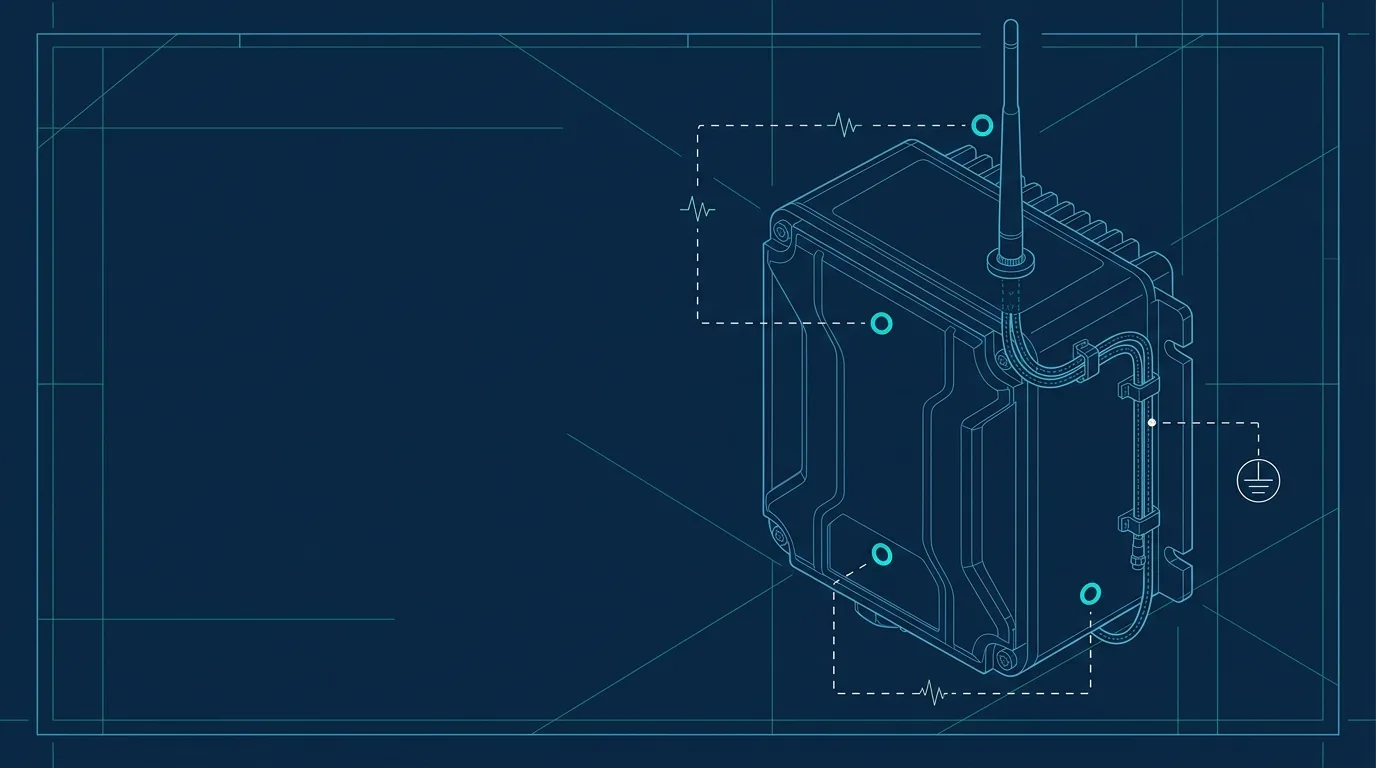
Keep it short and low loss: Use quality 50 Ω coax and keep runs as short as packaging allows. For longer external masts, step up to lower‑loss cable families to control insertion loss.
-
Use threaded, sealed connectors: Threaded interfaces resist vibration; IP‑rated mated pairs and boots keep dust and spray out. Remember that an IP67 rating (defined in IEC 60529) applies to the enclosure it was tested on: IP67 at the antenna body is only as strong as the connector interface you specify.
-
Add strain relief and corrosion control: Lock the cable mechanically near the antenna, route with wide bends, and prefer corrosion‑resistant materials. It saves you from intermittent opens that look like mysterious RTK drops.
Calibration, firmware, and antenna models
Calibration turns good hardware into predictable measurements.
-
Antenna models and PCV: Load the correct antenna descriptor or PCV file in your processing chain or confirm the receiver’s built‑in model matches your hardware. This keeps lever arms stable over different elevations and frequencies.
-
Elevation mask and weighting: Near partial canopy, a modest elevation mask and CN0‑aware weighting help cut low‑quality observations without crushing geometry. Document your chosen thresholds during validation so you can repeat results.
-
Gain and noise budgets: Verify the active antenna gain, total cable loss, and receiver LNA settings align with vendor guidance. u‑blox provides explicit targets for gain and total noise figure, which are useful guardrails during integration (u‑blox ZED‑F9P Integration Manual).
-
Interruption handling: After brief blockages, reacquisition to fixed should be quick once conditions permit. A 2024 study on RTK reliability provides useful context on fix‑only acceptance and typical reacquisition behavior for low‑cost receivers in field conditions (Tavasci 2024 RTK reliability).
Field test scenario and results you can reproduce
I recommend a two‑configuration comparison on the same platform and corrections source. Keep everything constant except the antenna and mount.
Setup and method
-
Platform: identical UAV frames with the same multi‑band RTK receiver and firmware. Baseline distance short and stable.
-
Variant A: multi‑band survey‑grade patch on a small ground plane, short internal coax to the receiver.
-
Variant B: compact choke‑patch on a slightly larger conductive plate, same cable strategy.
-
Flight patterns: 15–20 minutes static logging, a lawn‑mower pattern at 5 m/s across open rows and canopy edges, then a figure‑8 to provoke bank‑angle dynamics.
-
Metrics: time to first fix, percent of mission in fixed, number of fix drops, CN0 distribution by elevation, cycle‑slip counts, and reacquisition time after an induced blockage.
Acceptance targets to start with
Metric | Practical target | Notes |
|---|---|---|
Time to first RTK fix | 1–2 minutes in open sky | Longer than ~3 minutes flags an integration issue per industry troubleshooting guidance (Swift Navigation RTK checklist). |
Percent of mission in Fix | ≥ 85% in open fields | Lower under canopy edges is expected; tune mask and EMI layout. |
Horizontal and vertical RMS | 3–5 cm with 4 cm working cutoff | Use independent checkpoints for mapping validation as recommended in recent reliability work (Tavasci 2024 RTK reliability). |
Reacquisition to Fix after brief loss | About 9–13 seconds when conditions improve | Expect variations with geometry and interference. |
Interpretation heuristics
-
If Variant B shows a tighter CN0 distribution at low elevation and fewer fix drops during 180° turns, that’s a strong vote for the larger ground plane and choke geometry on your airframe.
-
If both variants struggle near the video transmitter or power bus, move the antenna, reroute harnesses, or enable receiver‑side interference rejection and repeat the test. Don’t assume it’s “just the canopy.”
Practical workflow example with GNSource
In one reproducible workflow, we mounted a lightweight multi‑band UAV antenna from GNSource on a rigid mast 10 cm above the airframe skin, with a bonded aluminum plate acting as a ground plane. The cable path used a ≤30 cm internal low‑loss pigtail to the RTK receiver with a sealed, threaded SMA at the antenna bulkhead, plus strain relief at both endpoints. We kept the video downlink and telemetry antennas a full boom length away and crossed power at right angles.
For calibration, we verified the antenna descriptor against our processing chain and documented lever arms from the airframe origin. We then flew the static and kinematic patterns described above with a modest elevation mask and CN0 weighting enabled. On this platform, we observed a steadier CN0 distribution at low elevations and fewer short fix drops during tight turns compared to a smaller ground‑plane variant. That observation reinforced the value of a rigid mount and properly sized ground plane rather than any specific antenna brand.
If you’re exploring model families, GNSource’s High‑Precision GNSS Survey and RTK Antennas page outlines options and phase‑center stability context useful for planning, and their Aviation and UAV category lists lighter variants suitable for small airframes: see High‑Precision GNSS Survey and RTK Antennas at GNSource High‑Precision Measurement and Aviation and UAV antennas at GNSource Aviation and UAV.
Troubleshooting and production checklist
-
Logs first: capture raw observations and event markers. If fix time drifts past two minutes in open sky, audit antenna gain, cable loss, and interference before blaming corrections.
-
Separate and shield: increase physical spacing from VTX, telemetry radios, and ESCs; use ferrites and reroute harnesses. Use receiver interference tools to identify narrowband offenders (Septentrio AIM plus overview).
-
Short and sealed RF: shorten coax, upgrade to lower‑loss where needed, and replace any connector that has seen moisture. The mated connector interface is often the environmental weak point, regardless of the IEC 60529 IP rating claimed for the antenna body.
-
Calibrate and document: confirm antenna models, lever arms, elevation masks, and weighting settings. Re‑run the same test plan after each change.
-
Validate deliverables: accept fix‑only positions for mapping deliverables and confirm accuracy with independent checkpoints, not just processing RMS.
Key takeaways
-
The antenna and its installation dominate RTK outcomes on farm UAVs; start with multi‑band, multi‑constellation hardware and a clear, rigid mount.
-
Keep RF paths short, sealed, and mechanically secured; specify threaded, IP‑rated connectors and proper strain relief.
-
Use antenna models, modest elevation masks, and CN0‑aware weighting to stabilize solutions near canopy edges.
-
Define a repeatable field‑test plan with pass‑fail metrics. Make a change, retest, then decide.
Short FAQ
Q: Do I need a full choke ring on a small UAV
A: Usually not. A well‑designed multi‑band patch with an adequate ground plane and careful placement often offers a better SWaP balance. Validate on your platform before committing.
Q: What elevation mask should I use near vegetation
A: Start modestly—often in the mid‑teens to around twenty degrees—then tune based on your CN0 distributions and fix availability. Over‑masking can hurt geometry.
Q: How do I tell if I’m EMI‑limited or canopy‑limited
A: Power down onboard transmitters one at a time and review interference monitors. If CN0 jumps or fix stability improves markedly, solve the self‑interference first.
Q: What’s an acceptable time to first fix after takeoff
A: In open sky, around a minute or two is typical if the RF path and corrections are healthy. If you’re pushing past three minutes, investigate using a troubleshooting flow like the one described by Swift Navigation’s RTK checklist for NTRIP issues.
If you need vendor antenna models or calibration pointers, you can contact GNSource for datasheets or PCV guidance.