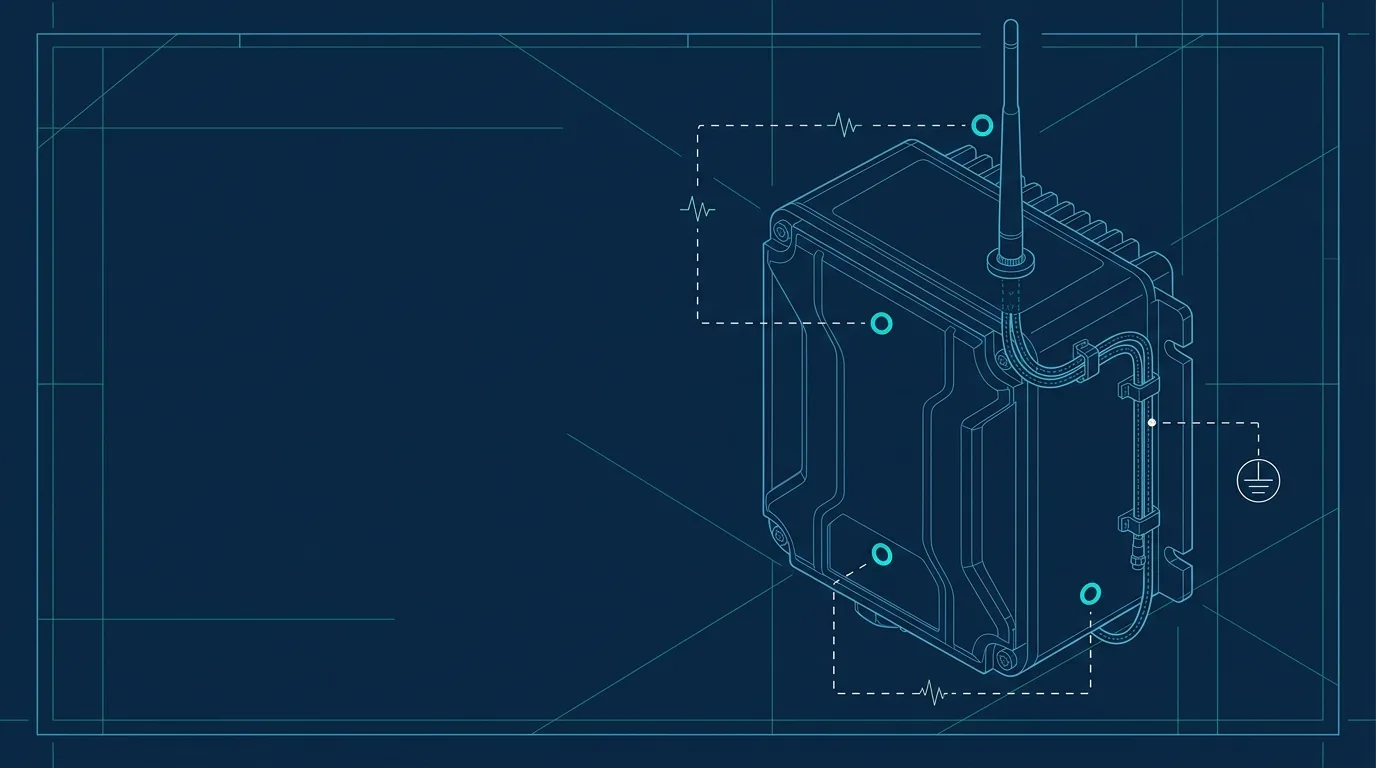
I learned this lesson the hard way on a 120-foot boom sprayer during corn pre-emerge: by hour six, our RTK fix ratio slid from steady green to a stuttering mess every time the rig hit washboard ruts and a dust plume wrapped the cab. The receiver looked fine on the bench. In the field, we counted cycle slips, watched SNR ripple, and spent the evening re-running a pass we’d already “finished.”
That day compressed years of antenna-durability mistakes into one run: fine dust packed the radome seams, the bracket flexed on a thin roof panel, and an inline SMA joint fretted itself into intermittent contact. UV and chemical exposure hadn’t yet done their worst, but the hairline crazing we saw later told the rest of the story. Here’s the deal: if you don’t engineer durability up front, you’ll debug reliability forever.
Key concepts that actually keep RTK stable
Carrier-phase continuity and cycle slips
For centimeter-level RTK, carrier-phase tracking must remain continuous. Mechanical shock, connector micro-movements, or momentary SNR dips create phase breaks (“cycle slips”) that kick solutions from FIX to FLOAT or SINGLE until the filter re-converges. You typically see this as a sudden fix loss followed by 10–60 seconds of recovery depending on constellation geometry and receiver settings.
Antenna pattern stability and phase center variation (PCV)
A clean, undamaged radome helps preserve the designed radiation pattern and a stable effective phase center. Asymmetric dirt buildup or surface abrasion shifts gain at low elevations and can bias the phase center, increasing residuals. Vendor installation notes consistently emphasize clean, unobstructed sky view and pattern integrity for multipath control; see guidance from NovAtel and Trimble on siting and multipath reduction in their installation resources and primers, for example the SMART2 install guide and multipath primer from NovAtel and Trimble’s base/rover setup pages.
Multipath vs. shielding and ground planes
Nearby conductive structures reflect GNSS signals, especially at low elevation angles, creating multipath that increases measurement noise and biases. Raising the antenna, maximizing clearance to reflectors, and using appropriate ground planes (or geodetic antennas with choke rings or equivalent mitigation) are standard ways to keep multipath in check. Major vendors’ siting guidelines are aligned here; see Trimble and Septentrio siting notes.
Cable loss and impedance discipline
Every dB between the antenna LNA and receiver matters. Excess loss, poor impedance control, and intermittent terminations translate into SNR hits and phase noise. Typical low-loss outdoor coax choices (per Times Microwave datasheets) include LMR-195 and LMR-240; around L1/L2 frequencies, LMR-195 is roughly half a dB per meter while LMR-240 is closer to a third of a dB per meter—always verify against the current catalog. Keep runs short, avoid unnecessary joints, and secure strain relief so connectors don’t fret under vibration.
Why farm environments break GNSS durability (and your RTK)
This is where “GNSS antenna durability farm equipment” stops being a buzz phrase and becomes an engineering requirement. Four threats dominate—dust, vibration, chemicals, and UV—and all of them show up in your logs as reduced fix ratio, higher cycle-slip counts, and longer re-convergence times.
Dust and mud
Fine dust infiltrates seams and glands, wicks moisture, and packs asymmetrically on the radome. That changes the radiation pattern and phase center and raises multipath at low elevations. Mud cakes can partially shadow the aperture. Net effect: SNR variance increases and cycle slips spike when the machine runs downwind of its own plume.
Vibration and shock
Random vibration on off-road equipment drives cable fretting, micro-motions at connector interfaces, and bracket flex that modulates antenna attitude. On the receiver side, dynamic stress tightens carrier-tracking margins; combine the two and you’ll see intermittent loss of lock on rough terrain. Tailored MIL‑STD‑810-style testing demonstrates that “one level fits all” is a myth; your profile should reflect the roof or mast where the antenna actually lives.
Agricultural chemicals
Fertilizers, pesticides, and cleaners attack radome resins, seals, and connector plating. Early damage looks cosmetic (dulling, slight crazing). Later it opens paths for moisture ingress and corrosion, changing impedance and inviting intermittent faults—often misdiagnosed as “GNSS went weird today.” Material selection and sealing details are your first defense.
UV exposure
Seasons of sunlight embrittle plastics and degrade sealants. Tiny cracks around fasteners and glands let dust and water in, and structural creep shifts the antenna’s attitude under vibration. After a year or two, you may still get fixes—but with more residuals and fewer hours above a 95% FIX threshold during long workdays.
Common engineering mistakes I still see
-
Pairing a premium RTK receiver with a consumer antenna and a 5 m generic RG‑316 run through chafing sheet metal.
-
Mounting on a flexible roof without a rigid subplate; the bracket bends, the antenna tilts, and phase center stability walks away.
-
Running RF coax alongside high-current harnesses and DC‑DC converters for meters at a time, then wondering about SNR swings.
-
Ignoring chemical and UV compatibility for radomes, boots, and O‑rings; six months later the seal fails and corrosion blooms.
-
Skipping acceptance tests: no vibration soak, no 24–72 h carrier-phase continuity log, no post‑install torque check.
Practical improvement checklist (what to specify and why)
Antenna selection
For exposed farm machinery, set IP67 as the floor for dust and temporary immersion protection, based on the ingress protection code defined by IEC 60529. If pressure washdowns are part of maintenance, look for designs tested to the road-vehicle IP69K concept in ISO 20653. Ask vendors for MIL‑STD‑810-style vibration and shock documentation tailored to off‑road equipment mounts. Prefer UV‑stable radome materials and coatings; where chemical exposure is routine (diesel, ammonia cleaners, fertilizer), prioritize resins and seals with documented compatibility (e.g., PC/PBT blends or PBT families) and stainless hardware with gold‑plated contacts.
Mounting and mechanical integration
Mount the antenna on the highest, stiffest location with an unobstructed sky view. If the roof panel flexes, add a 3 mm steel or aluminum subplate spanning ribs so the antenna’s attitude doesn’t modulate with every rut. Keep at least one antenna diameter from large conductors; on multirotors with carbon-fiber decks, elevate the antenna on a non-conductive mast to avoid shadowing. Use torque-specified fasteners with threadlocker or locking nuts; if you add elastomeric isolators, verify they don’t allow tilt under vibration.
Cabling and connectors
Use the shortest practical low-loss coax. As a rule of thumb from vendor catalogs, LMR‑240 loses roughly a third of a dB per meter around 1.6 GHz, while LMR‑195 is closer to half a dB per meter; confirm current datasheets before finalizing lengths. Factory-terminated assemblies reduce field variability. Provide real strain relief and sealed glands; avoid inline adapters and pigtails unless absolutely necessary. Route RF away from noisy harnesses; when crossings are unavoidable, do it near 90° and keep separation by several centimeters.
Firmware, diagnostics, and alerts
Baseline performance after install: log SNR distributions, carrier-phase residuals, and fix ratio over a normal work window. Configure alerts for SNR drops >3 dB from baseline or FIX time under 95% during operation. Enable anti-jam/anti-spoof features where available, and synchronize receiver firmware with vendor stability releases rather than chasing every minor update.
Maintenance and protection
Schedule seasonal inspections. Clean radomes with mild detergent (no aggressive solvents). Replace weather boots and O‑rings proactively. Consider removable protective covers for storage/transport that don’t adhere to or abrade the radome. After any maintenance, run a short RTK health check to confirm no unintended shifts in performance.
A neutral example from the field
On one sprayer retrofit, we standardized on a rugged, multi‑band antenna with a sealed bulkhead and a factory‑molded LMR‑240 lead, mounted on a 3 mm steel subplate. We routed the coax in its own channel with a sealed gland and orthogonal crossings. A configuration like this is typical of what GNSource supplies for harsh environments; the important part is validating sealing, vibration endurance, and cable loss against your own profile and length budget.
References to design intent
For siting and multipath mitigation principles, major vendors publish reliable guidance you can adapt to farm platforms; see NovAtel’s installation and multipath primers and Trimble’s rover/base setup pages. For environmental baselines, consult IEC 60529 for IP definitions, the ISO 20653 road‑vehicle standard for IP69K concepts, and MIL‑STD‑810H for tailored vibration/shock methodology. For cable attenuation, rely on the latest Times Microwave LMR catalog or individual product datasheets rather than memory.
Engineering test scenario: side-by-side rooftop comparison on a sprayer
Test objective
Demonstrate how antenna durability choices affect RTK reliability over a full application day in dust and vibration.
Assemblies under test
Assembly A (baseline): consumer-grade patch antenna (no IP rating), 5 m generic RG‑316 with two inline SMA adapters, mounted directly to a flexible roof panel.
Assembly B (recommended): rugged IP67 multi-band antenna with UV/chemical‑stable radome, factory‑molded LMR‑240 cable terminating at a sealed TNC bulkhead and gland, mounted on a 3 mm steel subplate with torque‑specified fasteners. Pre‑condition with a tailored random‑vibration soak aligned to your vehicle mount profile.
Instrumentation and measurements
-
Log RTK status (FIX/FLOAT/SINGLE) and percentage time in FIX over 8 hours.
-
Count carrier-phase cycle slips and measure average re‑convergence time after each slip.
-
Record SNR median and variance per band and constellation.
-
Capture temperature and, if available, vibration channels for correlation.
-
Perform post‑run inspection: radome abrasion, connector condition, fastener torque retention.
Expected outcomes (based on field experience)
Assembly B should sustain >95% FIX time with significantly fewer slips and tighter SNR variance. Assembly A will likely show intermittent dropouts coinciding with rough terrain and dust plumes, visible dirt ingress at seams, and early connector wear. The side‑by‑side trace gives procurement‑grade numbers to justify specification changes.
Acceptance-testing protocol you can adopt next week
-
Bench pre‑check: Verify antenna DC current draw, LNA gain, and cable/connector continuity. Document coax type/length and expected loss from the latest datasheet.
-
Mount verification: Inspect subplate stiffness, torque to spec with threadlocker, confirm gland sealing, and measure clearance to nearby conductors.
-
Vibration conditioning: Expose the mounted assembly to a tailored random‑vibration profile derived from your platform (MIL‑STD‑810 Method 514 approach). Re‑torque fasteners after cool‑down.
-
Baseline logging: Run 24–72 h carrier‑phase continuity and SNR logging with the machine stationary and during a representative duty cycle. Target ≥95% FIX during operating windows.
-
Alert thresholds: Configure automated alerts for SNR drop >3 dB from baseline and FIX time <95%. Store logs for trend analysis.
-
Seasonal inspection: Check radome surface, seals, boots, and connectors; clean with mild detergent; replace consumables; re‑run a 30‑minute RTK health check.
Citations for the protocol
-
For IP definitions use the official IEC 60529 publication page (IP67 as dust‑tight and temporary immersion classification context).
-
For tailored vibration/shock methodology consult public overviews of MIL‑STD‑810 vibration testing and obtain the actual standard for your profile.
-
For UV accelerated weathering language and limits, see ASTM durability/UV weathering standards overview (G154/G155 practices).
Decision matrix: spec quick-picks
Use case | Minimum IP | Vibration/shock target | Cable choice (≤10 m) | Mounting notes |
|---|---|---|---|---|
Rooftop sprayer/tractor | IP67 (IP69K if pressure wash) | Tailored MIL‑STD‑810 random; shock verification | LMR‑240 | Rigid subplate; ≥1× antenna diameter from reflectors |
Small multirotor UAV | IP67 | Tailored high‑frequency content; light shock | LMR‑195 (weight‑biased) | Non‑conductive mast above carbon fiber; secure strain relief |
Mast on harvester | IP67 | Higher RMS; fastener retention focus | LMR‑240 | Bonded ground plane or geodetic antenna; sealed bulkhead |
Base station on farm | IP67 | Low; wind‑induced motion only | LMR‑240/400 (length‑biased) | Clear sky view; anti‑theft bracket, weather shroud |
FAQ
How often should I replace antenna boots and O‑rings in agriculture?
Plan seasonal replacements if you operate in heavy chemical or UV exposure. Inspect at service intervals; if cracking or tackiness appears, replace sooner. Always re‑run a brief RTK health check after service.
Is IP67 enough for farm equipment that gets power‑washed?
IP67 addresses dust and temporary immersion. If you routinely use high‑pressure, hot‑water washdowns, specify antennas tested to the IP69K concept defined in ISO 20653 for road vehicles and confirm sealing around glands and bulkheads.
Do I need a ground plane on a modern multi‑band antenna?
It depends on the antenna design and local reflectors. Geodetic or choke‑ring designs build mitigation in; compact patches often benefit from an appropriate ground plane. Follow the manufacturer’s installation notes and validate with SNR/multipath logs.
How much cable loss is acceptable between antenna and receiver?
Keep it low. As a starting point, design for ≤2–3 dB total at L1/L2 across the entire run. Choose cable size accordingly and verify against current LMR datasheets, not rules of thumb.
Why does vibration show up as RTK dropouts when my bench tests look perfect?
Benches don’t simulate dynamic stress or micro‑movement at connectors. On‑vehicle vibration tightens tracking margins and can induce intermittent impedance changes. That’s why a tailored vibration soak and on‑platform logging matter.
Where to go from here
Specify IP67+ rugged antennas with UV/chemical‑stable materials, mount on a rigid subplate, minimize cable loss, validate with vibration soak and 24–72 h logs, and track SNR/fix trends over seasons.
If you want a second set of eyes on your spec or test plan, reach out to our engineering team for a quick review.