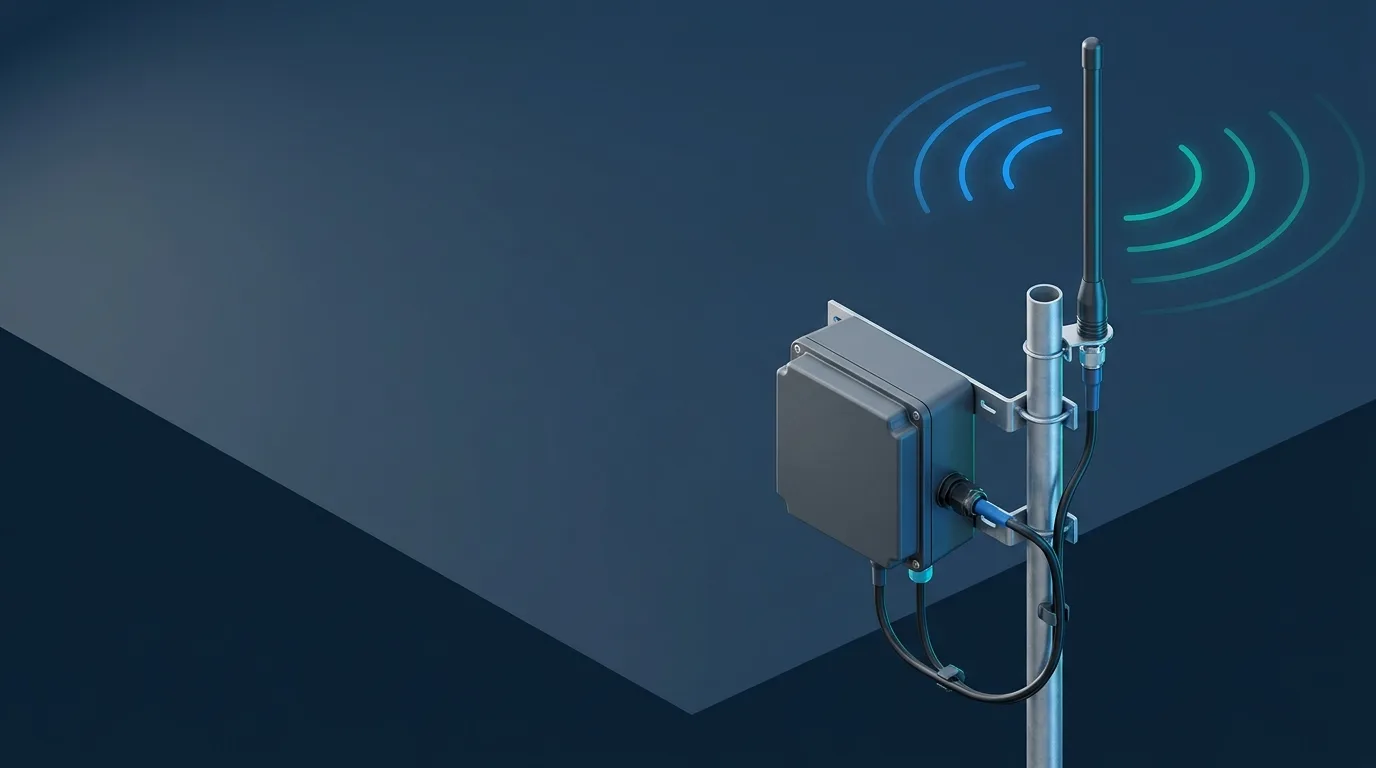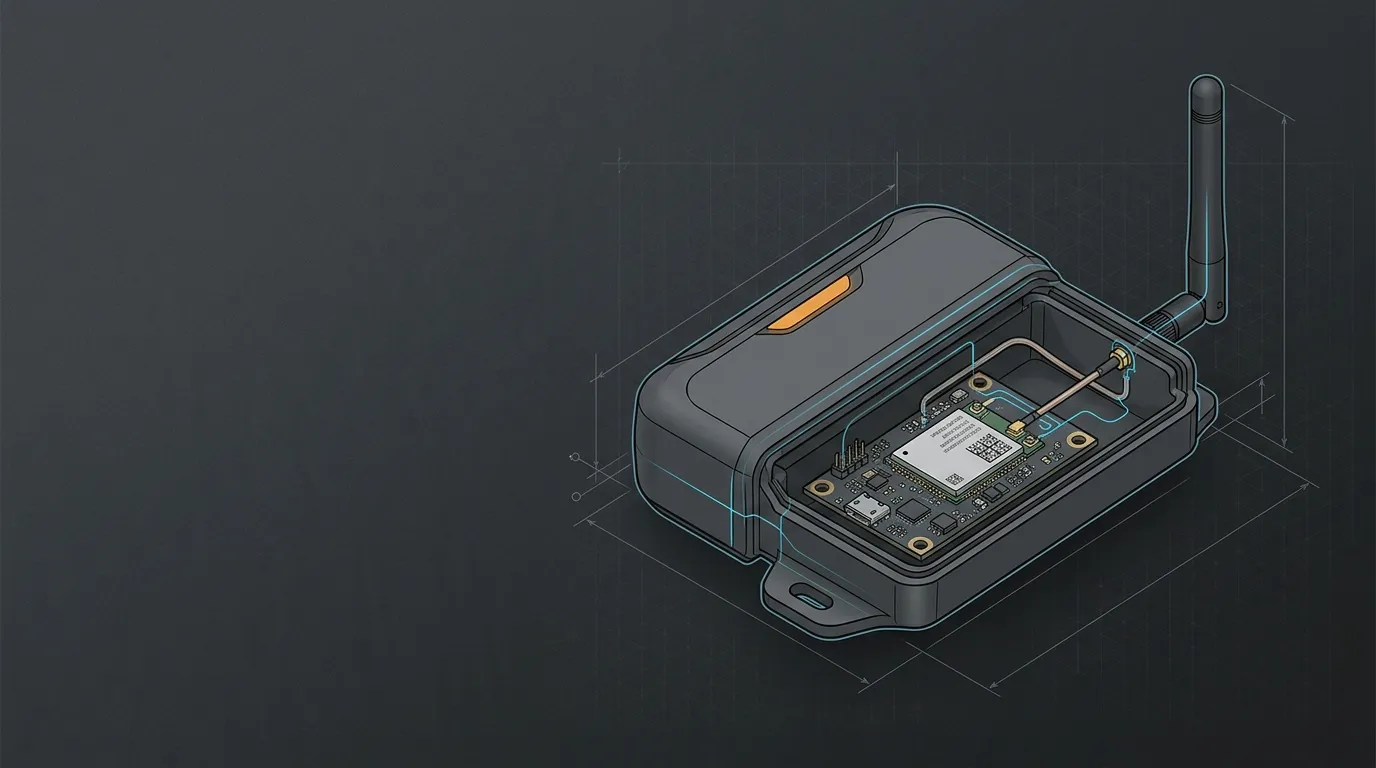
The 433 MHz antenna is the single highest-leverage part of a LoRa or ISM-band link, and the choice is simpler than the datasheets make it look: pick a quarter- or half-wave antenna tuned to 433 MHz, put it in the clear with a decent ground plane, keep the cable short, and the antenna’s gain matters far less than where it sits. At 433 MHz a wavelength is about 69 cm, which is why an efficient antenna is visibly long — a 5.5 dBi magnetic-mount whip runs ~890 mm — and why a PCB antenna inside a metal enclosure quietly destroys the range your radio is capable of.
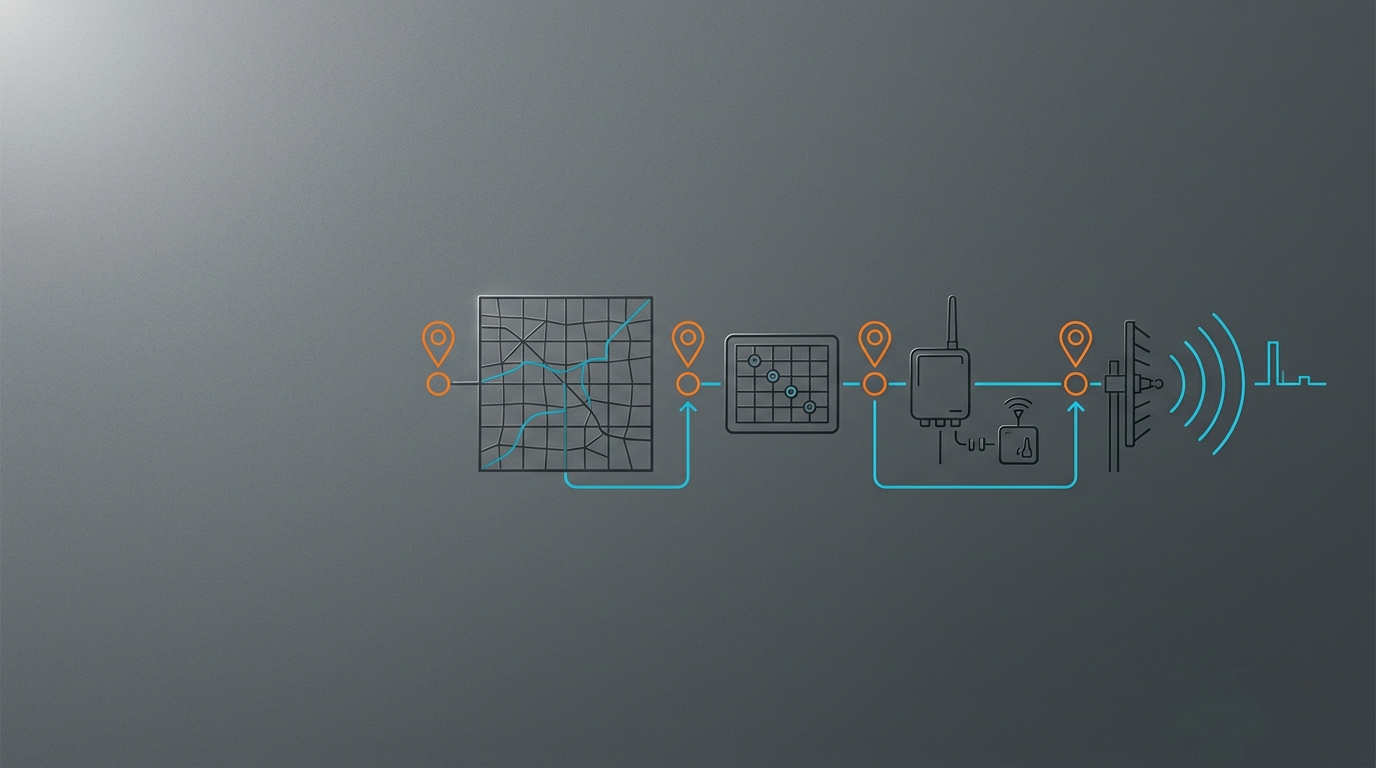
This guide covers the physics that set the range, the three antenna form factors used at 433 MHz (whip, magnetic mount, PCB), the mounting rules that make or break them, and a worked link-budget example you can run yourself with our link-budget calculator. It’s the 433 MHz slice of the IoT antenna buyer’s guide, which covers LoRa, 4G, 5G and Wi-Fi selection end to end.
Why 433 MHz gets the range it does
433 MHz sits in the unlicensed ISM band at 433.05–434.79 MHz (Region 1) — the 433 ±8 MHz window the LGW-XP antenna is tuned for. Two numbers explain why this band is the default for rural and industrial LoRa links:
- Free-space path loss at 433 MHz over 1 km is ~85 dB; at 2.4 GHz the same path costs ~100 dB. That ~15 dB difference means a 433 MHz link at equal power and gain reaches roughly five times farther than a 2.4 GHz link in free space.
- 433 MHz penetrates and diffracts around obstacles better than 2.4/5 GHz because longer wavelengths bend around foliage, walls and terrain features more effectively.
The trade-off is bandwidth and size. The ISM window is only 1.74 MHz wide, so 433 MHz is for low-data-rate telemetry (LoRa, modbus-over-radio, alarm links), not video. And the antenna is physically large: a quarter-wave is ~17 cm, a half-wave ~35 cm, and a gain-loaded whip can reach 89 cm. If your device needs to be smaller than that, you are trading antenna efficiency for form factor — the core decision in external vs PCB antennas for IoT.
What actually decides range: gain, efficiency and placement
Vendors quote gain, and buyers chase it, but gain is one of four variables — and rarely the one limiting the link.
| Variable | Typical 433 MHz values | What it does to range |
|---|---|---|
| TX power (EIRP limit) | +10 to +20 dBm (regional ISM limits) | +3 dB ≈ 1.41× free-space range |
| Antenna gain | 0–5.5 dBi (whips: ~0–3 dBi, loaded: to 5.5 dBi) | +3 dB ≈ 1.41× free-space range |
| Cable loss | RG174 ~0.5 dB/m, RG58A/U ~0.25 dB/m | -0.5 dB per metre directly off the budget |
| RX sensitivity | -125 to -137 dBm (LoRa SF7–SF12) | the biggest lever: 12 dB across spreading factors |
Read the table as a budget, not a spec sheet. A 3 dBi antenna upgrade buys the same free-space range as a 3 dB cable saving or a 3 dB sensitivity gain — but the antenna upgrade only helps if the current antenna is actually radiating. An antenna with 5.5 dBi gain sitting against a metal cabinet, or a PCB antenna inside a metal housing, can lose 10–20 dB to detuning and absorption — far more than any gain figure on the datasheet.
That’s why the practical ranking of 433 MHz antennas starts with form factor and placement, then gain:
- External whip or magnetic mount, clear of metal — the baseline for real range.
- External antenna, poorly placed (against metal, indoors, low-mounted) — works, but you’ve given back most of the advantage.
- PCB or chip antenna inside a plastic enclosure — fine for a few hundred metres of clear-sky range; not for field telemetry.
- Any antenna inside a metal enclosure — effectively a detuned stub; plan for single-digit metre range.
433 MHz antenna types: whip vs magnetic mount vs PCB
The three form factors used at 433 MHz cover almost every LoRa/ISM deployment:
| Type | Typical gain | Best for | Watch out for |
|---|---|---|---|
| Straight/flexible whip (LGW-1Y0001–003) | ~0–3 dBi, 430–460 MHz | Devices, cabinets, handheld bases | VSWR 3–5:1 at band edges; needs clearance |
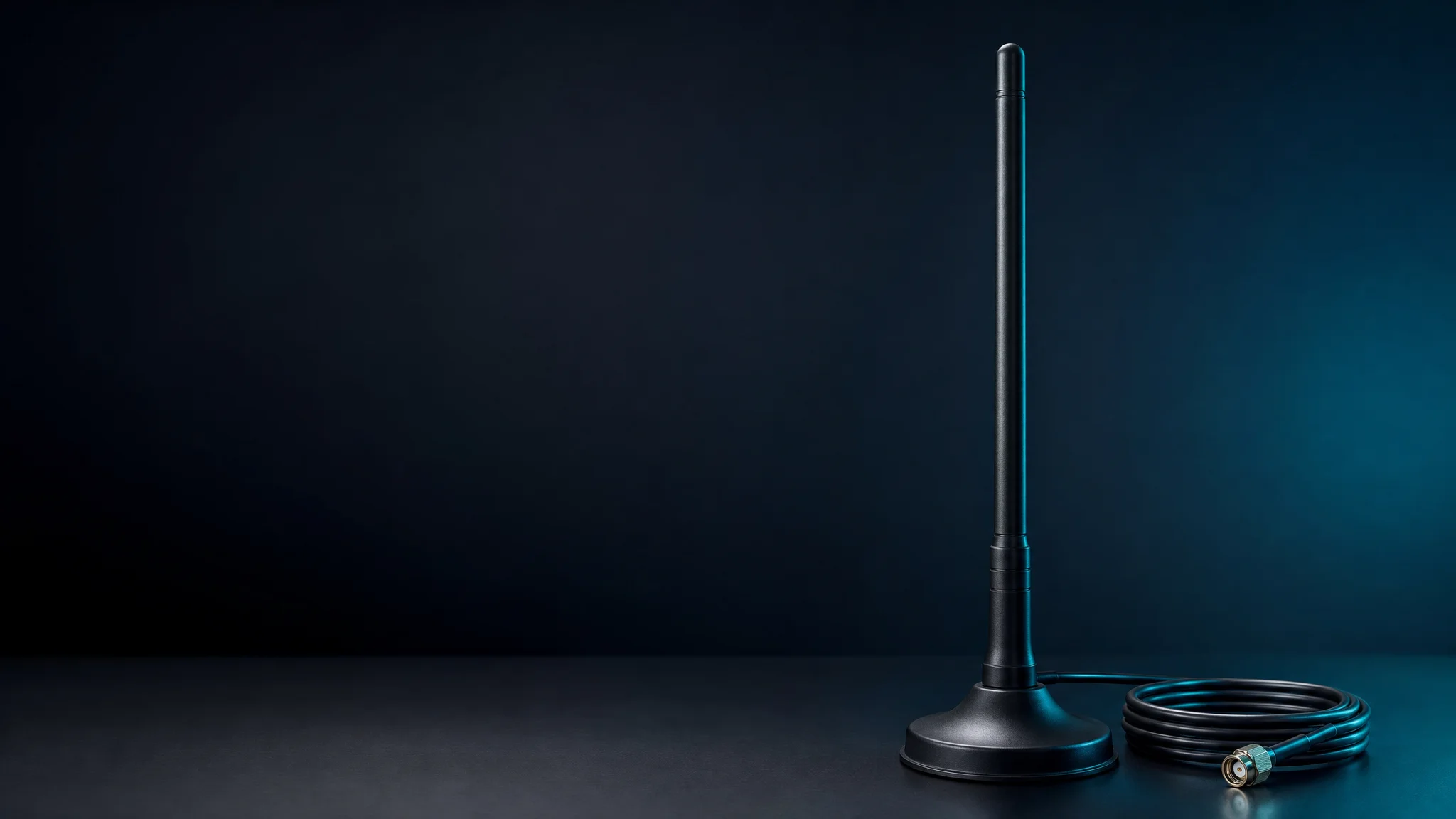
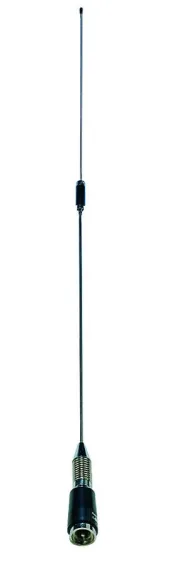
| Magnetic-mount whip (LGW-XP) | 5.5 dBi, 433 ±8 MHz | Vehicles, temporary field installs, roofs | 89 cm tall; 120 km/h wind limit; SL16 connector |
| PCB / chip (not shown) | -5 to +1 dBi typical | Compact OEM devices | Detuning near metal; short range |
Whips for 433 MHz are tuned for 430–460 MHz in this line. The flexible LGW-1Y0001 (VSWR ≤3.0, all-copper SMA) is the usual choice for a device enclosure; the straight and hinged variants trade a little VSWR for a stiffer or lower-profile shape. All three are vertical-polarization, 50 Ω antennas — match the radio’s connector and the 50 Ω rule is satisfied.
The magnetic-mount LGW-XP is a different animal: 5.5 dBi at 433 ±8 MHz with a VSWR ≤1.8 and 50 W power handling, on a magnetic base that doubles as the ground plane. It’s the right tool when you need temporary range from a vehicle roof or a test setup, and its 0.2 kg weight and 120 km/h wind rating make it a practical field antenna. The catch is the SL16 male connector — plan the adapter or cable before you buy, and see the connector guide below.
Mounting rules that make or break a 433 MHz link
Placement beats gain in the field, and three rules cover most failures:
- Give the antenna a ground plane or clear the metal. A magnetic mount uses the mounting surface as its counterpoise — it needs a real metal roof or plate to reach its gain. A whip bolted to a non-conductive bracket has no such plane and behaves like a detuned element. The rule of thumb: at 433 MHz keep the antenna at least one quarter-wave (~17 cm) from large metal surfaces in all directions.
- Height is range. Raising an antenna from 1 m to 2 m above ground adds ~6 dB to a real-world path — more than most gain upgrades deliver — by clearing the first Fresnel zone and local clutter. For fixed base stations, fiberglass omnidirectional antennas mounted on a mast are the standard answer; a vehicle magnetic mount gets the same benefit from roof height.
- Keep the cable short and the connector right. At 433 MHz, 3 m of RG174 costs ~1.5 dB of your budget; RG58A/U costs about half that per metre. Every dB spent in the cable is a dB that never reaches the receiver. Use the shortest, thickest cable the connector allows, and terminate with the correct connector the first time — SMA for device whips, SL16 for the LGW-XP.
Worked link budget: what your antenna really buys you
Put the variables together for a typical rural LoRa base:
- TX power: +14 dBm
- TX antenna gain: 2 dBi (whip), cable + connector loss: 0.5 dB
- RX sensitivity: -130 dBm (mid-rate LoRa), fade margin: 20 dB
- Budget: 14 + 2 - 0.5 - (-130) - 20 = 125.5 dB of allowed path loss
Free-space path loss at 433 MHz is ~85 dB at 1 km and grows 20 dB per decade, so that budget clears ~1 km in free space by a wide margin — real deployments are limited by terrain, foliage and Fresnel-zone clearance, not the radio math. Now change one variable: add 3.5 dBi of antenna gain (the LGW-XP) and shorten the cable to save 0.5 dB. The budget rises to ~129.5 dB — roughly a 1.6× free-space range gain, or the same range with 4 dB more fade margin against rain and interference. Run your own numbers with the link-budget calculator before specifying.
The two specs buyers skip
Two numbers matter more than gain at 433 MHz and are routinely ignored:
- VSWR. A whip at 5:1 VSWR reflects ~44% of the power back into the radio and can trigger output-power foldback. The LGW-XP’s ≤1.8 and the whip line’s ≤3.0 across 430–460 MHz are realistic band-edge figures — check that the antenna’s match covers your exact frequency, not just the band label.
- Power handling. LoRa radios rarely exceed +20 dBm, so 10 W-rated antennas are fine — but if the same antenna ever carries a 50 W radio (the LGW-XP handles 50 W), derate for continuous duty and connector quality.
Frequently asked questions
Does a higher-gain 433 MHz antenna always give more range? Only up to a point. Gain increases range in the direction the pattern is concentrated, but a high-gain collinear also narrows the vertical beam, so a moving or tilted node can fall out of it. For whip and magnetic-mount antennas the practical gains are 0–5.5 dBi, and placement and cable loss usually move the link more than a dB or two of gain.
How long does a 433 MHz antenna need to be? A quarter-wave at 433 MHz is ~17 cm, a half-wave ~35 cm, and a gain-loaded whip like the LGW-XP reaches ~89 cm. If the antenna must be much shorter, it is either electrically loaded (narrower bandwidth, lower efficiency) or it is not really a 433 MHz antenna.
Can I use a 433 MHz antenna indoors? Yes, but expect the range to drop sharply. Walls, floors and metal furniture absorb and reflect the signal, and an antenna a metre above the floor works very differently from one on a roof. Indoor links are usually fine for tens to a few hundred metres; outdoor links are where the 433 MHz physics pays off.
What connector do I need for a 433 MHz whip? Most device whips in this class use SMA (male on the antenna, female on the radio, or RP-SMA on Wi-Fi-style hardware — check polarity). The magnetic-mount LGW-XP uses SL16 male, so confirm the adapter or mating cable before ordering.
Is 433 MHz legal everywhere? 433.05–434.79 MHz is unlicensed in ITU Region 1 (Europe, Africa, Russia) with regional power and duty-cycle limits, and 433 MHz ISM devices are widely accepted in Region 3 markets. Regulatory limits differ by country — verify EIRP and duty cycle for your deployment region before designing the link.
This guide is part of the IoT & M2M antenna series. For a 433 MHz antenna for your device or vehicle, see the whip antennas and magnetic mount antennas ranges — or contact GNSource Engineering with your frequency, cable length and mounting surface and get a spec-matched recommendation.