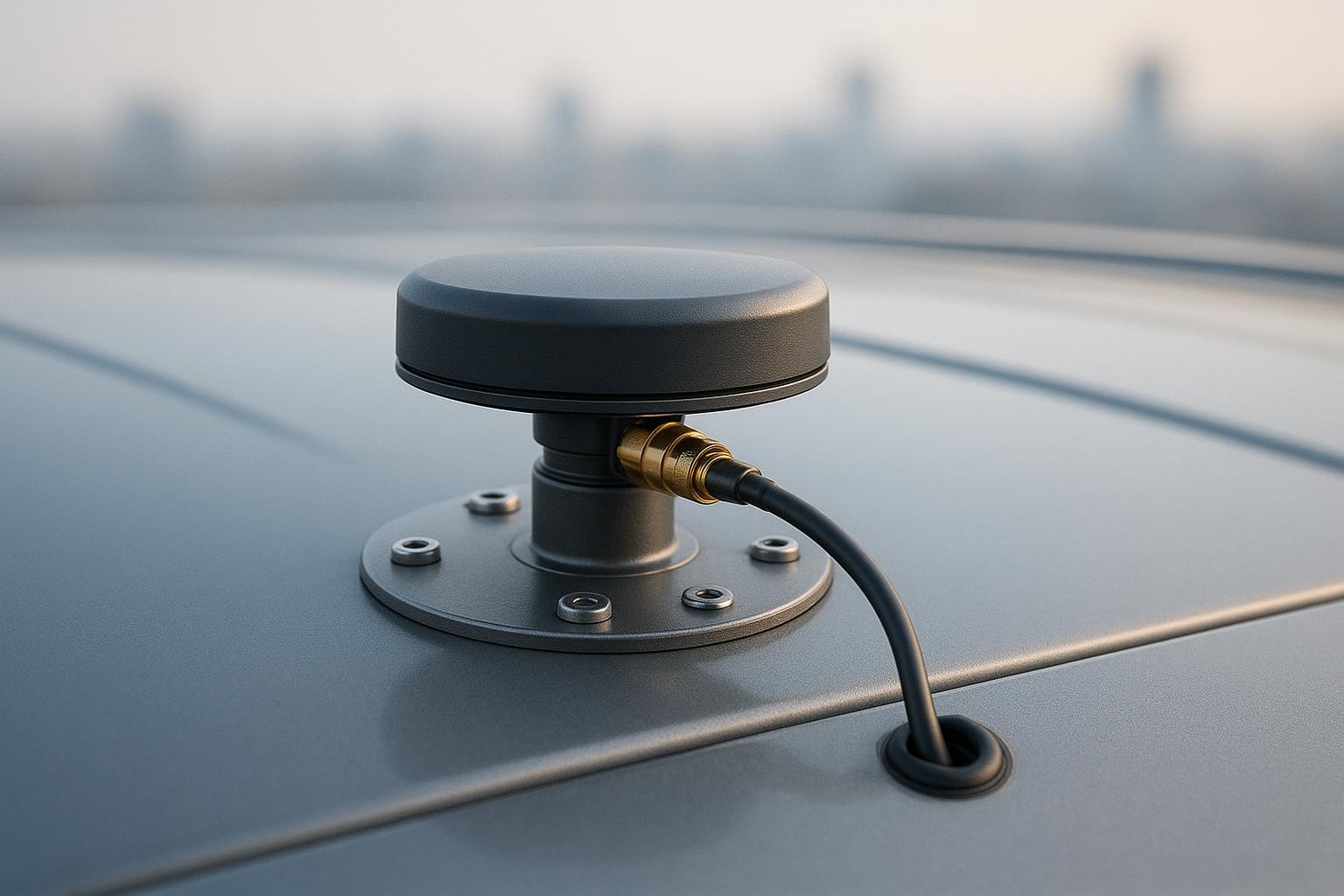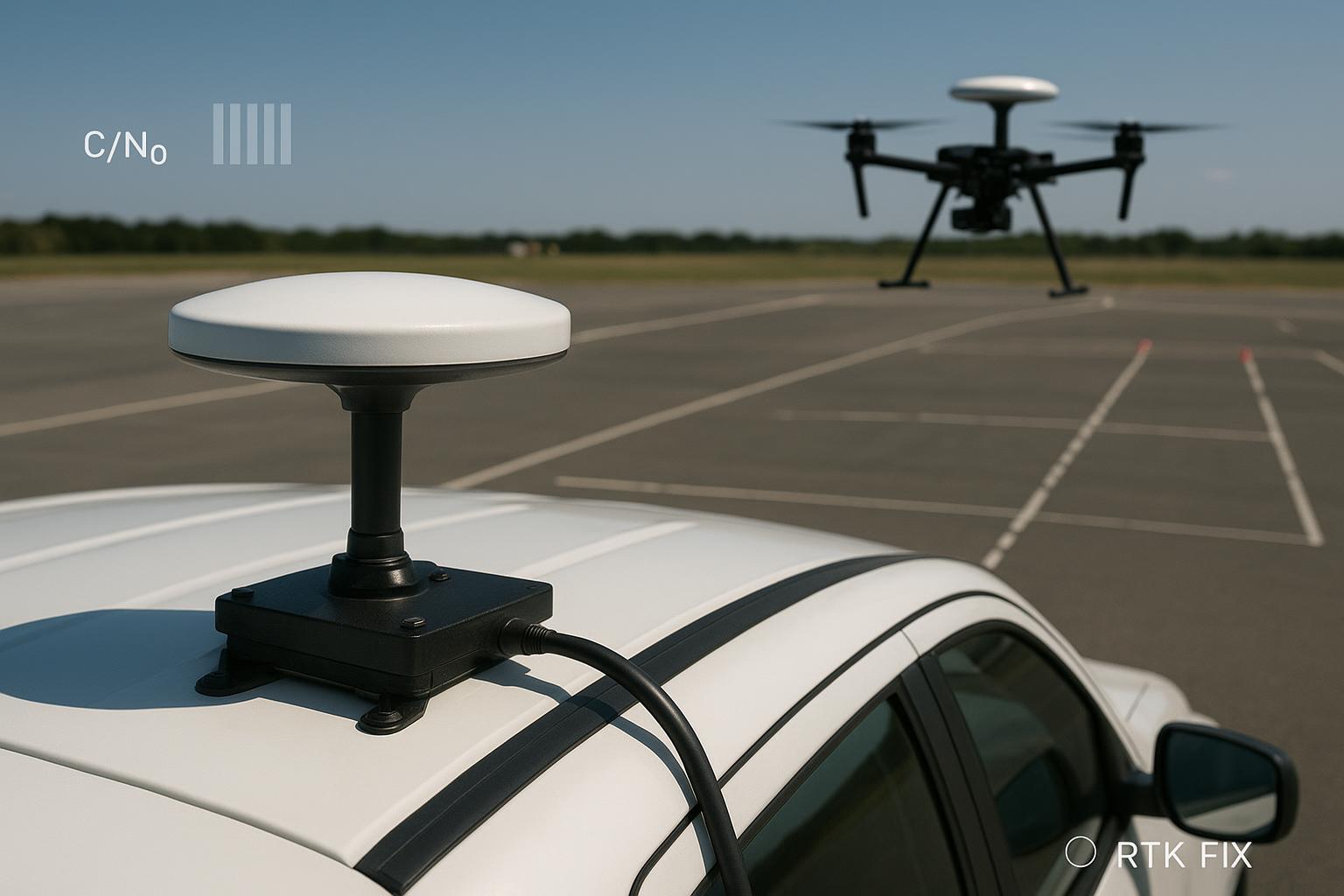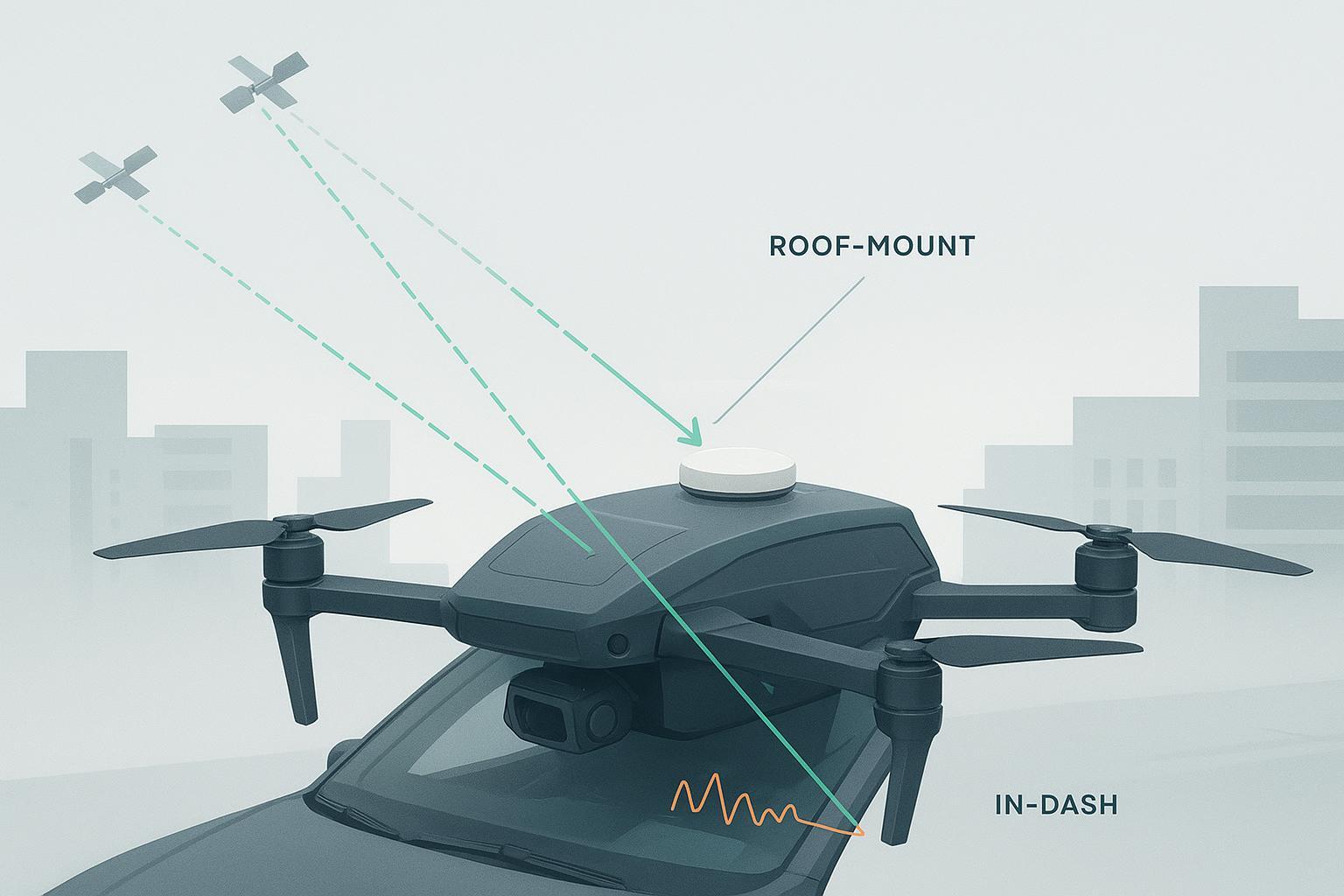
If your RTK fixes drop the moment you taxi into an urban corridor or push a high‑dynamic flight, the culprit is often placement, not firmware. Short version: an external, roof‑centered antenna usually delivers higher C/N0, fewer cycle slips, and a better fix ratio than an in‑dash or embedded antenna. That said, in‑dash can be the right call when aerodynamics, sealing, or cable runs dominate—provided you apply strict RF hygiene (shielding, pre‑filters, short coax) and accept a performance ceiling. According to u‑blox’s A/B testing of aftermarket telematics, a roof placement beat a dashboard install by a wide margin in 2D accuracy on identical hardware—≈1 m (50%) vs ≈4 m (50%) and ≈5 m (95%) vs ≈17 m (95%)—as shown in the company’s 2024 engineering blog post Dual‑band aftermarket telematics.
Quick comparison — roof mount vs in dash GNSS antenna
The table below sums up what changes in practice for drones, UGVs, and vehicle‑mounted ground assets.
Dimension | Roof‑mount (external) | In‑dash/embedded (internal) |
|---|---|---|
Sky view | Unobstructed hemisphere when centered; higher satellite count above 15° elevation | Obstructed by body, windshield, canopy; lower sky fraction |
Multipath | Lower when centered away from edges; roof acts as shield | Higher from dash/windshield reflections and nearby structures |
Typical C/N0 tendency (L1/L2/L5) | Higher median C/N0 and tighter spread | Lower median C/N0 with broader spread |
RTK fix ratio tendency (open/urban) | Higher in both; especially resilient in urban corridors | Acceptable in open sky; degrades sooner in urban/EMI |
TTFF‑FIX tendency | Faster to first fixed ambiguity | Longer and more fragile in marginal conditions |
Cycle‑slip rate under dynamics | Fewer slips due to margin | More slips when SNR margin is thin |
Cable/LNA budget | Needs proper gain if long coax; masthead LNA when required | Short coax helps; front‑end filtering often mandatory |
EMI exposure | Physically separated from ESCs, DC‑DCs, LTE/Wi‑Fi | Close to noisy harnesses and radios; higher desense risk |
Mechanical/aero | Adds weight/drag; sealing required | Clean aero; no new penetrations |
Serviceability | Fast visual checks and swap‑outs | Higher MTTR; enclosure disassembly |
Typical use cases | Survey‑grade RTK, BVLOS corridors, high‑EMI routes | Compact airframes, sealed enclosures, short cable runs |
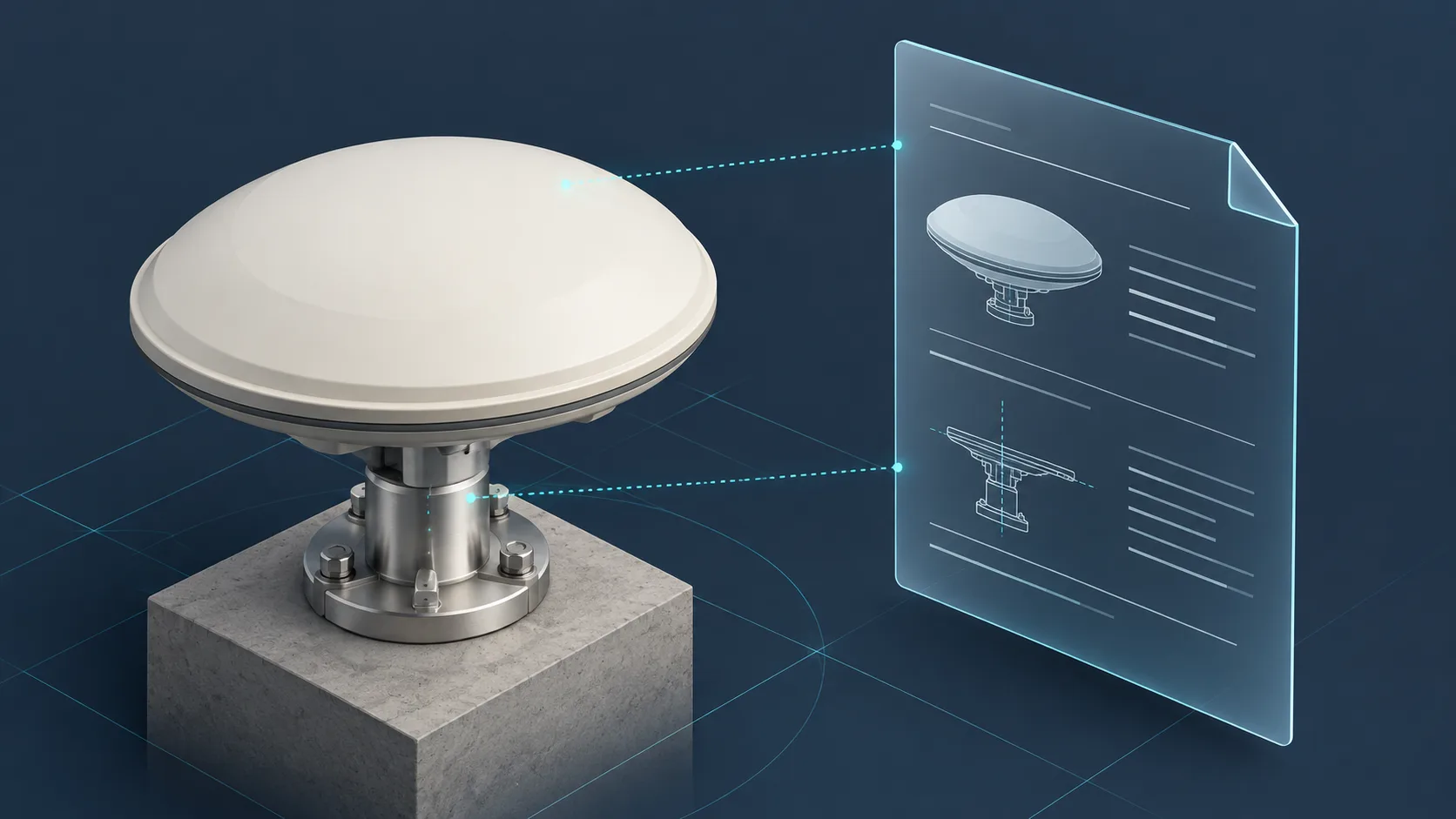
Notes and sources: u‑blox and NovAtel repeatedly recommend roof‑top mounting with separation from interferers; see the u‑blox ZED‑F9R Integration Manual and NovAtel’s CPT7/CPT7700 Installation and Operation Manual (≈1 m separation guidance).
What really changes in RTK when you move the antenna
-
Sky view and PDOP: A centered roof‑mount sees more low‑elevation satellites, improving geometry and PDOP. That margin matters when the correction stream hiccups or the platform yaws quickly.
-
Multipath on phase: In‑dash installs sit near glass, dashboards, and cabling that reflect signals, injecting code bias and decorrelating the carrier. That shows up as noisier residuals and a lower fixed‑epoch ratio.
-
C/N0 margin: Every decibel of margin buys tracking robustness. Windshields and enclosures attenuate signals; proximity to DC‑DCs and modems lifts the noise floor. Roof‑mounting restores the link budget.
-
Cycle slips and continuity: With better C/N0 and less multipath, external placements slip less during hard turns and accelerations, so the RTK engine keeps integers fixed more of the time.
Evidence frame:
-
u‑blox published a side‑by‑side route showing the dramatic accuracy penalty of a dashboard antenna versus a roof‑top unit on the same system in Dual‑band aftermarket telematics (2024).
-
Installation manuals from u‑blox advise clear sky placements; the ZED‑F9R Integration Manual explicitly recommends roof mounting for vehicles, and NovAtel’s CPT7/CPT7700 manual calls for physical separation (~1 m) from interferers to reduce desense.
Field vignette: roof‑center puck vs in‑dash embedded patch
Test design we’ve used with teams:
-
Hardware: two identical multi‑band RTK receivers, one external roof‑center active puck on a conductive plane, one embedded patch under the windshield. Timing is synchronized.
-
Scenarios: 10‑minute open‑sky hover/loop, 15‑minute urban canyon drive, 10‑minute high‑dynamics (yaw/pitch) run.
-
Logs: per‑satellite C/N0 histograms, satellites‑in‑view vs elevation, fix state per epoch, cycle‑slip events, TTFF‑FIX.
What we typically observe across projects (directional, not absolute):
-
Median C/N0 is consistently higher on the roof antenna, with fewer deep fades during turns or near glass.
-
The roof installation sustains a higher fixed‑epoch percentage in the urban leg and recovers faster after fades.
-
The in‑dash unit shows more cycle‑slips when radios spin up or during aggressive maneuvers.
For a public, quantified placement example (navigation accuracy rather than RTK), review u‑blox’s 2024 comparison: Dual‑band aftermarket telematics, which showed markedly better accuracy for the roof placement under identical conditions.
Cable loss and LNA headroom — worked method you can reuse
Preserving SNR at the receiver input is non‑negotiable for RTK. The math is simple and saves weeks of chasing ghosts later.
-
Total RF path loss (dB) = coax attenuation (dB/m at your band × length) + connector losses + any inline filter insertion losses.
-
Net gain budget (dB) = antenna/LNA gain − total RF path loss.
-
Target: keep enough margin so the effective noise figure at the receiver input preserves at least ~6 dB of SNR headroom during fades.
How to execute:
-
Select your coax and pull the attenuation at L1/L2/L5 from the official datasheet (e.g., Times Microwave LMR‑400 attenuation tables or Belden RG‑58/RG‑174 data). Use the worst‑case band for your calculation.
-
Add connector and filter losses (from their datasheets).
-
Choose an antenna with appropriate LNA gain or add a masthead LNA if the cable is long. Verify that total gain won’t drive compression or oscillation at the receiver front end.
-
Validate on the bench by measuring S21 of the chain and confirming the receiver’s C/N0 with and without long‑run cabling.
EMI and shielding realities in embedded installs
In‑dash and embedded locations sit next to the noisiest parts of your platform: DC‑DC converters, ESCs, harness bundles, LTE/5G and Wi‑Fi radios. The symptoms are classic—broadband noise raising the floor, narrowband birdies, and sporadic desense. Practical steps that consistently help:
-
Distance first: If possible, move the antenna away from emitters. NovAtel’s CPT7 manual recommends about a meter of separation as a baseline in vehicle installations.
-
Filter early: u‑blox integration guides outline band‑pass SAW filtering at the antenna input and, where needed, LTE notches before the LNA. Keep RF traces short and shielded.
-
Prove it with a sweep: Do a quick near‑field spectrum scan near the antenna feed with radios off vs on. If the floor jumps or lines appear in‑band, mitigate with added filtering, harness reroutes, ferrites, or relocation.
For detailed guidance, see the ZED‑F9R Integration Manual from u‑blox and NovAtel’s CPT7/CPT7700 Installation and Operation Manual.
How to choose — scenario‑based guidance
Think of it this way: prioritize the metric that pays your reliability bill. For the core decision “roof mount vs in dash GNSS antenna,” align architecture to constraints and threat model.
-
Need survey‑grade RTK continuity on drones or UGVs? Favor a roof/external mount centered on a proper plane; add a masthead LNA if your cable run is long.
-
Aero/sealing dominates (compact UAV or sealed enclosure)? Consider an embedded patch or small helical with a very short coax, solid shielding, and pre‑filters; validate performance early.
-
Operating near strong interferers (LTE towers, airports, ship decks)? External mount with additional pre‑filters; step up to CRPA only if the threat environment justifies the cost/weight.
-
Receiver far from the roof path? Either relocate the receiver or add a masthead LNA and low‑loss cable to protect SNR.
-
Fleet serviceability priority? External mounts standardize swap‑outs and cut MTTR.
Migration checklist: moving from in‑dash to roof mount
-
Pick a centered, flat location away from roof edges; confirm structural support and ground‑plane adequacy for your antenna type.
-
Plan the cable path with strain relief and weatherproof penetrations; choose low‑loss coax appropriate for your run length.
-
Add inline filtering or a masthead LNA if the budget is tight; verify gain stability and power delivery.
-
Seal and torque to spec; apply anti‑corrosion compound on connectors.
-
Calibrate lever‑arm and antenna reference parameters in the receiver; set an elevation mask appropriate to your environment.
-
Run A/B validation drives or flights: compare C/N0 histograms, fix ratio, TTFF‑FIX, and cycle‑slips against the prior install.
-
Document MTTR steps and spares; stock pre‑terminated cables to standard lengths.
-
Schedule periodic inspections for seals, cables, and connector corrosion.
Validation checklist for either architecture
-
Log synchronized runs in open sky and your worst urban corridor; include per‑satellite C/N0 and fix state.
-
Sweep for EMI with radios and payloads toggled; confirm improvements after each mitigation step.
-
Confirm the gain budget on the bench (S21) and in the field (receiver C/N0) at your longest cable length and lowest band.
-
Re‑run after firmware updates or payload changes—don’t assume RF stays constant.
Pricing and parts caveats (2026)
Class‑level guidance only: active roof‑mount multi‑band antennas typically price higher than embedded patches or small helicals; masthead LNAs add cost but can save a long cable run. Prices vary by band coverage (L1‑only vs L1/L2/L5), housing/IP rating, and included cabling, and they change regionally and over time. Treat any estimate as of 2026‑05‑29 and verify with distributors when you buy.
Also consider — related antenna options
If you’re standardizing vehicle or UAV external mounts and want durable housings with filtering options, review GNSource Vehicle‑Mounted GNSS Antennas for examples of IP‑rated enclosures and front‑end filtering approaches.
FAQ
Where should I place the antenna on a vehicle roof?
As high and central as possible, away from edges and other antennas. Vendors routinely recommend roof‑top placement; u‑blox’s ZED‑F9R manual does so explicitly, and NovAtel advises at least about one meter from strong emitters where feasible.
Can an in‑dash antenna deliver centimeter‑level RTK?
Sometimes in open sky with excellent RF hygiene, but it’s fragile in urban or high‑EMI environments. Expect earlier degradation in fix ratio compared with a roof‑mount. If in‑dash is mandatory, shorten coax, improve shielding, and add band‑pass and notch filtering per integration guidance.
When do I need a masthead LNA?
When cable and filter losses erode the SNR headroom at the receiver input. Pull attenuation from the coax datasheet (worst‑case band), add connectors/filters, and ensure your net gain budget preserves ≥~6 dB of margin under fades.
How do I diagnose interference quickly?
Log C/N0 while toggling payload radios and run a near‑field spectrum sweep near the antenna feed. If the floor rises or in‑band lines appear with radios on, add filtering, ferrites, separation, or relocate the antenna.
Citations and further reading
-
u‑blox placement A/B: Dual‑band aftermarket telematics (2024)
-
Vehicle roof placement recommendation: u‑blox ZED‑F9R Integration Manual
-
Physical separation guidance (~1 m) and interference mitigation: NovAtel CPT7/CPT7700 Installation and Operation Manual
-
Cable attenuation data: Times Microwave LMR‑400 and Belden RG‑58/RG‑174
Wrap‑up: For dependable RTK across mixed environments, a roof‑mount wins more often. If the airframe or enclosure can’t tolerate that, design your in‑dash install like an RF lab—short coax, strong filtering, clean grounding—and validate with logs until the numbers hold. In short, the roof mount vs in dash GNSS antenna decision should start with sky view and SNR margin, then work back through EMI, cabling, and serviceability.