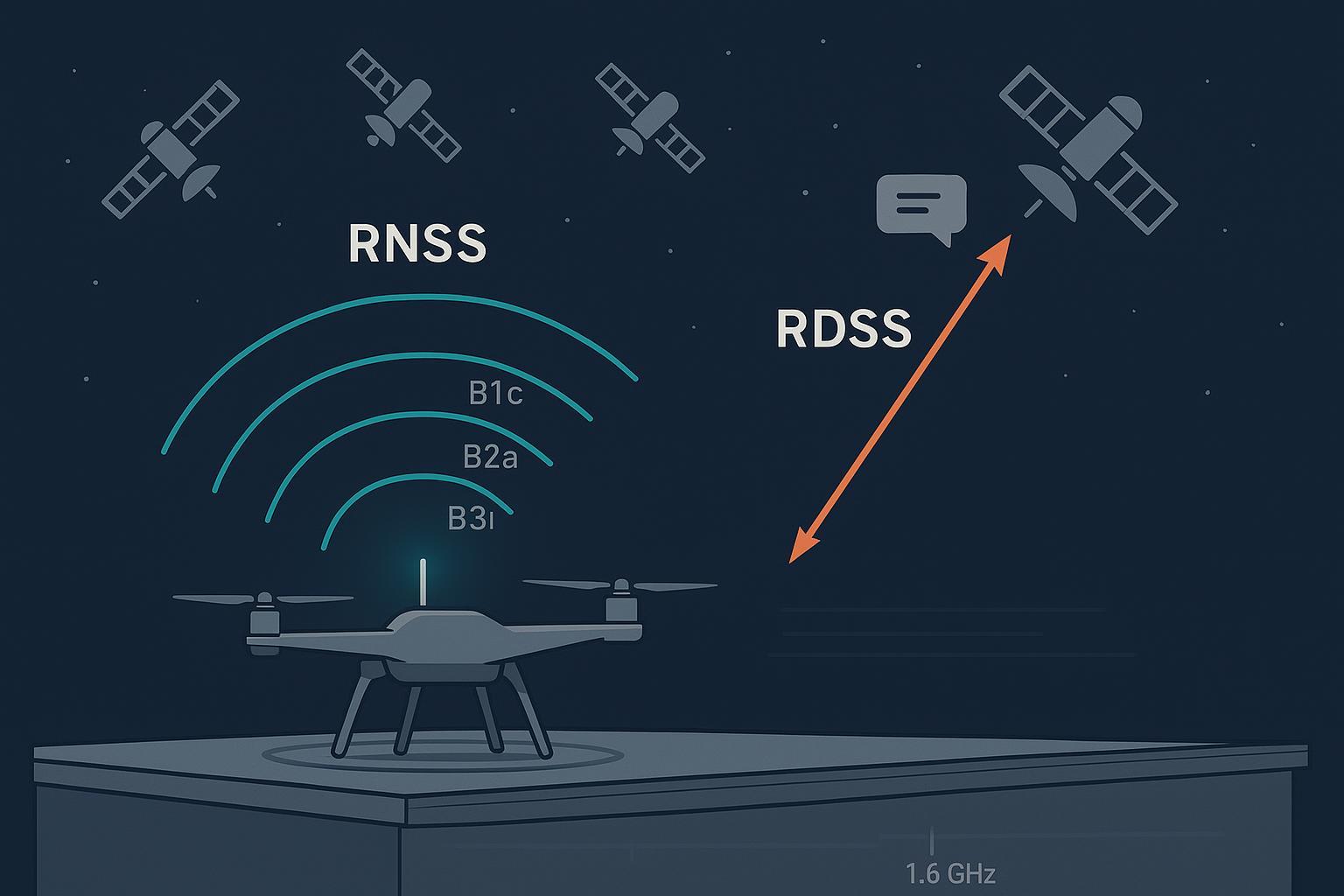
Most people file BeiDou under “China’s GPS,” and for the everyday fix that is fair — BeiDou’s positioning service works just like GPS, Galileo, and GLONASS. But BeiDou does one thing none of the others do, and it changes what a BeiDou antenna has to be. Alongside passive positioning, BeiDou carries RDSS — a two-way short-message service that lets a terminal report its position and exchange text over the satellite itself, with no cellular network. A receive-only antenna can position; it cannot message. That single difference is what separates a real BeiDou antenna from a GNSS puck that happens to receive the B1 signal.
This guide is the hardware-and-selection view of BeiDou. For the RDSS concept in depth, see RDSS vs RNSS and the BeiDou short-message guide; here we cover the bands a BeiDou antenna must cover, what RDSS asks of the hardware, and how to match an antenna to the services you actually use.
The bands a BeiDou antenna must cover
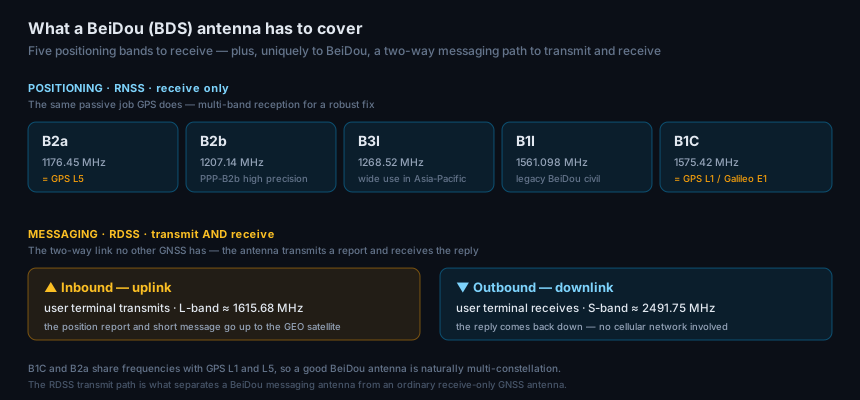
BeiDou’s civil positioning signals sit on five carrier frequencies: B1I (1561.098 MHz), B1C (1575.42 MHz), B2a (1176.45 MHz), B2b (1207.14 MHz), and B3I (1268.52 MHz). Two of those are worth noticing: B1C shares 1575.42 MHz with GPS L1 and Galileo E1, and B2a shares 1176.45 MHz with GPS L5. That overlap is deliberate interoperability — it means a well-designed BeiDou antenna is naturally multi-constellation, covering GPS and Galileo on the same elements. So “BeiDou antenna” rarely means BeiDou-only; it means an antenna whose band plan includes BeiDou’s, usually alongside everything else in the L-band.
B3I deserves a note because it is heavily used across the Asia-Pacific region and by many BeiDou-first receivers, so a genuinely BeiDou-oriented antenna covers B3 where a GPS-first design might not bother.
RNSS and RDSS: two jobs, one system
Here is the split that governs BeiDou antenna selection. BeiDou runs two different services, and they ask different things of the antenna.
RNSS — Radio Navigation Satellite Service — is the passive, GPS-like positioning service. The antenna receives the B1/B2/B3 signals coming down from the constellation and the receiver computes a fix. Nothing is transmitted. This is what every GNSS antenna does, and for BeiDou it means clean multi-band reception with a low axial ratio and a stable phase center — the ordinary marks of a good receiving antenna.
RDSS — Radio Determination Satellite Service — is the part that is BeiDou’s alone. It is an active, two-way service: the terminal transmits a burst up to a geostationary BeiDou satellite, the ground control station relays it, and a reply comes back down. It carries a position report and a short text message — regionally, up to around 120 Chinese characters per message — over the satellite, with no terrestrial network in the loop. On a ship past the coverage of shore comms, or a vehicle beyond the cellular edge, RDSS is how the platform stays connected.
The difference between the two is the difference between a receiver and a transceiver — and it is why the antenna choice is not a detail.
What RDSS asks of the antenna
RDSS splits the antenna’s work across two bands that a positioning antenna never touches. The terminal transmits its report up on L-band, around 1615.68 MHz, and receives the reply down on S-band, around 2491.75 MHz — neither of which is a GNSS positioning frequency. So an RDSS-capable antenna is really three things in one package: a receive chain for the B1/B2/B3 positioning signals, a transmit path for the L-band uplink, and a receive path for the S-band downlink.
Combining them is the hard part. The antenna is trying to hear weak positioning signals from space while radiating a watts-level transmit burst a few centimeters away, and the transmit energy can easily desensitize the quiet receive channels. Getting the isolation and filtering right so the two coexist is exactly why an integrated RNSS-plus-RDSS antenna is a purpose-built part rather than a receiver with a transmitter bolted on. GNSource’s BDS short-message antenna line — from handheld spiral terminals to vehicle and masthead units — is built around that coexistence, and the RDSS-capable anti-jamming CRPA arrays add null-steering on top for contested use.
PPP-B2b: high precision without a base station
There is a third BeiDou service worth knowing when you spec an antenna. On the B2b band (1207.14 MHz), BeiDou broadcasts a Precise Point Positioning correction stream — PPP-B2b — that delivers roughly decimeter-class positioning without any base station or network connection, over the satellite, across the service region. If your application wants that accuracy, the antenna simply has to receive B2b cleanly; the corrections ride the signal you are already tracking. It is one more reason a BeiDou-oriented antenna should cover the full B1/B2/B3 plan rather than just B1.
Choosing a BeiDou antenna
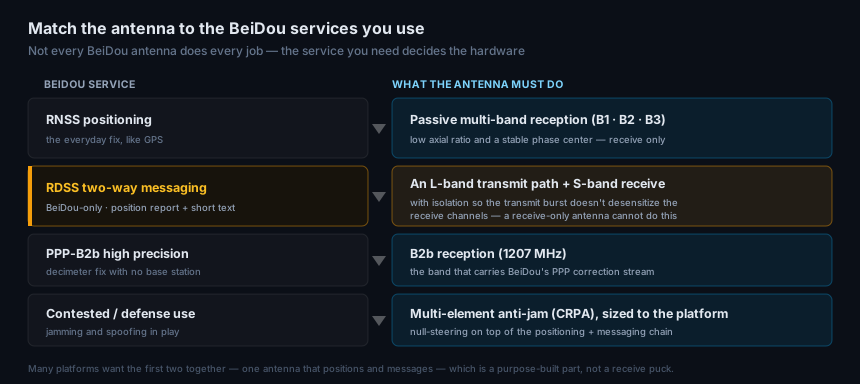
The selection question is really “which BeiDou services do you use?” — and the answer decides the hardware:
| If you need | The antenna has to |
|---|---|
| RNSS positioning only | Receive B1/B2/B3 passively, with low axial ratio and a stable phase center |
| Positioning + RDSS messaging | Add an L-band transmit path and S-band receive, with isolation so the transmit burst doesn’t desensitize the receive channels |
| PPP-B2b high precision | Cover B2b (1207 MHz) to receive the PPP correction stream |
| Contested / defense use | Add multi-element anti-jam (CRPA) null-steering, sized to the platform |
| Multi-constellation robustness | Cover B1C/B2a, which overlap GPS L1/L5 and Galileo — usually automatic in a good BeiDou antenna |
The most common ask on real platforms is the second row — one antenna that both positions and messages — because that is the capability that lets a vehicle, vessel, or dismounted user stay located and connected where the network doesn’t reach. Matching that to a form factor, from a handheld whip to a masthead unit, is the practical part; the BDS short-message line spans it.
Frequently asked questions
What makes a BeiDou antenna different from a GPS antenna? For plain positioning, not much — BeiDou’s B1C and B2a even share frequencies with GPS L1 and L5, so a good multi-band antenna receives both. The real difference is BeiDou’s RDSS two-way messaging service: an RDSS-capable BeiDou antenna also transmits on L-band and receives on S-band to carry position reports and short text messages over the satellite, which no GPS-only antenna does.
What frequencies does a BeiDou antenna use? BeiDou’s civil positioning bands are B1I (1561.098 MHz), B1C (1575.42 MHz), B2a (1176.45 MHz), B2b (1207.14 MHz), and B3I (1268.52 MHz). RDSS messaging adds an L-band uplink around 1615.68 MHz (transmit) and an S-band downlink around 2491.75 MHz (receive). A full BeiDou antenna covers the B1/B2/B3 positioning set; an RDSS-capable one adds the L and S messaging bands.
Can one antenna do both BeiDou positioning and RDSS messaging? Yes — the integrated units do exactly that, but it takes design work. The antenna receives weak positioning signals while transmitting a watts-level RDSS burst, so it needs the isolation and filtering to keep the transmit path from desensitizing the receive channels. That is why these are purpose-built parts rather than a receive antenna with a transmitter added.
Is BeiDou RDSS available worldwide? The short-message service is strongest regionally — the classic RDSS service covers China and surrounding areas with regional short messages up to around 120 Chinese characters. BeiDou’s positioning (RNSS) and the PPP-B2b high-precision service have broader coverage. Match your expectation to where you actually operate.
Do I need a BeiDou antenna if I already receive GPS? If you only need a position, a modern multi-band GNSS antenna likely already receives BeiDou alongside GPS. You need a purpose-built BeiDou antenna when you want RDSS two-way messaging, BeiDou-specific bands like B3, or PPP-B2b corrections — capabilities that require the antenna to transmit, or to cover bands a GPS-first design skips.
Written by GNSource Engineering. GNSource manufactures BeiDou/BDS GNSS antennas — from RDSS-capable handheld and vehicle terminals to anti-jam arrays — for positioning and two-way messaging on platforms that operate beyond the network. Talk to our engineers about a BeiDou antenna for your platform, or explore the BDS short-message line.